
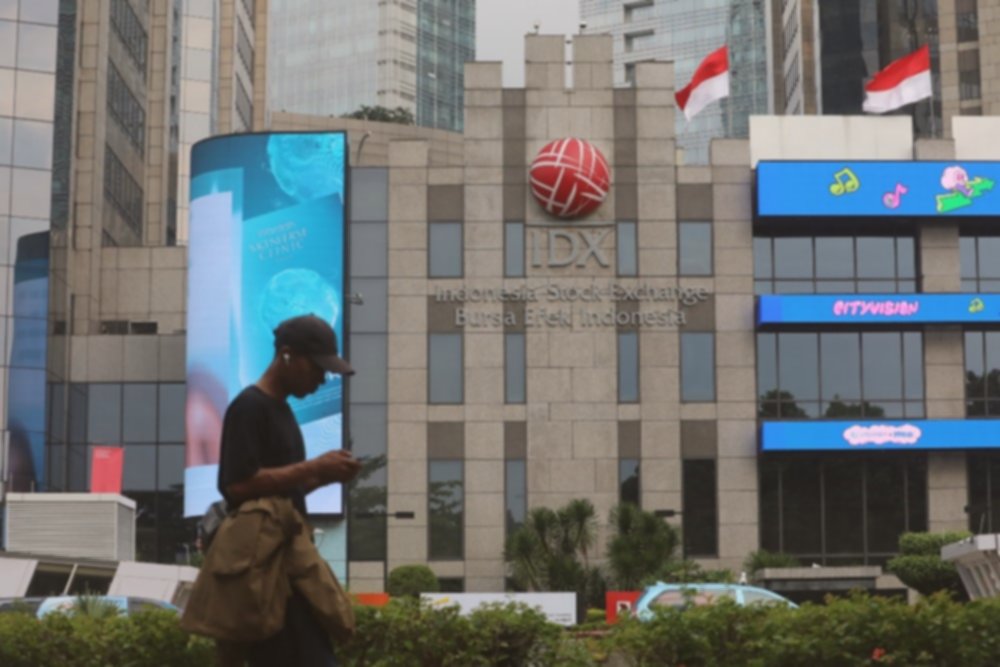

JAKARTA – The Indonesian stock market experienced its most significant correction among ASEAN nations as trading concluded on Friday, August 29, 2025. This downturn positioned the Jakarta Composite Index (IHSG) at the forefront of regional declines, contrasting sharply with some of its neighbors.
According to data from the Indonesia Stock Exchange (IDX), the IHSG concluded its latest trading session with a 1.53% drop, shedding 121.59 points to close at 7,830.49. The market breadth clearly reflected this weakness, with 630 stocks recording declines, 190 remaining unchanged, and only 136 managing to strengthen. Consequently, Indonesia’s market capitalization shrank by Rp195 trillion from the previous close, settling at Rp14,182 trillion. Adding to the bearish sentiment, foreign investors registered a net sell of Rp1.12 trillion on the day, further widening the year-to-date foreign capital outflow to a substantial Rp50.94 trillion.
When juxtaposed against other ASEAN stock indices, the IHSG’s performance on Friday stood out as the deepest correction in the region. Conversely, the Vietnamese stock market demonstrated the strongest gains, highlighting a divergent trend across Southeast Asian bourses.
A detailed breakdown of ASEAN market performance on Friday, August 29, 2025, as documented by the IDX, reveals a mixed bag with Indonesia at the bottom. The IDX Composite Index (IHSG) in Indonesia fell 1.53% to 7,830.49, though it maintained a year-to-date gain of 10.60%. Meanwhile, Thailand’s SET Index saw a 1.08% decline to 1,236.61, marking a YTD loss of 11.68%. In Malaysia, the FTSE Bursa Malaysia KLCI Index dropped 0.75% to 1,575.12, reflecting a YTD decrease of 4.09%. The Philippines’ PSEi Index also posted a loss of 0.56%, closing at 6,155.57, with a YTD decline of 5.72%. In contrast, Singapore’s Straits Times Index (STI) rose 0.37% to 4,269.70, boasting a strong YTD gain of 12.73%. Leading the region, Vietnam’s VN-Index surged 0.48% to 1,680.86, demonstrating an impressive YTD increase of 32.69%.
Earlier, Reydi Octa, a prominent Indonesian capital market observer, had warned that the IHSG’s customary bullish trend heading into the fourth quarter could be severely hampered by escalating domestic social-political tensions. Indeed, widespread demonstrations across Indonesia have intensified significantly since the beginning of this week, starting on Monday, August 25, 2025, directly impacting investor sentiment.
“The seasonal bullish trend of the IHSG in Q4 could be disrupted if social-political turmoil persists,” Reydi stated on Friday, August 28, 2025. He elaborated, “Investors don’t solely focus on fundamental and economic data; they also closely monitor stability.” This underscores the market’s sensitivity to non-economic factors.
Despite the immediate downturn, Reydi maintains that the IHSG’s slump, attributed to the current social-political situation, is likely short-term in nature. He further suggests that present market conditions are, in fact, ideal for propelling an IHSG rebound, citing several key factors that could provide a strong tailwind.
Firstly, Bank Indonesia has signaled further easing of the BI Rate, following an earlier cut this August that brought the rate down to 5%. Secondly, the U.S. Federal Reserve is also widely anticipated to implement interest rate cuts in September. These coordinated global monetary easing signals are generally positive for equity markets.
Moreover, the decline in the 10-year Government Bond (SBN) yield to approximately 6.3% and the Short-Term Rupiah Bond (SRBI) yield to around 5.05% makes the stock market relatively more attractive for investors seeking higher returns. This momentum is poised to support the valuation of the IHSG, particularly benefiting large-cap banking stocks which are highly sensitive to monetary policy changes and hold significant weight within the index.
“The momentum of declining interest rates will be a more dominant influence going forward,” Reydi concluded. He added, “I believe that if the current correction leads to a deeper dip in the index, it will present an even better opportunity for a potential rebound in the future,” suggesting that investors should view the current downturn as a strategic entry point.
Summary
The Indonesian stock market, represented by the Jakarta Composite Index (IHSG), recorded the sharpest decline among ASEAN nations on Friday, August 29, 2025. The IHSG dropped 1.53% to close at 7,830.49, leading to a Rp195 trillion market capitalization shrinkage and a Rp1.12 trillion foreign net sell. This performance contrasted with strong gains in Vietnam and Singapore, though Thailand, Malaysia, and the Philippines also saw declines.
The downturn was attributed to escalating domestic social-political tensions and widespread demonstrations impacting investor sentiment. Despite this, a capital market observer suggested the slump is likely short-term and presents a rebound opportunity. Anticipated interest rate cuts by Bank Indonesia and the U.S. Federal Reserve, alongside declining bond yields, are expected to support a future rally, particularly benefiting large-cap banking stocks.