
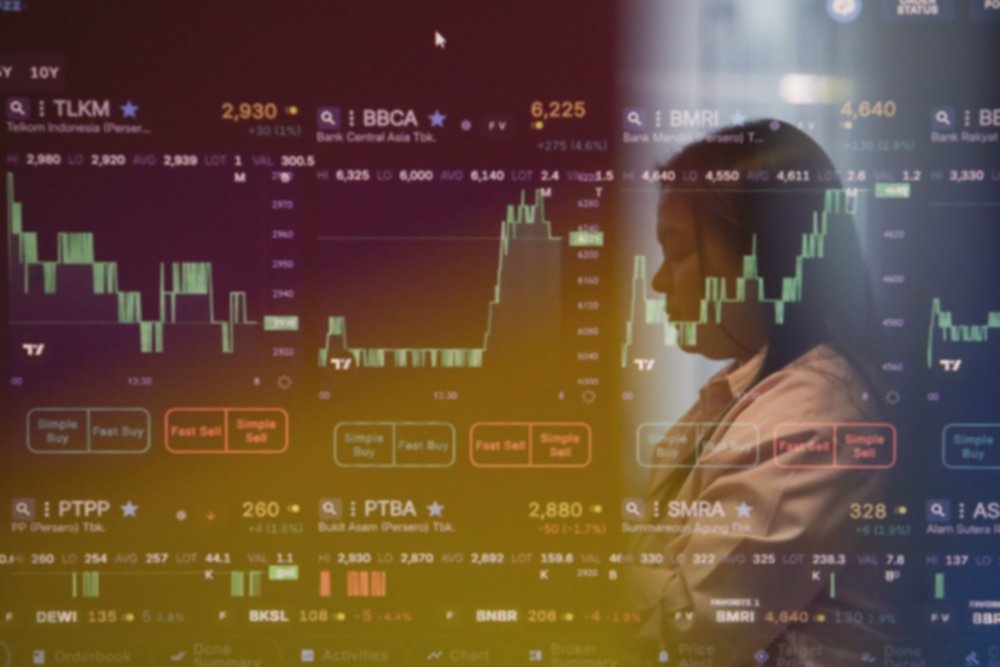

Flooring Guide by Cinvex – JAKARTA – The Jakarta Composite Index (IHSG) struggled during the first session of trading today, witnessing a sharp decline of 4.94% within the first three hours.
Data from the Indonesia Stock Exchange (IDX) reveals that the index plummeted to 5,889.48, retreating from its morning opening level of 6,207.10. Market sentiment remains overwhelmingly negative; out of the hundreds of listed constituents, 752 stocks recorded losses, 169 remained stagnant, and only 38 managed to hold on to gains.
Widespread Sell-off Across Conglomerate Stocks
The downturn hit stocks affiliated with major Indonesian conglomerates particularly hard. Notable decliners included PT Barito Pacific Tbk. (BRPT), which dropped 13.47% to Rp1,670, and PT Chandra Daya Investasi Tbk. (CDIA), which fell 13.79% to Rp750. Other significant losers featured PT Petrindo Jaya Kreasi Tbk. (CUAN) down 12.10% to Rp690, PT Petrosea Tbk. (PTRO) sliding 15.00% to Rp4,080, and PT Chandra Asri Pacific Tbk. (TPIA) retreating 13.42% to Rp1,645.
The bearish trend extended to stocks linked to Happy Hapsoro. PT Bukit Uluwatu Villa Tbk. (BUVA) slumped 13.17% to Rp725, while PT Sanurhasta Mitra Tbk. (MINA) fell 13.17% to Rp290. Similarly, PT Rukun Raharja Tbk. (RAJA) dropped 12.90% to Rp3,240, and PT Raharja Energi Cepu Tbk. (RATU) plunged 12.11% to Rp4,680.
Anthoni Salim’s portfolio also felt the pressure, with PT Indofood CBP Sukses Makmur Tbk. (ICBP) down 5.15% to Rp6,450, PT Indofood Sukses Makmur Tbk. (INDF) falling 4.18% to Rp6,300, PT PP London Sumatra Indonesia Tbk. (LSIP) declining 3.54% to Rp1,225, and PT Salim Ivomas Pratama Tbk. (SIMP) retreating 7.08% to Rp525.
Market Outlook and External Catalysts
David Kurniawan, Equity Analyst at Indo Premier Sekuritas, noted that investor focus throughout June 2026 has shifted from MSCI rebalancing concerns toward the central bank’s ability to stabilize the rupiah and restore foreign investor confidence. While Bank Indonesia (BI) has hiked interest rates to 5.25% to combat external pressures, the market remains skeptical regarding the policy’s effectiveness in curbing currency volatility and capital outflows.
“If the rupiah displays stability over the next few weeks, market sentiment could improve, potentially paving the way for foreign capital to return to domestic stocks and bonds,” Kurniawan stated in a research note on Tuesday, June 2, 2026.
Furthermore, the U.S. Federal Reserve’s monetary policy remains a critical focal point. Investors are eagerly awaiting signals from the mid-June FOMC meeting regarding interest rates and U.S. inflation prospects. A hawkish stance from the Fed could bolster the U.S. dollar, further limiting capital flow into emerging markets. Conversely, any indications that inflation is cooling could provide a much-needed boost to riskier assets, including the Indonesian stock market.
Revised Growth Targets
In a report titled Equity Strategy: Repricing the Risk; Potential Tactical Reliefs to Emerge, analysts at BRI Danareksa Sekuritas (BRIDS) emphasized that the IHSG’s year-to-date decline reflects a rising risk premium for Indonesia, rather than a mere byproduct of broader emerging market trends.
Four primary factors are driving the waning investor interest in the Indonesian market: fiscal risks stemming from rising oil prices due to the Strait of Hormuz closure, reduced policy predictability, a negative outlook on Indonesia’s debt ratings, and the exclusion of various local stocks in the recent MSCI rebalancing. Short-term risks also persist, including an upcoming S&P outlook review in July and the MSCI Market Accessibility review in June.
“We have revised our December 2026 IHSG target to 7,200, down from our previous target of 9,440. This reduction accounts for the removal of a 40% conglomerate stock premium that previously influenced our valuation,” the analysts noted on Tuesday, June 2, 2026.
Disclaimer: This report is for informational purposes only and does not constitute a recommendation to buy or sell securities. Investment decisions remain the sole responsibility of the reader. Bisnis.com is not liable for any losses or gains resulting from investment decisions made based on this information.
Summary
The Jakarta Composite Index (IHSG) experienced a sharp decline of 4.94% to 5,889.48 at its morning close, with 752 out of 959 listed stocks recording losses. This widespread sell-off significantly impacted stocks linked to major Indonesian conglomerates. Investor sentiment remains largely negative, focusing on Bank Indonesia’s ability to stabilize the rupiah and restore foreign investor confidence.
Market analysts note that the IHSG’s year-to-date decline reflects a rising risk premium for Indonesia, driven by factors such as fiscal risks, reduced policy predictability, and a negative debt rating outlook. External catalysts, including the U.S. Federal Reserve’s monetary policy, are also critical for capital flow into emerging markets. Consequently, BRI Danareksa Sekuritas has revised its December 2026 IHSG target downwards from 9,440 to 7,200.