
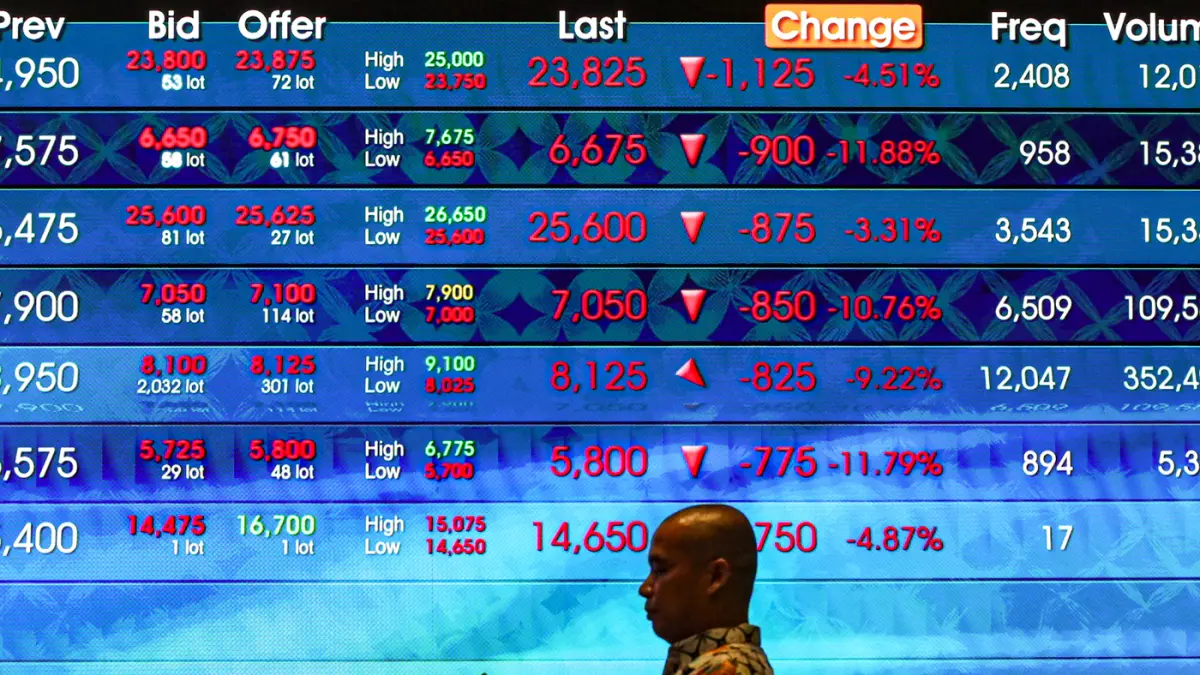

Flooring Guide by Cinvex — The Indonesia Stock Exchange Composite Index (IHSG) faces potential volatility this Wednesday, pressured by a combination of surging global oil prices and persistently high international interest rates.
The IHSG opened with a slight gain of 11.67 points, or 0.19 percent, reaching 6,207.10. Conversely, the LQ45 index, representing 45 blue-chip stocks, dipped by 0.25 points or 0.04 percent to settle at 619.02.
Analysts from the Lotus Andalan Sekuritas Research Team noted that while the short-term outlook for the Indonesian market shows signs of improvement, it remains vulnerable to external headwinds. Specifically, elevated energy prices, global interest rate hikes, and a narrowing trade surplus continue to weigh on investor sentiment.
On the international front, U.S. markets hit record highs on June 2, 2026, fueled by growing optimism surrounding artificial intelligence (AI) and the semiconductor industry. While this rally reflects strong confidence in the long-term growth cycle of AI, the market is simultaneously contending with risks tied to the concentration of gains within a few large-cap technology stocks.
IHSG Closes Higher Driven by Energy Sector Stocks
Meanwhile, geopolitical tensions between the U.S. and Iran have intensified concerns over global energy supplies, particularly following threats to block the Strait of Hormuz. This instability has pushed global oil prices toward the 100 U.S. dollar per barrel mark, raising fears of renewed global inflationary pressure.
These concerns are compounded by robust U.S. labor market data and rising inflation in the Eurozone, which have limited the scope for major central banks to cut interest rates. The Lotus Andalan Sekuritas Research Team cautioned that this cocktail of high energy costs, sticky inflation, and elevated interest rates could dampen investor appetite for emerging markets, including Indonesia.
Despite these external pressures, there is positive news domestically. Indonesia’s manufacturing PMI returned to the expansion zone in May 2026, signaling a recovery in economic activity following a contraction the previous month. However, foreign investors remain cautious, recording a net sell of 1.39 trillion rupiah, which underscores a lack of full confidence in the domestic market among global players.
Furthermore, Indonesia’s trade surplus has narrowed significantly to just 90 million U.S. dollars due to a sharp rise in imports. Inflation for May 2026 also climbed to 3.08 percent year-on-year, driven largely by increased transportation and energy costs. Within the banking sector, high levels of undisbursed loans suggest that while liquidity remains strong, demand for productive credit has yet to fully recover.
Global market performance remains varied. On Tuesday, May 2, European bourses saw broad gains: the Euro Stoxx 50 rose 1.17 percent, the UK’s FTSE 100 climbed 0.33 percent, Germany’s DAX gained 0.48 percent, and France’s CAC 40 increased 0.77 percent. Wall Street similarly trended upward, with the Dow Jones Industrial Average rising 0.45 percent, the S&P 500 adding 0.13 percent, and the Nasdaq Composite climbing 0.48 percent.
In the Asian regional market, the Nikkei surged 1,706.26 points or 2.56 percent to 68,440.50, and the Shanghai Composite gained 7.72 points or 0.19 percent to 4,082.82. Conversely, the Hang Seng declined 395.32 points or 1.52 percent to 25,643.00, while the Strait Times Index rose 42.16 points or 0.83 percent to 5,139.58.
Summary
The Indonesia Stock Exchange Composite Index (IHSG) is currently facing volatility due to a combination of rising global oil prices, persistent international interest rates, and a narrowing trade surplus. While the local manufacturing sector shows signs of recovery, investor sentiment remains cautious as foreign players continue to record significant net sells. These external headwinds are further exacerbated by geopolitical tensions and inflationary pressures that limit the potential for global central bank rate cuts.
Despite these challenges, the broader global market has shown varied performance, with U.S. and European indices trending upward fueled by optimism in the technology and AI sectors. Domestically, Indonesia struggles with rising inflation and stagnant demand for productive credit within the banking industry. Analysts suggest that these combined economic pressures continue to dampen the appetite for emerging markets, creating a challenging environment for the IHSG.