
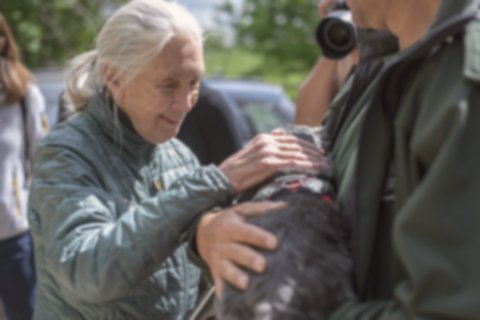
Jane Goodall, the iconic primatologist and world’s foremost expert on chimpanzees, has died at the age of 91. The Jane Goodall Institute (JGI) confirmed the news on Wednesday, October 1st.
Dame Valerie Jane Morris-Goodall passed away from natural causes while on a conservation speaking tour in Los Angeles, California, USA.
“Goodall was an extraordinary individual who embodied courage and conviction. Throughout her life, she dedicated herself to advocating for wildlife, promoting conservation, and inspiring a more harmonious and sustainable relationship between humans, animals, and nature,” the JGI said in an official statement.
Born in London, England, on April 3, 1934, Goodall’s passion for animals was evident from a young age, fueled by the book “The Story of Dr. Dolittle” and a burgeoning curiosity about African ecosystems.
A pivotal trip to Kenya in 1957 led to a meeting with paleoanthropologist Louis Leakey, an encounter that would change the course of her life. Leakey recognized her potential and encouraged Jane to study chimpanzee behavior (Pan troglodytes) as a key to understanding human ancestors.
Three years later, Goodall embarked on her groundbreaking research in Gombe Stream National Park, Tanzania. Lacking formal academic training in a field then dominated by men, she spent months observing chimpanzees, giving them names like Fifi, Passion, and David Greybeard.
“It isn’t just human beings who have personality, who are capable of rational thought [and] emotions like joy and sadness,” Goodall stated in a 1996 PBS documentary.
In 1966, Goodall left Gombe to pursue her doctoral program at the University of Cambridge. Her dissertation detailed her extensive studies in Gombe, notably documenting the groundbreaking moment when she observed a chimpanzee using a twig to fish termites from a nest.
This discovery sent shockwaves through the scientific community, challenging the long-held belief that only humans could create tools. Louis Leakey famously declared, “Now we must redefine tool, redefine Man, or accept chimpanzees as human!”
Goodall also documented unique chimpanzee behaviors such as hunting and eating meat, proving they were omnivores, not vegetarians as previously believed. She observed chimpanzees embracing in apparent grief over the death of a member of their group and developing rudimentary forms of communication. However, she also uncovered a darker side, witnessing instances of females killing the infants of other chimpanzees.
“Like humans, chimpanzees also have a dark side,” she wrote in her book “Reason for Hope” (2000).
In the 1970s, Goodall’s focus shifted towards conservation. She founded the Jane Goodall Institute (JGI) in 1977, which now manages the world’s longest-running chimpanzee research project and environmental education programs for young people.
Until her death, Goodall remained a tireless advocate for the environment, spending approximately 300 days a year traveling the world. During her lectures, Dr. Jane often began with an imitation of a chimpanzee call, much to the amusement of her audience.
“The greatest danger to our future is apathy,” she wrote in a 2002 essay for Time Magazine.
UNESCO Director-General Audrey Azoulay described Goodall as someone who transformed the world’s understanding of great apes.
“Dr. Jane’s signature chimpanzee greeting at UNESCO last year will continue to resonate for years to come,” she said.
Goodall is survived by her son, Hugo Eric Louis van Lawick, known as Grub, and three grandchildren. She raised her son emulating the close mother-child bond she observed in chimpanzees in Gombe.
Throughout her life, Jane Goodall received numerous accolades, including Commander of the Order of the British Empire (1995), United Nations Messenger of Peace (2002), French Legion of Honour (2006), and the Presidential Medal of Freedom from U.S. President Joe Biden in January 2025.
Summary
Jane Goodall, the world-renowned primatologist and expert on chimpanzees, passed away at the age of 91 from natural causes while on a conservation speaking tour. The Jane Goodall Institute confirmed her death, highlighting her dedication to wildlife advocacy, conservation, and fostering a harmonious relationship between humans, animals, and nature. Goodall’s groundbreaking research in Gombe Stream National Park, Tanzania, revolutionized our understanding of chimpanzee behavior.
Goodall’s work challenged existing beliefs by documenting tool use, omnivorous diets, and complex social behaviors among chimpanzees. She founded the Jane Goodall Institute in 1977 to further chimpanzee research and environmental education. Throughout her life, she remained a dedicated advocate for the environment and received numerous accolades, including being a United Nations Messenger of Peace and receiving the Presidential Medal of Freedom.