
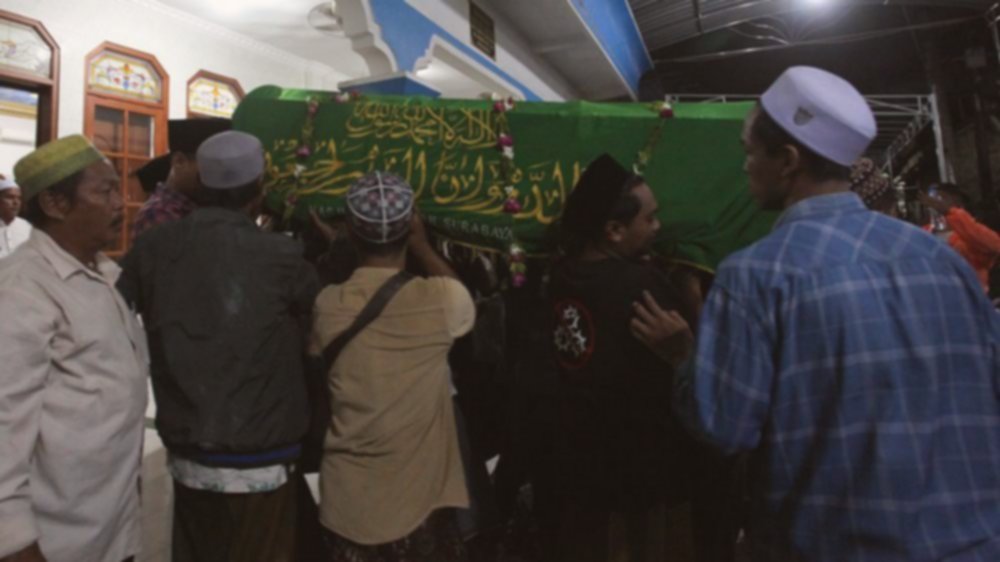

The death toll from the devastating collapse of the Al Khoziny Islamic boarding school mosque in Sidoarjo, East Java, continued to climb, reaching 63 by Monday (06/10). This tragic incident has brought forth a complex discussion surrounding accountability, faith, and the law.
Amidst the grief, a striking sentiment has emerged from some parents of the deceased students (santri), who state they will not pursue legal action against the pesantren. They view the collapse as an act of “destiny” rather than a consequence of negligence. This perspective resonates with the pondok (pesantren) leader, Abdus Salam Mujib, who similarly attributed the incident to “Allah’s will, requiring patience from all parties.”
However, several observers argue that police must initiate legal proceedings to ensure such a catastrophe does not recur. Jules Abraham Abast, Head of Public Relations for the East Java Regional Police, confirmed that the investigation into the case will commence once the victim evacuation and debris clearing operations are complete, beginning with a site investigation followed by a full inquiry.
‘This incident is destiny and a disaster’
On the seventh day following the collapse of the Al Khoziny pesantren mosque, heavy machinery remained on-site, meticulously clearing the fallen concrete slabs. Basarnas, Indonesia’s National Search and Rescue Agency, reported that at least 63 bodies have been recovered, most of which have been transported to Bhayangkara Hospital of the East Java Police for identification.
Families of the deceased students gathered around the SAR command post, anxiously awaiting updates about their children. Many parents confirmed they had provided DNA samples to assist with the identification of the remains. “DNA has been taken, but we are still waiting for it to be matched with those at the hospital,” shared Ahmad, a relative of a student from Sampang, Madura. They have chosen to remain at the post, determined to ensure no more bodies are found.

Air Marshal Mohammad Syafii, Head of Basarnas, affirmed that search and rescue operations would continue despite seven days of intensive efforts. “We cannot confirm how long it will take, but the SAR operation will continue until the location is declared clear and no more bodies or body parts are found,” he stated.
Lina, one of the grieving parents, expressed a profound sense of resignation. She refused to blame anyone for the disaster that claimed dozens of lives and injured hundreds, considering her son’s death sacred or “syahid” (martyrdom) as it occurred during worship. “This is a disaster, no one could have predicted it. It was Allah’s will,” she articulated, stating her lack of desire to pursue legal action and accepting the event as fate. “No parents are thinking in that direction,” she added. Lina, originally from West Java, hopes the identification of the recovered bodies will be swiftly completed so they can repatriate their children for burial.
Muhammad Sukron, another parent from Sampang, East Java, echoed similar sentiments. He also perceived the collapse of the Al Khoziny mosque as an act of destiny, not a result of negligence by the pesantren management. He firmly believes the construction of the prayer hall was undertaken with careful consideration, devoid of any recklessness. “I consider this destiny, and hopefully, this event will serve as a lesson for the pesantren to be even more careful in future constructions,” Sukron remarked.

Consequently, Sukron believes the incident should not be taken to court, as he sees no intentional wrongdoing by the pesantren leaders. His only demand is for improved construction processes in the future. “The world of pesantren operates on ‘sami’na wa atho’na’ [we hear and we obey] to the kiai, and I am certain this kind of thing was not an intentional act by the leaders,” the 46-year-old said, adding, “So I don’t ask for anything. Hopefully, this serves as a point of correction for the pondok.” Sukron also assured that there was no coercion or persuasion from the pesantren to prevent legal action, stating it was purely the conscious decision of the students’ parents. “There was no inducement or persuasion from the leaders, from the pesantren. Everything is in accordance with the beliefs of each parent,” affirmed the father of Muhamad Ya’dan Rakasahud, who survived the collapse.
‘Cannot hide behind the excuse of destiny’
Ismail Al-A’lam, a researcher at the Paramadina Center for Religious and Democratic Studies (PUSAD), explained that ‘qadar’ (destiny) in Islam refers to the laws and decrees ordained by Allah for all things, leaving no room for deviation. However, while destiny is pre-determined, humans remain unaware of their specific fate. Therefore, humanity is commanded to practice ‘tawakkal’ (reliance on God) and ‘ikhtiar’ (effort), alongside faith and righteous deeds.

Tawakkal signifies submission and the conviction that ultimate outcomes belong solely to Allah, while ikhtiar represents humanity’s active pursuit of goals. These two concepts, Ismail emphasizes, are inseparable and must be simultaneously embraced by Muslims in all endeavors. “Because when someone leans towards one path and neglects the other, it will inevitably have consequences for their religious attitude,” Ismail Al-A’lam told BBC News Indonesia on Monday (06/10). He continued, “Someone who prioritizes only tawakkal but puts in minimal effort… or even no effort at all, becomes fatalistic, unwilling to progress. So, even if destiny is determined, we must still strive and make an effort.”
However, Ismail notes that sometimes individuals he refers to as “those with religious authority” selectively use the incomplete concept of “destiny” for personal gain, for instance, to evade criticism. In the context of the Al Khoziny pesantren tragedy, Ismail criticized the pondok leader’s statement that the mosque collapse was solely “Allah’s will.” He views such a statement as an attempt to shirk responsibility for the deaths of dozens of students. “In Islam, it cannot be like that; we practice tawakkal and ikhtiar. We accept destiny, but we also take responsibility as a subject,” he added. “And he [the Al Khoziny pondok leader] cannot hide behind destiny to absolve himself of responsibility. So, he must take responsibility, acknowledging his negligence.”

Acknowledging negligence, according to Ismail, should be seen as an effort towards improvement for the pesantren, rather than an act that undermines its authority. Therefore, he believes there is nothing wrong if parents demand accountability from the pesantren management, as they entrusted their children to their care. Ismail suggests that any resignation among student families, viewing the event as destiny, might stem from a “lopsided power dynamic” between them and the pesantren leaders. “Many parents come from villages, with less education and economic weakness, creating an unequal power dynamic,” he explained. “Awareness of this condition must be raised by educated santri so that such unequal relationships do not persist.” Furthermore, Islam teaches that all humans are equal before the law, meaning there are no exceptions or privileges. “That might be difficult to acknowledge, let alone accept, especially for pesantren with charisma and community recognition… And from an external perspective, acknowledging negligence is not a problem; it’s actually gentle.”
‘Must be handled criminally, to prevent recurrence’
While the exact cause of the four-story building’s collapse remains unconfirmed, several experts suggest negligence in its construction. The first alleged oversight is the suspected lack of an IMB (Building Permit) for the mosque. Secondly, the building’s foundation is believed to have been inadequate for the load it was supporting. Thirdly, there are suspicions that the mosque’s construction was unplanned and did not adhere to technical standards, especially given the building’s history as initially designed for only one story. Fourthly, structural column failure has been proposed as a contributing factor to the collapse. Columns are crucial vertical structural elements that transfer loads from floors, roofs, and walls to the foundation.

Agustinus Pohan, a criminal law expert from Parahyangan University, asserted that the alleged negligence leading to the deaths of dozens of students must be legally accounted for through police action, irrespective of any complaints from the victim’s families. “Because this is not a ‘delik aduan’ [complaint-based offense],” Agustinus told BBC News Indonesia. “Moreover, with more than 50 victims, this is clearly an extraordinary case.” Pohan emphasized that criminal legal action is imperative to prevent similar incidents from occurring in the future. He added that it serves as a deterrent for anyone constructing buildings without permits or disregarding proper construction principles. “So, in my opinion, the police are obliged to conduct an investigation. Again, it’s not about wanting to punish, although ultimately someone might be punished, but that’s not the primary goal. The goal is to prevent recurrence,” he stressed. “Indeed, if the police do not act, it would be wrong.”

Professor Eva Achjani Zulfa, a permanent professor at the Faculty of Law, University of Indonesia, concurred with this view. She stated that regardless of the pesantren leader’s perspective on the incident as destiny, acts of negligence leading to the death of others constitute a criminal offense. This provision is stipulated in Article 359 of the Criminal Code, which states: “Whoever, due to their fault (negligence), causes the death of another person, shall be punished with a maximum imprisonment of 5 years or a maximum confinement of 1 year.” In the context of the mosque collapse, the alleged negligence is evident in the structural failure of the building. Like Agustinus Pohan, she believes legal action is essential to prevent similar events in the future.

“I acknowledge that pesantren are institutions not dependent on government subsidies, often relying on communal efforts for construction, and we respect that,” she explained. “However, we can question whether the construction complied with building permits? How effective was the oversight from the Ministry of Religious Affairs?” she queried. “Therefore, there must be a correction through criminal justice to ensure that santri children do not become victims of similar incidents.” To establish the legal framework and identify those responsible for the tragedy, Eva added, the police must investigate the building’s origins, design plans, contractor engagement, and the extent of government oversight. She acknowledged, however, that pursuing legal action against religious leaders could potentially spark social unrest, especially if it targets revered figures or community role models. In such sensitive situations, law enforcement typically considers all factors.
“This means confrontational approaches should be avoided. In my opinion, since there are no complaints from the victim’s families, the approach should be restorative justice,” Eva suggested. The “restorative justice” she proposed involves peaceful legal enforcement, such as imposing administrative sanctions like a temporary closure of the pesantren until its buildings are confirmed to have permits and guaranteed safety. “That too is a form of punishment for the pesantren organizers,” she remarked. “This could be an alternative for the police to find a middle ground, preventing potential conflict in the community.”
What did the police say?
Jules Abraham Abast, Head of Public Relations for the East Java Regional Police, reiterated that the investigation into the collapse of the Al Khoziny pesantren mosque would commence only after the victim evacuation and debris clearing operations are fully completed. To that end, the regional police have deployed personnel alongside the SAR team to conduct the clearing. “The law enforcement process will certainly be carried out after the cleaning process, after the dismantling of the remaining materials is truly finished, truly clear,” he stated at the East Java Regional Police on Monday (06/10). “And when there are no more necessary activities and no remaining victims in the form of bodies or body parts to be taken to Bhayangkara Hospital for identification.” Abast affirmed that once all evacuation and clearing processes are complete, the police will initiate the investigation at the crime scene, followed by the inquiry process. He added that no witnesses have been questioned yet, but once the evacuation is finalized, investigators will begin summoning all parties connected to the incident.
Reporters Petrus Riski in Surabaya and Mustofa in Pamekasan contributed to this report.
Summary
The collapse of the Al Khoziny Islamic boarding school mosque in Sidoarjo, East Java, tragically resulted in 63 deaths. Many grieving parents and the pesantren leader attribute the incident to “destiny” or “Allah’s will,” opting not to pursue legal action. Conversely, police have committed to an investigation once search and clearing operations conclude, as it is not a complaint-based offense.
Legal experts emphasize that negligence causing death is a criminal offense requiring police action, irrespective of family complaints. Potential causes cited include a lack of building permits, inadequate foundation, and structural failures in the unplanned multi-story construction. This investigation aims to prevent future occurrences and ensure accountability for building standards and oversight.