
Over the past year, coinciding with the first year of President Prabowo Subianto and Vice President Gibran Rakabuming Raka’s administration, PT Pertamina (Persero) has made significant strides in bolstering national energy security. These initiatives prominently feature the development and implementation of environmentally friendly energy solutions.
Early in 2025, the government launched a comprehensive program designed to reduce greenhouse gas emissions within the energy sector. A cornerstone of this effort is the mandatory increase in the blend of Crude Palm Oil (CPO) in diesel fuel, commonly known as biodiesel, which officially rose to 40 percent (B40). Furthermore, the government has actively supported the advancement of bioavtur, or Sustainable Aviation Fuel (SAF), demonstrating a strong commitment to sustainable practices across various sectors.
Eniya Listiani Dewi, Director General of New, Renewable Energy, and Energy Conservation (EBTKE) at the Ministry of Energy and Mineral Resources (ESDM), expressed strong appreciation for Pertamina’s unwavering commitment to developing greener fuels. This includes both their pioneering work in SAF development and the successful implementation of crucial government programs such as B40. “In the aviation sector, Pertamina already has biofuel known as SAF. Additionally, the B40 program has been running very well; as of today (February 14, 2025), approximately 12 million kiloliters of the mandatory B40 program have been distributed. We highly commend Pertamina’s implementation of biofuel initiatives,” stated Eniya.
Following the biodiesel mandate, the government also announced a mandatory 3 percent bioavtur blend for 2026. Eniya clarified that the previous bioavtur roadmap had envisioned a 1 percent mandatory blend starting in 2027. “However, after recalculating with Pertamina, we believe that bioavtur implementation can be accelerated to 3 percent and made mandatory in 2026,” Eniya revealed during a hearing with Commission XII of the House of Representatives in February 2025.
Pioneering Sustainable Aviation Fuel (SAF) Production
Pertamina has indeed achieved remarkable success in developing Sustainable Aviation Fuel (SAF), also known as bioavtur. Their efforts span from blends using palm oil to more recent initiatives incorporating used cooking oil (UCO).
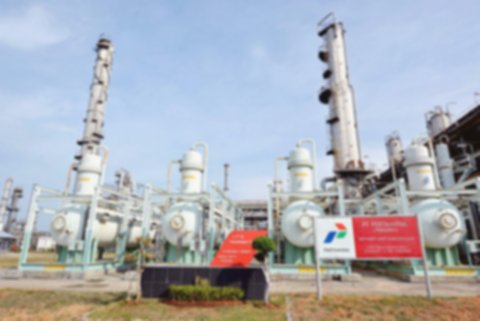
Through its Refinery Unit (RU) IV, specifically the Cilacap Refinery, Pertamina began producing SAF derived from palm kernel oil in 2022. Expanding its sustainable portfolio, the refinery ventured into UCO-based SAF production starting in 2025, achieving a 2.5 percent blend. Wahyu Sulistyo Wibowo, General Manager of the Cilacap Refinery, informed media at the facility on Sunday, October 19, 2025, that “PT KPI RU IV Cilacap has successfully processed SAF with UCO content, which is already relatively beyond expectation with a blend reaching 2.5 percent.”
This innovative product was subsequently commercialized through PT Pertamina Patra Niaga in mid-August 2025 and has already been utilized by PT Pelita Air Service for its Jakarta-Denpasar route. The production process leverages Co-Processing UCO technology, employing the domestically developed “Katalis Merah Putih” catalyst. Notably, this product has met stringent international standards, including ASTM D1655 and DefStan 91-091, making it the first officially certified SAF in Indonesia and Southeast Asia.
Plans are underway to replicate SAF production at RU II Dumai and RU VI Balongan refineries. Currently, SAF is produced at the Treated Distillate Hydrotreating (TDHT) unit of the Cilacap Refinery, boasting a capacity of 9,000 barrels per day. Looking ahead, both the RU VI Balongan and RU II Dumai refineries are targeted to achieve a production capacity of 8,000 barrels per day each, significantly boosting Indonesia’s SAF output.
SAF is widely recognized as a pivotal eco-friendly energy solution for the future of the aviation sector. Airbus Indonesia has expressed strong support for Pertamina’s endeavors to accelerate SAF development in the country. Ridlo Akbar, Senior Manager Business Growth at Airbus Indonesia, affirmed that SAF represents the most realistic solution for driving the decarbonization of the aviation industry. “As a drop-in fuel, SAF can be used directly without requiring modifications to aircraft or airport infrastructure. Technically, SAF is capable of reducing carbon emissions by up to 80 percent compared to fossil fuels, making it a significant step towards low-emission aviation,” Ridlo explained. He further added that all Airbus aircraft are capable of flying with up to a 50% SAF blend and are targeting 100% SAF usage by 2030. “We believe that with close collaboration among fuel producers, aircraft manufacturers, regulators & policymakers, and airline operators, SAF can become the new standard for global aviation,” he concluded.
Advancing the B40 Biodiesel Program
Minister of Energy and Mineral Resources, Bahlil Lahadalia, has allocated 15.6 million kiloliters (KL) of biodiesel for the B40 program this year. The implementation of this crucial initiative is formalized under the Minister of Energy and Mineral Resources Decree Number 341.K/EK.01/MEM.E/2024. “We, from the Ministry of ESDM, have decided on the increase from B35 to B40. Today, we announce that it will be effective from January 1, 2025,” Bahlil stated during a press conference on Friday, January 3, 2025.
PT Kilang Pertamina Internasional (KPI), functioning as the Subholding Refining & Petrochemical, is actively fulfilling the government’s mandate for the B40 program. This commitment to renewable fuel sources (BBN) is vital for supporting national energy self-sufficiency.
Taufik Aditiyawarman, President Director of Kilang Pertamina Internasional, highlighted that the refineries’ readiness to produce B40 underscores KPI’s dedication to providing better energy from environmental, economic, social, and sustainability perspectives. “The production of B40 Biosolar will undoubtedly contribute to KPI’s achievement of Net Zero Emission by 2060 or sooner, support the Sustainable Development Goals in ensuring access to affordable energy, and align with ESG principles,” Taufik elaborated.
B40 is a specific blend comprising 40 percent Fatty Acid Methyl Esters (FAME), derived from CPO or palm oil, and 60 percent conventional diesel fuel.
Currently, B40 is produced at the Plaju Refinery in South Sumatra and the Kasim Refinery in Southwest Papua. The Plaju Refinery is targeted to produce 119,240 KL of B40 per month, while the Kasim Refinery aims for 15,898 KL per month. The Biosolar production program has seen continuous growth since its inception with B20 in January 2019, progressively increasing its composition to B30 in 2019, B35 in 2023, and now reaching B40 in early 2025, marking a steady advancement towards more sustainable energy solutions.
Summary
Pertamina has significantly advanced Indonesia’s energy security and sustainable solutions, aligning with the new administration’s goals. The government launched a mandatory B40 program in early 2025, increasing the Crude Palm Oil blend in diesel fuel to 40% to reduce greenhouse gas emissions. Pertamina has successfully implemented this program, distributing approximately 12 million kiloliters by February 2025, with 15.6 million kiloliters allocated for the year. This marks a steady increase from B20, B30, and B35 blends in previous years.
Concurrently, Pertamina has pioneered the development and production of Sustainable Aviation Fuel (SAF), also known as bioavtur. Starting with palm kernel oil in 2022, they expanded to UCO-based SAF production in 2025 at Cilacap Refinery, achieving international certifications. This innovative fuel, commercialized in mid-2025, is now utilized by Pelita Air Service, with plans to expand production to other refineries. The government has also accelerated a mandatory 3% bioavtur blend for 2026, recognizing SAF’s potential to significantly decarbonize the aviation sector.