
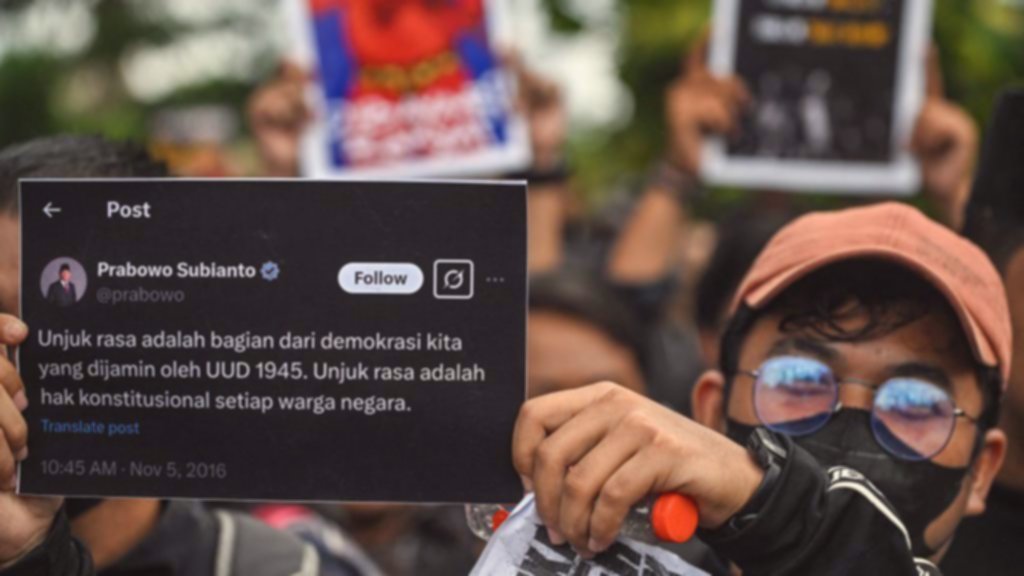

Public satisfaction surveys regarding the performance of President Prabowo Subianto reveal a stark divergence in public opinion. A recent poll conducted by the Center for Economic and Law Studies (Celios) assigned Prabowo a dismal score of 3 out of 10, while Poltracking Indonesia claims public trust in the Prabowo-Gibran administration has soared to 81.5%.
Amidst these conflicting survey results, several influential groups, including the All-Indonesia Student Executive Board (BEM Seluruh Indonesia) and a coalition of civil society organizations, are planning to voice their criticism against President Prabowo through street demonstrations near the State Palace in Jakarta on Monday, October 20.
What truly lies behind these disparate figures concerning Prabowo’s performance? And do the ongoing series of protests across various regions factor into the comprehensive assessment of Prabowo’s performance over the past year? BBC News Indonesia will report directly from the protest sites in Jakarta and engage with several experts to explore these critical questions.
Score of 3 out of 10
The Center for Economic and Law Studies (Celios) research institution has released the comprehensive findings of its performance assessment survey for the first year of President Prabowo Subianto and Vice President Gibran Rakabuming Raka’s administration.
The rigorous evaluation was conducted through a dual approach: a panel survey involving 120 journalists from 60 national media outlets, complemented by a public survey of 1,338 respondents across Indonesia.
The results paint a concerning picture, showing that Prabowo-Gibran received an average score of just 3 out of 10, broadly reflecting a public perception of “very poor” performance during their inaugural year in office.
This critical assessment is based on six pivotal indicators:

1. Program Achievements: Regarding the cabinet’s program achievements over the past year, a substantial 29% of respondents rated them “very poor,” with an additional 43% rating them “poor.” Only 26% considered them “sufficient,” and a mere 2% gave a “good” rating, indicating widespread dissatisfaction.
2. Policy Alignment with Public Needs: The majority of respondents expressed significant concern about how well policy plans matched public needs. 36% described the alignment as “very poor” and 44% as “poor.” Only 18% found it “sufficient,” and a meager 2% rated it “good,” suggesting a disconnect with public priorities.
3. Leadership: The administration’s leadership also garnered largely unsatisfactory results. 33% of respondents rated the cabinet’s leadership “very poor,” and 31% rated it “poor.” While 28% found it “sufficient,” only 9% rated it “good.” Notably, no respondents gave a “very good” rating for this critical aspect.
4. Budget Management: The Prabowo-Gibran cabinet also received a decidedly negative assessment from the majority of respondents concerning budget management. A significant 42% rated it “very poor,” while 17% deemed it “sufficient,” and only 3% gave a “good” rating, highlighting substantial concerns over financial stewardship.
5. Policy Communication: Celios highlighted that the Prabowo-Gibran administration’s approach to communicating and explaining its policies was largely perceived as a failure by the public. A striking 63% of respondents rated government policy communication “very poor,” and 28% rated it “poor.” Only 5% felt communication was “sufficiently good,” and 4% rated it “good.” This data indicates that the government has demonstrably struggled to provide clear, transparent, and easily understandable information, often leading to public confusion and a significant lack of broad support for its policies.
6. Law Enforcement: This area also received serious and widespread criticism. Celios’ findings show that a staggering 73% of respondents rated law enforcement “very poor,” and 38% rated it “poor.” In stark contrast, only 18% rated it “sufficient,” 6% rated it “good,” and a mere 1% rated it “very good.” These figures suggest that the public still perceives legal processes as profoundly unjust and inconsistent, with a persistent impression that “the law is sharp downwards but blunt upwards.” In other words, Celios concluded that the performance in strengthening the legal system and law enforcement agencies is exceptionally low.
Based on these damning findings, Celios asserted that the Prabowo-Gibran administration’s first year clearly faces serious issues regarding the legitimacy of its performance in the eyes of the public. This can be interpreted as a potent warning signal that the government operates without a strong base of public support and risks further erosion of trust if it relies solely on image building without substantive performance improvements.
More specifically, Celios observed that President Prabowo Subianto’s performance during his first year in office was considered worse compared to his initial 100 days.

During the first 100 days, public perception of his performance was rather positive, with 61% of total respondents giving scores ranging from 5 to 7. “However, public perception shifted drastically, with a significant rise in the lowest score (1) from 5% to 29%,” Celios explained, indicating a steep decline in approval.
Interestingly, Celios also assessed Vice President Gibran Rakabuming Raka’s individual performance as even lower than that of the overall administration. Gibran received an average score of just 2 out of 10.
A striking 76% of respondents rated the eldest son of former President Joko Widodo’s performance as “very poor,” 17% as “poor,” 7% as “sufficient,” and only 1% as “good.” “No respondents gave high scores in the 8-10 range,” the Celios report highlighted, underscoring a critical public view of his role.
Poltracking Indonesia Survey
A sharply contrasting assessment emerged from Poltracking Indonesia, which conducted a national survey in early October 2025 using a stratified multistage random sampling method.
Field data collection for this extensive survey took place from October 3-10, 2025, involving a robust sample of 1,220 respondents. The survey boasts a margin of error of +/-2.9% at a 95% confidence level and comprehensively covered all 38 provinces.
The results presented a significantly more positive outlook, indicating that public trust in the Prabowo-Gibran administration reached a remarkable 81.5%.
Furthermore, satisfaction with the performance of both leaders during their initial period in office stood at an impressive 78.1%.

According to Poltracking Indonesia, several key factors contributed to this high level of public trust and satisfaction. These include the perceived strong leadership style and government programs that are seen as directly benefiting the public.
Among those expressing satisfaction with the Prabowo-Gibran administration’s performance, commonly cited reasons included the firm and authoritative leadership demonstrated by Prabowo-Gibran during their first year, as well as government aid described as well-targeted and the popular free nutritious meals program.
In several key sectors, such as education, health, defense and security, and socio-cultural affairs, satisfaction levels notably exceeded 70%, suggesting strong public approval in these domains.
However, three specific areas recorded satisfaction scores below 70%: law and anti-corruption efforts, politics and national stability, and the economy, indicating areas for potential improvement.
Regarding the performance evaluation of the President’s cabinet members, the highest satisfaction levels were observed for Minister of Religious Affairs Nasaruddin Umar (65.7%), followed closely by Erick Thohir as Minister of Youth and Sports (63.5%), Minister of Finance Purbaya Yudhi Sadewa (61.2%), Agus Harimurti Yudhoyono as Coordinating Minister for Infrastructure and Regional Development (61%), and TNI Commander Agus Subianto (60.2%). Satisfaction with other ministers or ministerial officials remained below 60%.
Poltracking Indonesia also surveyed public perception of several flagship Prabowo-Gibran programs. The ambitious Free Nutritious Meals program reportedly garnered a satisfaction rate of 53.5%.
Another significant initiative, the development of three million subsidized homes, was claimed to be of interest to 54.7% of respondents.
For the Red and White Cooperatives program, Poltracking Indonesia noted that an overwhelming 85.4% of respondents expressed agreement with its establishment.
Concerning household economic conditions, 65.4% of respondents stated they were “better,” while 26.6% reported “worse” conditions over the past year, indicating a largely positive perception of economic well-being.
Similarly, regarding household income, approximately 60.7% reported it as “better,” and 31.8% assessed it as “worse” during the last year, further reflecting a cautiously optimistic economic sentiment among the public.
Index Politica Survey
Adding to the diverse landscape of public opinion, the Index Politica survey institution also conducted a poll specifically targeting satisfaction with the performance of President Prabowo Subianto and his Red and White Cabinet. Their findings align with the more positive assessments, showing that a significant 83.5% of respondents were satisfied with President Prabowo’s performance.
This survey was carried out from October 1-10, 2025, involving an extensive sample of 1,600 respondents across 27 provinces. Respondents were carefully selected at random using a multistage random sampling method, ensuring broad representation.
The survey’s margin of error was calculated at +/- 3%, with a high confidence level of 95%, reinforcing the reliability of its findings.
Based on these survey results, the vast majority of respondents, 83.5%, expressed satisfaction with President Prabowo Subianto’s performance during his first year in leadership, echoing the sentiment of other positive polls.
Furthermore, an impressive 90.8% of respondents reported being aware of the President’s various activities and policies through widespread media coverage. “As many as 90.8% of respondents learned about the President’s activities and policies through mass media and social media reports,” stated Fadhly Alimin Hasyim, Research Director of Index Politica, to reporters on Wednesday, October 15, 2025, highlighting the administration’s visibility.
This article will be updated periodically.
- One year of Prabowo-Gibran’s government – ‘A reversal of democracy’ and what challenges might lie ahead?
- One year of Prabowo’s government – The ‘cute grandpa’ image ends, militaristic character re-emerges
- How do the military, business community, and political parties underpin Prabowo Subianto’s power?
- From promotion to burial in a heroes’ cemetery as a right for recipients of honorary medals – Why have some names sparked controversy?
- Why did Prabowo recruit several former military personnel from the 1998 tragedy era?
- A portrait of the Prabowo-Gibran administration’s public policies – Viral first, then revoked
Summary
Public opinion regarding President Prabowo Subianto’s performance shows a stark divergence. A Celios poll assigned him a dismal 3 out of 10, reflecting “very poor” performance across six indicators, including policy communication and law enforcement, and a significant decline in approval since his first 100 days.
Conversely, Poltracking Indonesia reported 81.5% public trust and 78.1% satisfaction, citing strong leadership and beneficial programs like free nutritious meals, with Index Politica also finding 83.5% satisfaction. Amidst these conflicting survey results, various student and civil society organizations are planning street protests on October 20 to voice criticism against the Prabowo-Gibran administration.