
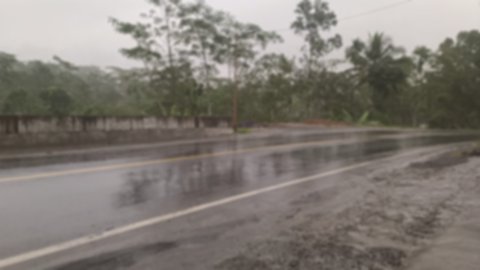

Heavy rainfall lashed the vicinity of Mount Semeru, an active stratovolcano straddling the border of Lumajang and Malang Regencies in East Java, on Friday, November 21. This intense precipitation subsequently triggered significant cold lava floods, a common geological hazard in the area following volcanic eruptions or substantial rain.
Reports gathered indicate that the cold lava flood began at 2:42 PM Western Indonesian Time (WIB), with its powerful currents directed towards Besuk Kobokan in Sumberwuluh, Lumajang Regency. This specific locality is a well-known natural channel for volcanic debris and mudflows originating from Mount Semeru, especially during periods of high rainfall.
Satriyo Nurseno, the Head of Emergency and Logistics for the East Java Regional Disaster Management Agency (BPBD Jatim), officially confirmed these critical developments. He noted that the cold lava flood exhibited a maximum acceleration (amaks) reading of 43 mm, indicating a substantial and vigorous flow of volcanic material.
“Indeed, it is still ongoing,” Satriyo stated when contacted for confirmation on Friday, November 21. He further elaborated on the situation, adding, “The last amaks reading was 43 mm, but it has now decreased to 26 mm,” suggesting a reduction in the intensity of the cold lava flow as the day progressed.

Satriyo expressly clarified that the cold lava flood was solely a consequence of the torrential downpour and was not preceded by any eruptive activity from Mount Semeru. He underscored that the high intensity of rain significantly increased the water discharge in the river systems, subsequently swelling the cold lava flows with loose volcanic material.
“It was simply the high intensity of rain in the upper reaches that resulted in the increased flow and discharge of cold lava streams. There was no eruption,” he reiterated, emphasizing the meteorological origin of this particular natural phenomenon.
Meanwhile, observations by kumparan, a prominent local news portal, revealed that Pronojiwo District in Lumajang Regency was still experiencing rain. The weather across the region remained uniformly overcast throughout the afternoon, maintaining conditions that could potentially exacerbate further cold lava activity.
Summary
Heavy rainfall near Mount Semeru on Friday, November 21, triggered significant cold lava floods in East Java. The powerful currents, beginning at 2:42 PM Western Indonesian Time, were directed towards Besuk Kobokan in Lumajang Regency. Satriyo Nurseno of the East Java BPBD confirmed the event, noting an initial maximum acceleration reading of 43 mm, which later decreased to 26 mm.
Nurseno expressly clarified that the cold lava flood was solely a consequence of the torrential downpour and not due to any eruptive activity from Mount Semeru. He emphasized that the intense rain increased water discharge, swelling the cold lava flows with loose volcanic material. Observations by a local news portal indicated continued rain and overcast conditions, maintaining the potential for further cold lava activity.