
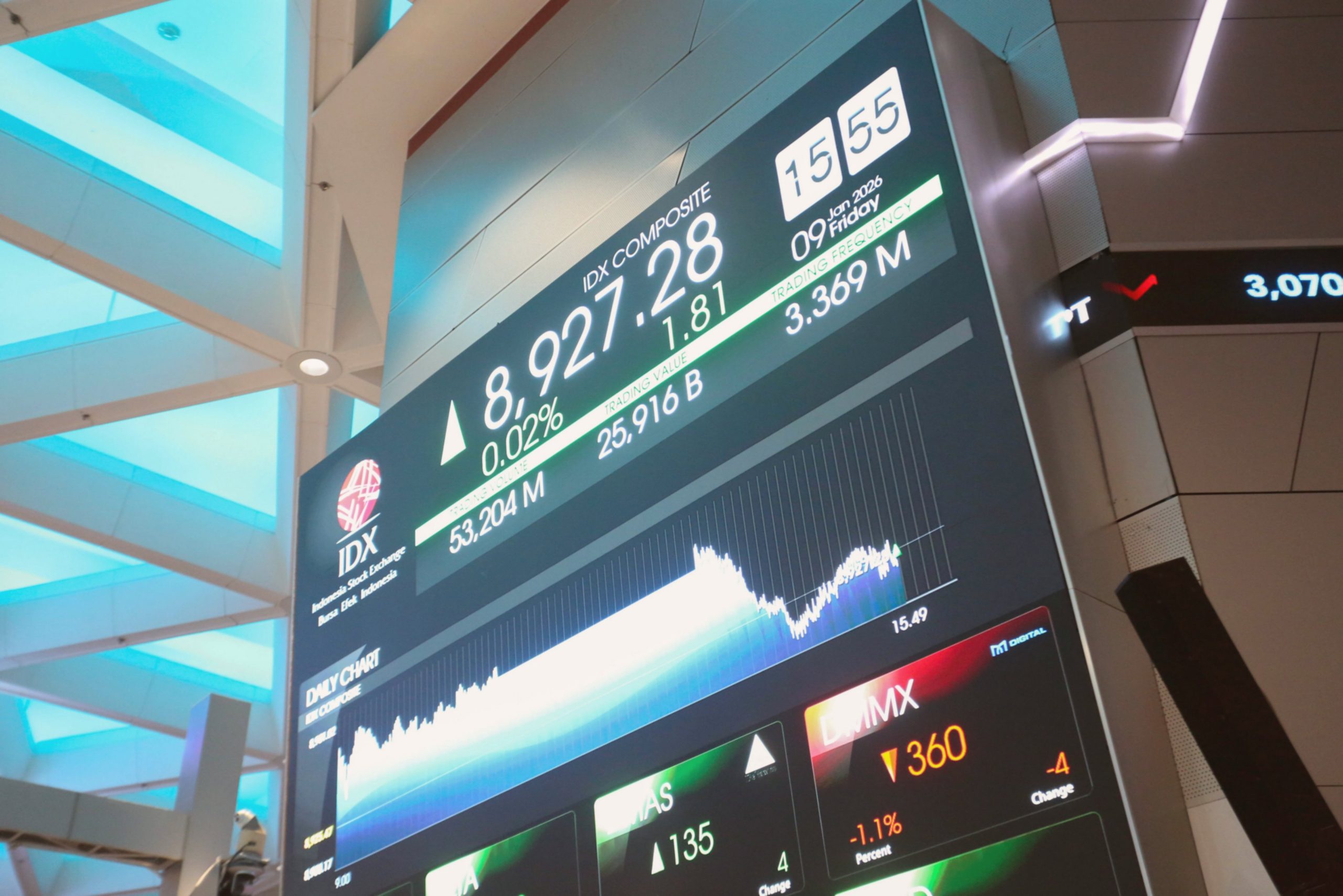

The Indonesian capital market has been navigating a week of contrasting dynamics. Despite a significant net sell-off by foreign investors, amounting to trillions of rupiah, the Jakarta Composite Index (IHSG) has displayed remarkable resilience, bolstered by robust support from domestic investors.
At the close of the first trading session today, the index weakened to 8,876.9, correcting by 115.28 points or 1.28%. With the exception of the health sector, all 10 sectors on the Indonesia Stock Exchange (IDX) collectively dipped into the red this afternoon. Cyclical, transportation, and energy sectors bore the brunt of these declines, correcting by 2.89%, 2.66%, and 2.35% respectively.
Throughout the week, the pressure from foreign capital outflow has been notably consistent. On Monday, January 19, 2026, foreign funds amounting to Rp 710 billion flowed out of the regular market. This figure surged dramatically to Rp 1.88 trillion on Wednesday, January 21, 2026, and continued on Thursday, January 22, 2026, with an outflow of Rp 964 billion.
Cumulatively, over Rp 3.5 trillion in foreign funds exited the nation’s stock market in a short span. “However, despite such immense pressure, the IHSG has shown impressive tenacity,” stated Reza Fahmi Riawan, Head of Retail Marketing & Product Development Division at PT Henan Putihrai Asset Management, to Katadata.co.id on Friday, January 23.
For instance, during today’s trading, the index momentarily rebounded to an intraday high of 9,031.49, though it ultimately closed lower at 8,876.9. Similarly, yesterday (Thursday), the IHSG also strengthened significantly to an intraday high of 9,109, before closing slightly weaker at 8,992.
“This movement reflects substantial buying power from domestic market participants,” Reza elaborated, underscoring the vital role of local investors.
Global Sentiment and Domestic Resilience
Reza highlighted that the IHSG’s ability to hold its ground is occurring amidst improving global sentiment. Abating geopolitical tensions in Greenland and expectations of a dovish global interest rate policy have collectively fostered a ‘risk-on’ environment in international financial markets.
“This positive psychological condition has also extended to local investors, even as foreign investors opted to distribute big-cap banking stocks such as BBCA, BMRI, and BBRI,” he noted, pointing out the divergence in investor behavior.
He suggested that the foreign sell-off in the banking sector is likely linked to concerns over valuations or the financial sector’s growth prospects. Yet, this very moment of price correction was strategically leveraged by local retail and institutional investors to accumulate these blue-chip stocks. Consequently, domestic liquidity has emerged as a critical anchor, preventing the market from experiencing deeper corrections.
Outlook and Investment Strategy
Looking ahead, Reza projects that the IHSG will likely remain in a consolidation phase, trading within the 8,000–8,350 range until next week. The potential for a sideways trajectory remains open as the market seeks equilibrium between positive global sentiment and the persistent pressure from foreign outflows.
In light of these conditions, he advises domestic investors to adopt a selective and prudent approach, prioritizing fundamentally robust stocks. Particular attention should be paid to consumer staples, telecommunications, and energy sectors, which continue to demonstrate consistent profit growth.
“A ‘buy on weakness’ or gradual accumulation strategy can be effectively applied during price corrections, with technical support levels around 8,000–8,100 serving as key buying zones,” he explained, providing actionable guidance for investors.
Furthermore, discipline in investment planning and risk management remains paramount. Investors are encouraged to avoid getting swept up in fleeting rebound euphoria and to continually monitor external catalysts, such as U.S. economic data and the Federal Reserve’s interest rate policy trajectory.
“Domestically, the release of Q4 financial reports and the government’s fiscal policy direction will be crucial determinants for the market’s subsequent movement.”