
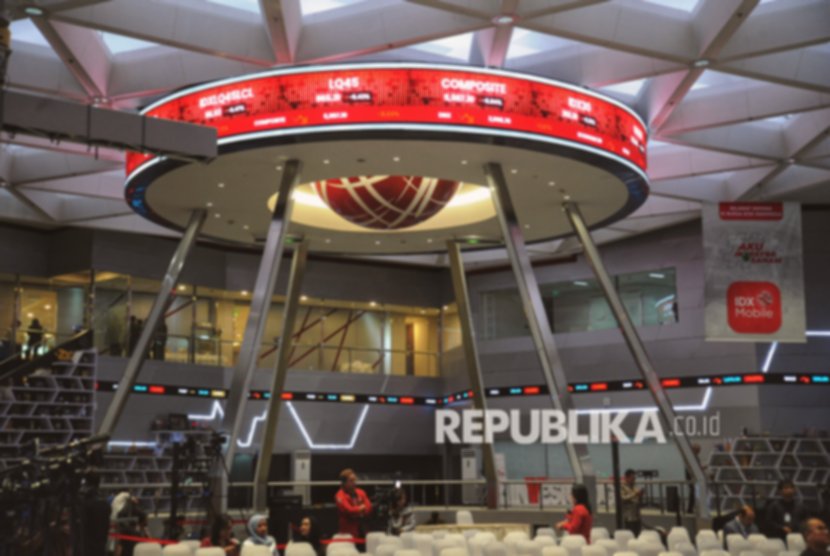

Flooring Guide by Cinvex – , JAKARTA — The Indonesian Composite Stock Price Index (IHSG) on the Indonesia Stock Exchange (IDX) closed lower on Friday afternoon, reflecting significant market concern over Morgan Stanley Capital International’s (MSCI) proposed changes to its free-float methodology. This anticipated shift has cast a shadow over investor sentiment.
The IHSG concluded the trading day down 41.16 points, a 0.46 percent decline, settling at 8,951.00. Concurrently, the LQ45 index, representing 45 blue-chip stocks, also saw a dip, falling 1.51 points or 0.17 percent to close at 873.59.
Analysts at Phintraco Sekuritas highlighted the driving force behind the IHSG’s weakness. In their research note from Jakarta on Friday (23/1/2026), they stated, “The weakening of the IHSG was primarily triggered by the anticipation of MSCI’s new methodology implementation for calculating the free float of Indonesian shares. There are widespread concerns that this could lead to considerable selling pressure from foreign investors, particularly targeting stocks predominantly held by institutions or conglomerates.”
MSCI plans to revise its free-float calculation method for Indonesian issuers, aiming to facilitate their inclusion in global indices. As part of this crucial process, MSCI actively sought market input regarding the potential use of the Monthly Holding Composition Report from the Indonesia Central Securities Depository (KSEI) as an additional reference for determining share free float.
The public consultation period for this proposal closed on December 31, 2025. The results of this consultation are expected to be announced before January 30, 2026. Should the changes be approved, they are slated for implementation during MSCI’s index review in May 2026, marking a pivotal moment for Indonesian firms targeting global market visibility.
This proposed modification to the free-float methodology holds immense importance for Indonesian issuers listed on the capital market who aspire to be included in MSCI indices. Currently, the IDX only registers share ownership reports exceeding 5 percent. In contrast, KSEI’s comprehensive data includes shareholders holding less than 5 percent, thereby offering a significantly more detailed and accurate picture of public ownership structures.
Across the broader Asian landscape, regional stock markets experienced a positive close. This was bolstered by the Bank of Japan’s (BoJ) decision to maintain its benchmark interest rate at 0.75 percent, a move made ahead of Japan’s general election scheduled for February 8, 2026. In line with this, the yield on Japan’s 40-year government bonds decreased by 4 basis points to 3.953 percent, although shorter-term bonds saw their yields rise.
The IHSG, which opened in negative territory, struggled to recover throughout the day. It remained in the red zone for the entire first trading session and continued its downward trend into the second session, ultimately closing lower.
An analysis of the IDX-IC Sectoral Index revealed mixed performance. Only two sectors managed to strengthen: the health sector, which climbed by 0.83 percent, and the infrastructure sector, which posted a modest gain of 0.12 percent. Conversely, nine sectors recorded declines, with transportation and logistics experiencing the steepest fall at 2.23 percent. This was closely followed by the non-primary consumer goods sector, down 2.17 percent, and the industrial sector, which dropped by 1.57 percent.
Among the day’s top gainers were RMKO, BAIK, LPCK, TOOL, and JAST. Conversely, the shares that saw the largest declines included PTRO, ZATA, DAAZ, MPPA, and MAHA.
Trading activity was robust, with a total of 3,319,645 transactions recorded. The volume of shares traded reached an impressive 64.15 billion, totaling a value of Rp 32.04 trillion. Market breadth indicated a challenging day for investors, as 191 stocks advanced, 495 weakened, and 118 remained stagnant.
At the close of trading, other major regional Asian stock indices also showed positive momentum. The Nikkei index rose by 108.70 points or 0.20 percent to 53,797.60. The Shanghai index climbed 13.58 points or 0.33 percent to 4,136.16. Hong Kong’s Hang Seng index gained 119.54 points or 0.45 percent to 26,749.50, and the Straits Times index surged by 63.13 points or 1.31 percent to 4,891.45.