
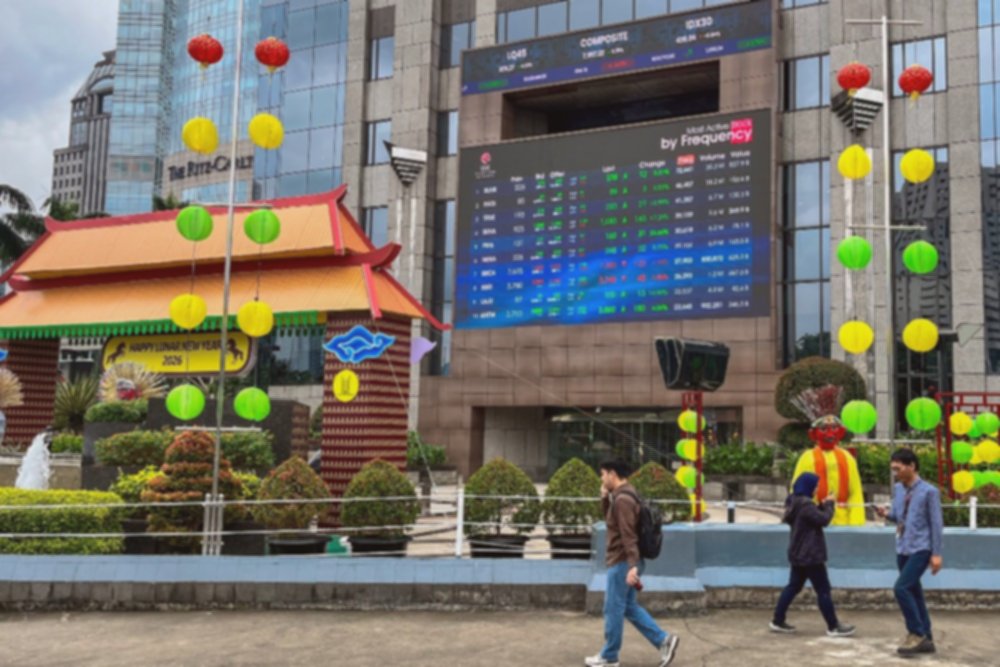

JAKARTA — The Indonesian Composite Stock Price Index (IHSG) is projected to remain under significant pressure next week, showing a tendency to weaken within the range of 6,825–7,445. This forecast follows the index’s decline on Thursday, April 2, 2026, which saw it close down by 2.19% daily at 7,026.78 by the end of last week.
This downturn was primarily triggered by negative global sentiment, particularly the escalating conflict tensions between the United States and Iran. Such geopolitical unrest has driven up global oil prices, subsequently placing considerable strain on regional stock markets, including Indonesia’s.
Muhammad Wafi, Head of Research at Kisi Sekuritas, highlighted that the market’s weakness intensified after US President Donald Trump indicated a continuation of military operations. This statement fueled concerns about potential disruptions to the global energy supply and exacerbated broader geopolitical tensions, impacting investor confidence.
Leading stocks such as BREN, AMMN, and BRPT also experienced a notable correction on Thursday, as President Trump’s remarks heightened global geopolitical instability. The ongoing uncertainty regarding energy supply has propelled oil prices upwards, further injecting volatility into the financial markets.
Consequently, the IHSG registered a decline throughout the week of March 30 to April 2, 2026. This downward trend was exacerbated by a substantial outflow of foreign funds, totaling Rp2.94 trillion within a single week. Heavy selling pressure was also evident on large-capitalization stocks, driven by profit-taking activities amidst the heightened global uncertainty.
On the domestic macroeconomic front, several indicators point towards a noticeable slowdown. Indonesia’s inflation rate for March 2026 was recorded at 3.48% year-on-year, a decrease from the previous month and still within target. However, manufacturing activity, as reflected by the Purchasing Managers’ Index (PMI), dipped close to the stagnation level at 50.1, signaling challenges from both demand and production cost pressures.
Furthermore, Indonesia’s trade balance surplus narrowed to US$1.28 billion in February 2026. This reduction was a result of decelerating export growth coupled with an increase in imports, adding another layer of concern for the nation’s economic outlook.
Given this potent combination of global and domestic pressures, the IHSG’s short-term movement is expected to be constrained, with a predominant tendency to weaken. Nevertheless, opportunities for support may still emerge from commodity-based stocks, especially given the persistently high trends in energy and raw material prices, which could offer some resilience.
The prevailing global instability, primarily stemming from the escalation of geopolitical conflicts and the surge in energy prices, remains a significant burden on market performance. Amidst this backdrop of uncertainty, market participants are increasingly adopting a “risk-off” stance. This cautious approach is driven by growing apprehensions about global inflation and the future direction of interest rate policies by the US Federal Reserve.
Investors will be closely monitoring crucial US economic data, including the Consumer Price Index (CPI), ISM PMI, and labor market figures, to gauge future monetary policy decisions. While US stock markets, including the S&P 500, Nasdaq, and Dow Jones, actually saw significant gains in early April 2026 – initially hindered by surging oil prices but later recovering on hopes of de-escalation and falling energy costs – the situation in the Asia Pacific region appears more fragile. Asia Pacific bourses are experiencing varied movements with dominant downward pressure, primarily due to rising oil prices weighing on energy-importing nations and weakening regional currencies. Despite these challenges, a ray of optimism emanates from China’s robust economic data, particularly its export sector and potential for economic recovery, which could provide some regional counterbalance.
Disclaimer: This article is not intended to solicit the purchase or sale of stocks. Investment decisions are solely at the discretion of the reader. Bisnis.com is not responsible for any losses or gains arising from readers’ investment decisions.