
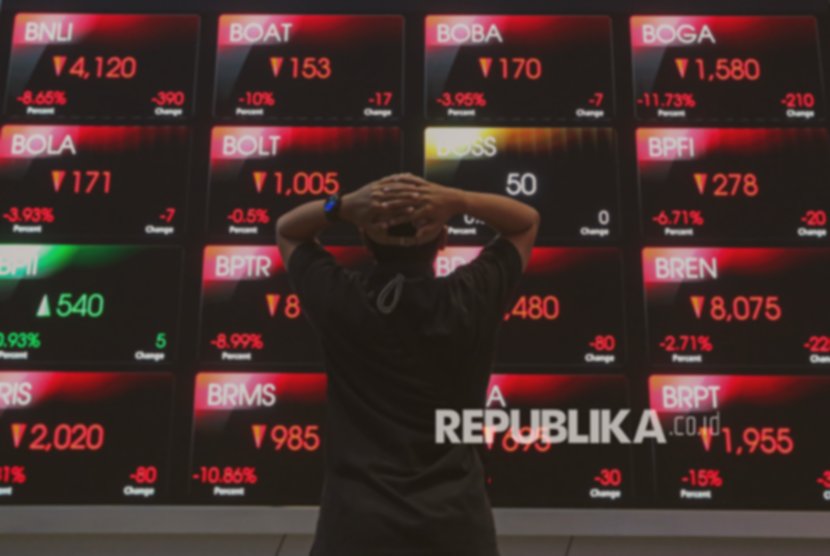
JAKARTA — The Indonesia Stock Exchange (BEI) concluded the trading week from March 30 to April 2, 2026, with varied stock performance. The Jakarta Composite Index (IHSG) experienced a decline, settling at 7,026, while the market capitalization reached Rp 12,305 trillion.
According to an official statement from the BEI on Saturday (April 4, 2026), the IHSG saw a 0.99 percent movement during the week, closing at 7,026.782, down from its previous week’s position of 7,097.057. This weakening trend in the primary stock index was mirrored in the market’s overall valuation.
Accompanying the IHSG’s downturn, the total market capitalization also recorded a significant decrease of 1.69 percent, shrinking to Rp 12,305 trillion from Rp 12,516 trillion recorded in the preceding week. This indicates a broad-based reduction in the value of listed companies.
Further reflecting the market’s soft performance, the average daily transaction volume on the Indonesia Stock Exchange declined by 8.62 percent, falling to 25.87 billion shares from 28.31 billion shares the week prior. Similarly, the average daily transaction value saw an even steeper drop of 36.69 percent, settling at Rp 14.77 trillion from Rp 23.33 trillion.
Amidst these declines, one segment of stock trading activity demonstrated growth: the average daily transaction frequency. The BEI reported an increase of 3.08 percent, with transactions rising to 1.78 million times from 1.73 million times in the previous week, suggesting persistent, albeit smaller, investor engagement.
Foreign investors concluded the week on April 2, 2026, with a net sell of Rp 813.51 billion. Year-to-date in 2026, foreign investors have accumulated a substantial net sell value of Rp 33.83 trillion, indicating a sustained outflow of capital from the Indonesian market.
In response to market dynamics, the Indonesia Stock Exchange has actively pursued various initiatives over the past week aimed at revitalizing the stock market, with a particular focus on enhancing the transparency of Indonesia’s capital market. These efforts are crucial for fostering a more robust investment environment.
As part of these strategic initiatives, the Financial Services Authority (OJK), in collaboration with the BEI and PT Kustodian Sentral Efek Indonesia (KSEI), has successfully completed four key agendas to strengthen Indonesian capital market transparency. These achievements are integral to proposals submitted to global index providers, including MSCI, signaling Indonesia’s commitment to international standards.
These accomplishments form a vital component of the eight “Action Plans for Accelerating Indonesian Capital Market Integrity Reform,” which were launched on February 1, 2026. Key reforms include providing public access to share ownership data exceeding 1 percent, implementing announcements for high shareholding concentration (HSC), enhancing the granularity of investor classifications within KSEI data, and increasing the minimum free float requirement to 15 percent through adjustments to BEI Regulation Number I-A.
The BEI emphasized that these milestones underscore the ongoing commitment of both the BEI and KSEI to support the broader Indonesian capital market reform agenda. Their objective is to significantly improve transparency, enhance the quality of information, and bolster the confidence of both domestic and global investors. Moving forward, the implementation of these transparency reforms is expected to drive greater market efficiency, strengthen investor protection, and elevate the global competitiveness of Indonesia’s capital market.
Earlier, the OJK highlighted the Indonesian capital market’s highly dynamic movement and significant volatility during the first three months of 2026. The Jakarta Composite Index (IHSG), specifically from January 1 to April 1, 2026, experienced a substantial correction, nearing 17 percent.
Hasan Fawzi, Chief Executive of Capital Market, Derivative Finance, and Carbon Exchange Supervision at the OJK, stated during a press conference on Indonesian capital market reform achievements at the BEI Building in Jakarta on Thursday (April 2, 2026), that as of April 1, 2026, the IHSG stood at 7,184.44, reflecting a 16.91 percent correction year-to-date (YTD).
This period of weakening performance was attributed to the escalating geopolitical tensions in the Middle East, alongside domestic factors related to updates from international rating agencies concerning the outlook for Indonesia’s capital market. These external and internal pressures contributed to investor caution.
However, Hasan pointed out that this corrective trend was not isolated to Indonesia’s capital market, but was rather a widespread phenomenon affecting nearly all stock exchanges across regional and global markets. This context is important for understanding the market’s behavior.
He further elaborated that this global trend largely reflects external dynamics rather than solely a response to domestic fundamental conditions. This perspective helps contextualize the market’s performance within broader international financial movements.
Amidst these evolving dynamics, the OJK, in collaboration with the BEI and other self-regulatory organizations (SROs), continues to closely monitor daily developments to assess the extent of investor reactions. Their vigilance ensures a timely understanding of market sentiment.
Crucially, Hasan confirmed that, to date, the resilience and endurance of Indonesia’s domestic market have been maintained and remain robust, providing reassurance to market participants despite recent volatility.