
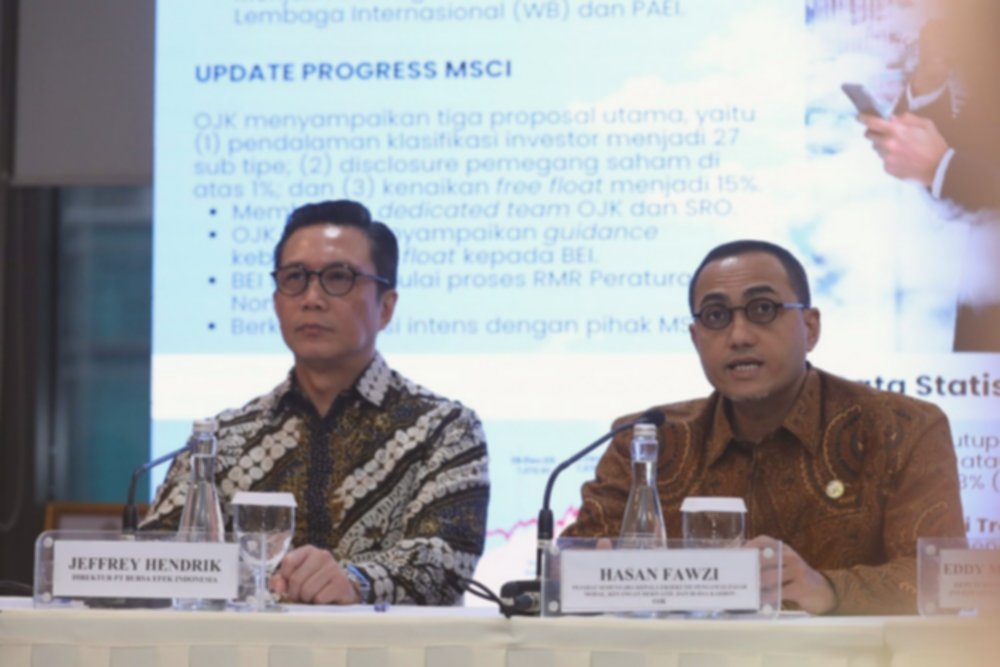
JAKARTA — The Indonesian Stock Exchange (BEI) has provided comprehensive clarifications regarding its newly introduced High Shareholding Concentration (HSC) list, a strategic initiative aimed at significantly enhancing transparency within Indonesia’s dynamic capital market.
Irvan Susandy, Director of Trading and Exchange Member Regulation at the BEI, elucidated that the HSC List serves as a public announcement jointly issued by the BEI and the Indonesia Central Securities Depository (KSEI). This list identifies shares that exhibit an observable concentration of ownership held by a limited number of investors, drawing attention to potential market dynamics.
Irvan further explained that the determination of HSC status is meticulously carried out by a specialized committee. This committee, comprising representatives from both the BEI and KSEI, rigorously assesses various aspects including supervisory oversight, the characteristics of listed companies, and their respective shareholders. He made this statement on Wednesday, April 22, 2026.
The core objective of the HSC framework, Irvan underscored, is to foster greater public transparency concerning the ownership concentration within listed companies. He detailed the structured process for identifying HSC, which commences with a “Trigger Factor,” proceeds to a thorough HSC Checking phase, and culminates in a public announcement. Notably, the BEI is also adjusting the criteria for its prominent indices, IDX30, LQ45, and IDX80, to integrate aspects related to HSC shares.
During the crucial “Trigger Factor” phase, shares flagged by the HSC Committee undergo an in-depth assessment of their shareholding structure. These trigger factors encompass several critical aspects, including price volatility, supervisory considerations, and market liquidity, among others, ensuring a holistic evaluation.
Should a share be identified as exhibiting High Shareholding Concentration, the BEI is committed to promptly informing the public. Moreover, listed companies are empowered to rectify their shareholding structure to address HSC concerns through strategic improvements, such as a refloat of shares, or various corporate actions designed to diversify ownership. Irvan affirmed that the BEI will issue a “recovery announcement” to the public once a listed company has demonstrably resolved its share ownership concentration.
In a related development, MSCI acknowledged its awareness of recent announcements from the Financial Services Authority (OJK), the BEI, and KSEI, pertaining to a series of significant capital market transparency reforms in Indonesia. These pivotal measures include enhanced shareholder disclosure for holdings exceeding 1%, improved granularity in investor classification within share ownership data, the formal introduction of the High Shareholding Concentration (HSC) framework, and a forward-looking roadmap to increase the minimum free float threshold to 15%.
“MSCI is currently evaluating the scope, consistency, and effectiveness of these new data sources and measures,” the index provider stated in an announcement on Tuesday, April 21, 2026. This assessment is crucial for its broader determination of free float and overall investability assessment, which impacts global investment decisions.
During its May 2026 index review, MSCI confirmed it would maintain previously announced measures applicable to Indonesian securities. Specifically, MSCI will implement a freeze on all increases to Foreign Inclusion Factors (FIF) and the Number of Shares (NOS) for Indonesian constituents.
Furthermore, MSCI will refrain from adding any new shares to its MSCI Investable Market Indexes (IMI). The firm will also not conduct any upward migration of stock size classifications, which includes preventing any reclassification of stocks from Small Cap to Standard categories. Crucially, MSCI will proceed to remove shares identified by Indonesian authorities as falling under the High Shareholding Concentration (HSC) framework. Additionally, MSCI may leverage the new 1% shareholder disclosure data to adjust its free float estimates as deemed necessary.
However, MSCI emphasized that it will not incorporate data from these new sources and disclosures into its free float assessment or index calculations until its comprehensive review process is finalized and feedback from market participants has been thoroughly received and evaluated. This cautious approach underscores MSCI’s commitment to robust data integrity and market consultation.