
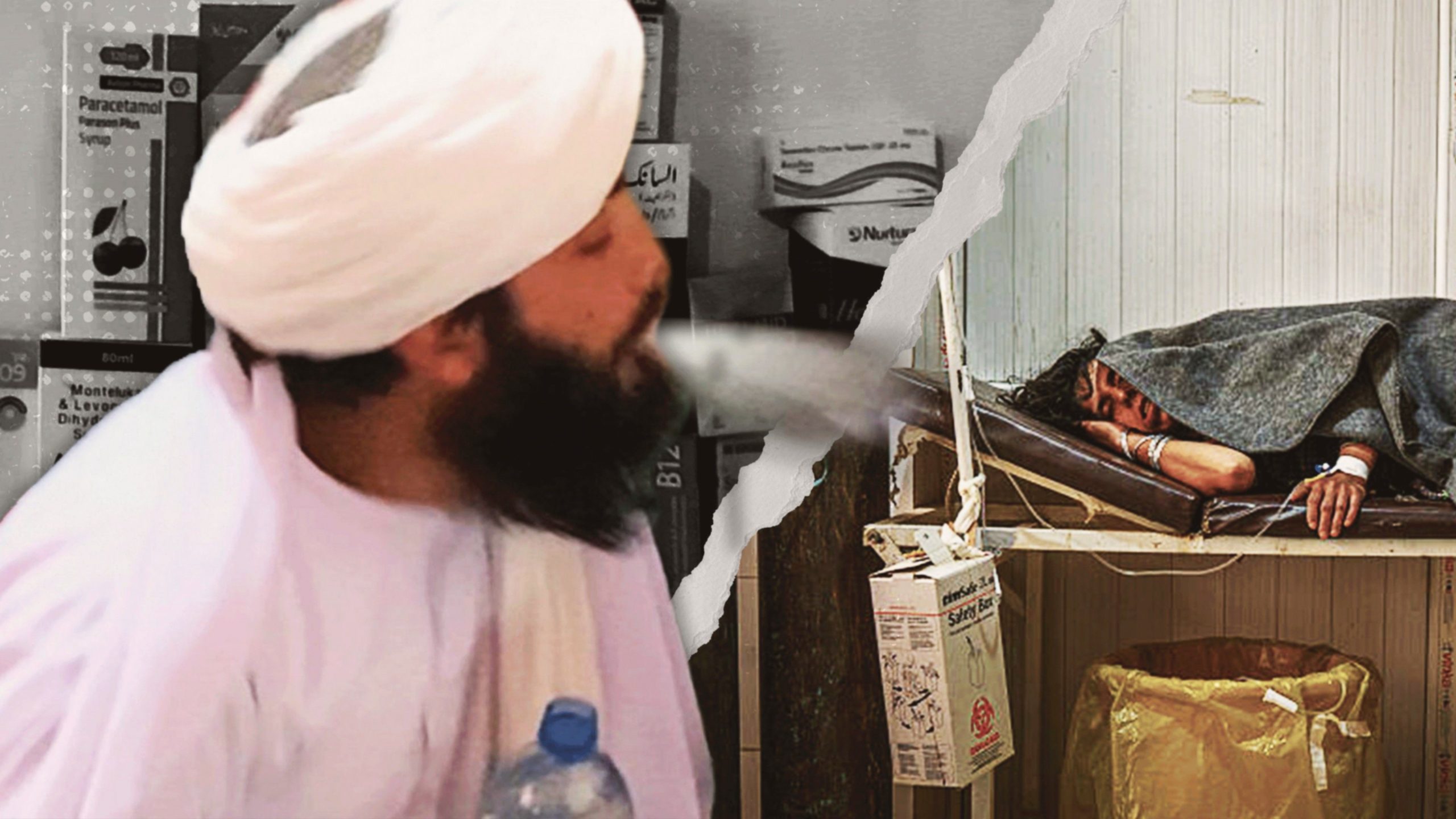

On the outskirts of Kandahar in southern Afghanistan, dozens of people gather outside a modest home. They have come in search of a miracle, hoping to find a path to recovery from life-threatening diseases such as cancer.
Inside a room with brightly colored walls, the atmosphere is heavy with desperation. Men, women, and children sit or lie weakened by their ailments, crowding the space. While not everyone suffers from terminal conditions, the air is thick with the hope of those who have nowhere else to turn.
In one corner of the room sits Neda Mohammad Qadri. Clad in a white turban with a long black beard, he is the man this crowd has traveled miles to see. With nothing more than a bottle of water, which he sips and then sprays onto the person before him, Qadri claims to be a spiritual healer.
He presents himself as an instrument of divine intervention, claiming he can alleviate the suffering of those battling cancer and thalassemia.

Qadri operates without any medical background or even formal religious training. Just a few years ago, his career was entirely unrelated to healthcare; he worked as a cook. He claims his transition began when people started approaching him for talismans, which inspired him to open his alternative healing practice.
According to Qadri, many patients have seen their conditions improve under his care. These claims have caused his popularity to skyrocket, drawing an ever-increasing number of visitors, particularly cancer patients seeking a final glimmer of hope.
Why are citizens turning to spiritual healers?
The rise of such practices is a direct reflection of a crumbling healthcare infrastructure. Data from the World Health Organization (WHO) indicates that Afghanistan sees more than 24,000 new cancer cases annually, resulting in nearly 17,000 deaths. However, experts believe the true numbers are likely much higher, as many patients remain undiagnosed due to a severe shortage of hospitals, clinics, and trained medical professionals.
Read also:
- Afghan women ‘banned from attending midwifery courses’ by the Taliban
- Afghanistan Earthquake: ‘Some men refused to touch injured or deceased women’
- Women victims of the Afghanistan earthquake ‘suffer more’ due to the extreme shortage of female doctors
The situation worsened significantly after the Taliban took control in 2021, leading to a drastic reduction in international aid. A notable example is the International Committee of the Red Cross (ICRC), which was forced to cease its support for Mirwais Hospital in Kandahar—a vital regional medical hub—due to funding constraints.

Beyond the lack of facilities, the cost of medical care is prohibitively high. Even at specialized facilities, such as the cancer hospital recently established by the Taliban government in Kabul, the financial burden is too much for many families to bear.
Experts note that Afghanistan has one of the highest cancer prevalences in the region, driven by lifestyle factors such as high salt consumption, the use of smokeless tobacco known as naswar, and extreme levels of environmental pollution.

Those desperate for treatment are often forced to make extreme sacrifices, traveling long distances or even bringing their own basic medical supplies when seeking care from what few resources remain.
Until about 18 months ago, residents of southern Afghanistan, particularly Kandahar, could cross into Pakistan without a visa to access better-equipped hospitals. This lifeline has now been severed. The Chaman–Spin Boldak border crossing has been repeatedly closed following clashes between Afghanistan and Pakistan, and strict regulations now limit the flow of essential medicines from Pakistan, which Afghanistan heavily relies upon.
These combined factors have pushed an already fragile healthcare system to the brink of total collapse.
‘I lost my child, I have been deceived’
The human cost of this crisis is devastating. Nazir Ahmad Maiwandwal’s 24-year-old wife, Shukriya, passed away last March. Diagnosed with a brain tumor after suffering from severe headaches for over a year, she had initially received successful surgery in Pakistan.
“After the operation, my wife’s condition began to improve. She gained weight, and for six months, everything seemed fine. However, her health slowly began to decline again,” Maiwandwal recalls. In their desperation, the couple tried to return to Pakistan, but the border had been closed to visa-free travel.
“I applied for a Pakistani visa three times, but it was always rejected. I went to Kabul, but even the cancer treatment center there lacked radiotherapy. I returned home in despair.”
Read also:
- Afghan women share ‘horrific experiences’ of giving birth under Taliban rule
- ‘My three sons starved to death, I hope the angels take them home’ – A mother’s testimony on malnutrition in Afghanistan
- Crisis in Afghan hospitals: ‘There is nothing we can do but watch babies die’
Stories like this are common across the country. This sense of helplessness drives people to entrust their lives to spiritual healers like Qadri, waiting in lines for a splash of water they hope will cure them. Qadri claims he sees between 250 and 400 people every day from all corners of Afghanistan.
Among them was Habibullah’s son, Assad.

Before visiting Qadri, Habibullah had taken his son to Pakistan, only to be told that the disease was terminal. Doctors advised him to take Assad home so he could spend his final days with his family. Refusing to give up, Habibullah heard rumors of Qadri’s “miracles” and sought his help.
“He took a photo of my son and told him to keep it. He said that after ten days, his face would change so much that even my son wouldn’t recognize himself,” Habibullah says. They returned home with renewed hope, but instead, Assad’s condition deteriorated rapidly. He died on the way to a hospital.
“I lost my son. He was cheated with empty promises. Qadri took money and sheep, but he didn’t cure the cancer. Now, my son’s wife is a widow with five children to support,” Habibullah says, calling Qadri a “fraud.”

Another Kandahar resident, who requested anonymity, visited Qadri for skin cancer. Qadri told him there was no need to go to Pakistan and requested a sheep as an offering, promising a total recovery.
Over the course of a week, Qadri provided prayers along with injections of ceftriaxone and tablets of co-amoxiclav and augmentin—powerful antibiotics typically used for bacterial infections, not cancer. Realizing his condition was not improving, the man eventually managed to travel to Lahore, Pakistan, where he recovered through proper medical treatment.
‘Medical intervention remains paramount’
Medical experts warn that the substances Qadri administers are dangerous. Ceftriaxone must be administered intravenously, and none of the antibiotics he provides are used in the treatment of cancer. Misusing these drugs without specialist supervision can lead to severe complications, including drug resistance.
In response to these allegations, Qadri denied demanding payment for his services. He told the BBC that any money received is a voluntary gift of gratitude from the people. He also claimed that he prescribes medication only after “consulting with doctors” and insists he never discourages anyone from seeking professional medical care.

Qadri is not alone in offering such services. Mohammad Aziz Saeedi from Nangarhar shared that his twin daughters, who suffer from thalassemia, were initially taken to spiritual healers on the recommendation of relatives. Instead of improving, their health declined as healers prescribed food restrictions and “blessed water.” Only after returning to monthly blood transfusions and medical care did their condition stabilize.
While experts acknowledge that spiritual healing can provide mental comfort and emotional support for those with chronic illnesses, they emphasize that it is never a substitute for medical intervention. Unfortunately, for those waiting outside Qadri’s door, a lack of options and a fading sense of hope often leave them with no other choice.
With additional reporting by BBC Global Journalism