
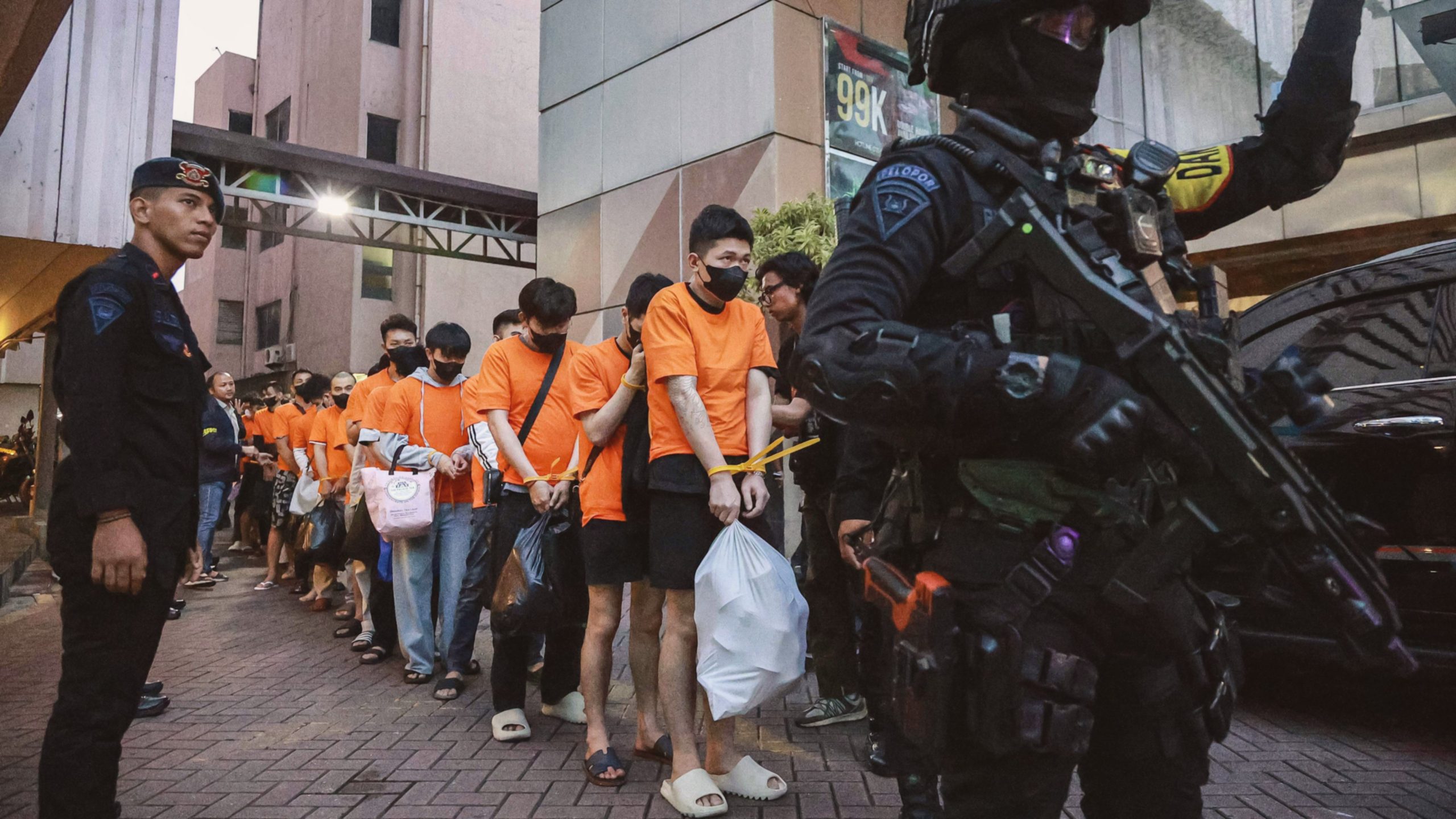

The recent arrest of 320 foreign nationals at an illegal online gambling hub in Hayam Wuruk, Jakarta, has sparked concerns among cybersecurity experts that Indonesia is fast becoming a safe haven for transnational crime syndicates. This raid raises critical questions: Who are the primary actors backing these operations, where is the illicit funding flowing, and who is financing these complex underground networks?
On Saturday (May 9), authorities apprehended 321 individuals at the Hayam Wuruk Plaza Tower in West Jakarta. The operation was concealed on the 20th and 21st floors, disguised behind a facade with no official company signage. Of those detained, 320 were foreign nationals, while one was an Indonesian citizen previously employed in similar roles in Cambodia.
“We are still investigating the specific role of the Indonesian national, though preliminary findings suggest they were working in customer service,” stated Brigadier General Wira Satya Triputra, Director of General Crimes at the National Police’s Criminal Investigation Department (Bareskrim Polri).
The detainees were allegedly tasked with various operational duties, including marketing, customer service, administration, and debt collection. Police are now working to identify the masterminds behind this international syndicate. As of Monday (May 11), investigators were still tracing the financiers, office leasers, and the massive capital flows sustaining the operation. Wira emphasized that investigations are ongoing to uncover the sponsors and funding channels that enabled these individuals to operate within Indonesia.
While police noted that the gambling network had been active for approximately two months and managed roughly 75 websites, they have yet to release the specific domains to the public.
Immigration Oversight and the Search for Masterminds
The investigation is currently a multi-agency effort. The Ministry of Immigration and Corrections has pledged to track down the sponsors who guaranteed the stay of the 320 foreign nationals involved. Arief Eka Riyanto, Head of the Immigration Supervision Sub-directorate, confirmed that their office is conducting a thorough inquiry into how these individuals gained entry and sponsorship in Indonesia.
Currently, the foreign suspects have been transferred to immigration detention centers in Kuningan, South Jakarta, and West Jakarta, while the Indonesian suspect remains in police custody for further interrogation. The group consists of 228 Vietnamese, 57 Chinese, 13 Myanmarese, 11 Laotians, five Thais, three Malaysians, and three Cambodian nationals. Most entered on tourist visas, which had already expired, further complicating their legal status.

The Anatomy of a Cybercrime Syndicate
Pratama Persadha, head of the Communication and Cybersecurity Research Center (CISSReC), warns that those caught on the ground are often merely technical operators or executors. “They function like employees in a standard company, complete with shifts, performance targets, and specialized divisions for customer service, transaction processing, and digital marketing,” Pratama explains. He notes that many of these lower-level staff members may not even know the true identity of the operation’s owners.
Modern cyber-syndicates intentionally fragment their organizational structure to ensure that if one layer is compromised, the core remains protected. In the Hayam Wuruk case, it is highly probable that the detainees only possessed limited knowledge of the command chain. The true intellectual actors, or “invisible hands,” often operate from abroad, utilizing false identities, encrypted communications, offshore servers, and digital intermediaries.
Despite this, Pratama stresses that mass arrests are vital. By analyzing electronic devices, communication metadata, financial transactions, and login patterns, investigators can build a map of the larger criminal infrastructure.
Is Indonesia Becoming a Safe Haven?
Pratama warns that the Hayam Wuruk raid is a red flag, suggesting that Indonesia could be emerging as a new “safe haven” for Southeast Asian gambling networks. Such operations require significant local support—large office spaces, high-speed internet, bank accounts, and logistical backing. He argues that this level of infrastructure implies the involvement of local actors who facilitate the business, whether by providing property, procuring mobile numbers, or laundering money through shell companies.
Meanwhile, other Southeast Asian nations have begun aggressive crackdowns. Cambodia, for instance, recently stepped up efforts to dismantle cyber-scam and gambling syndicates, leading to the deportation of high-profile figures. This pressure has caused a migration of these criminal enterprises toward nations like Indonesia.
Financial crime expert Yenti Garnasih points to “high moral corruption” as a factor, noting that the existence of such a hub indicates that local parties are complicit in allowing these operations to flourish. “From an anti-money laundering perspective, it is clear that certain parties are backing these gambling operations, controlling the money, and enjoying the proceeds, all while remaining shielded from the law,” Yenti asserts.

The Challenge of Effective Law Enforcement
Data from the Financial Transaction Reports and Analysis Center (PPATK) reveals that online gambling transactions in 2025 reached a staggering Rp 286.84 trillion across 422.1 million transactions. While the government claims these figures represent a 40% decline compared to previous trends, the persistent use of digital payment methods like QRIS poses a significant challenge.
However, experts like Yenti Garnasih remain critical, labeling past police efforts as “failures” because they rarely target the actual masterminds. She urges law enforcement to shift from using the Information and Electronic Transactions (ITE) Law to utilizing the Anti-Money Laundering (TPPU) Law. “The TPPU Law is the final hope for rooting out these syndicates, as it allows the state to seize assets and pursue the kingpins, rather than just the agents or players,” she argues.
Modern Investigation: Following the Digital Trail
Tracking the masterminds is admittedly difficult due to sophisticated “multi-layered financial laundering.” Criminals frequently use thousands of nominee accounts, e-wallets, and cryptocurrency to obscure the trail of illicit funds. “Once money is converted into digital assets through exchanges and moved via decentralized finance or privacy coins, the investigation requires advanced cyber-financial intelligence,” Pratama explains.
Yet, the digital world is never truly traceless. Servers, blockchains, and device metadata all create links. By using digital link analysis, investigators can map connections between seemingly unrelated data points—such as IP addresses, emails, or phone numbers. Success in dismantling these networks, Pratama concludes, depends on the integration of cyber-forensics, financial intelligence, and international cooperation. Without addressing the local ecosystem and the flow of money, these networks will simply regenerate elsewhere.
Summary
Indonesian authorities recently arrested 320 foreign nationals and one Indonesian citizen operating an illegal online gambling hub out of a West Jakarta office tower. The syndicate, which managed roughly 75 websites, employed individuals in various operational roles, including marketing and debt collection. Police are currently investigating the network’s financial backers, office facilitators, and the sponsors who enabled these foreign workers to enter Indonesia on expired tourist visas.
Cybersecurity experts warn that Indonesia may be becoming a safe haven for transnational crime as neighboring countries intensify their own crackdowns. While the captured workers are low-level operators, investigators are urged to utilize anti-money laundering laws to trace digital financial trails and identify the “invisible” masterminds behind the operation. Effective dismantling of these syndicates will require a combination of cyber-forensics, international cooperation, and a thorough investigation into the local infrastructure supporting these illicit activities.