
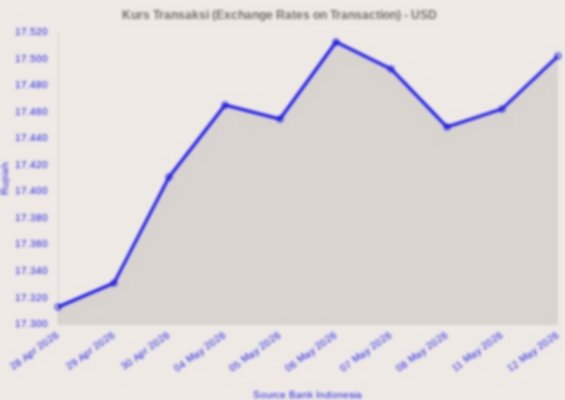
JAKARTA – Bank Indonesia (BI) has expressed strong confidence that the Rupiah will soon stabilize and trend toward appreciation, despite recent volatility. The central bank views the currency’s current correction—which has seen it cross the IDR 17,500 per US Dollar threshold—as a short-term phenomenon driven primarily by global pressures.
Ramdan Denny Prakoso, Head of the Communication Department at Bank Indonesia, stated that the primary drivers of the Rupiah’s recent weakness are external. Geopolitical tensions in the Middle East have pushed oil prices up by over 40%, while the United States’ monetary policy continues to exert pressure on global markets.
“Since late February 2026, currency movements worldwide have been heavily influenced by global dynamics, particularly the conflict in the Middle East,” Denny explained during a press briefing at the BI Complex in Jakarta on Wednesday, May 13, 2026.
In addition to geopolitical risks, the rising yield of the 10-year US Treasury, which has climbed toward 4.5% from 4% in February, has bolstered the US Dollar index. This surge has pressured various emerging market currencies, including the Philippine Peso, Thai Baht, Indian Rupee, and South Korean Won.
Domestically, the Rupiah has faced seasonal pressure due to high demand for US Dollars for dividend repatriations, foreign debt repayments, and the financial requirements of the Hajj season.
Despite these challenges, BI is implementing a robust strategy to ensure stability. “Bank Indonesia is fully aware of these conditions. We are strengthening seven strategic steps to ensure the Rupiah remains stable with an appreciative trend. Our economic fundamentals remain superior compared to many other nations,” Denny added.
Indonesia’s economic foundation remains resilient, evidenced by a high Q1 growth rate of 5.61%. Furthermore, inflation is well-managed at 3.48%, remaining within the target range of 2.5% plus or minus 1%.
To maintain this stability, BI is active across global markets. “We are present in the market around the clock. When the Jakarta market closes, we stand by in the European and US markets to monitor Non-Deliverable Forward (NDF) transactions and ensure the Rupiah stays stable,” Denny emphasized.
The seven-step strategic plan, instructed by President Prabowo Subianto, is being executed with maximum synergy across various government agencies. Earlier, BI Governor Perry Warjiyo met with President Prabowo at the State Palace to discuss the currency’s trajectory.
The first of these steps involves aggressive intervention in the domestic spot market, Domestic Non-Deliverable Forwards (DNDF), and offshore NDF markets in financial hubs like Hong Kong, Singapore, London, and New York. BI maintains that foreign exchange reserves are more than sufficient to support these operations.
Secondly, BI is utilizing Bank Indonesia Rupiah Securities (SRBI) to attract capital inflows, countering outflows from Government Securities (SBN) and stocks. “While SBN and stocks have seen year-to-date outflows, SRBI has successfully recorded IDR 78.1 trillion in inflows, which helps strengthen the exchange rate,” Perry Warjiyo noted.
The third step involves the continued purchase of SBN in the secondary market, with BI having purchased IDR 123.1 trillion year-to-date. Fourthly, BI and the Ministry of Finance are ensuring ample banking liquidity, reflected in double-digit growth of the primary money supply.
The fifth measure tightens the restriction on dollar purchases without underlying transactions, lowering the limit from $100,000 to $50,000 per person per month, with plans to further reduce it to $25,000. Simultaneously, BI is strengthening Local Currency Transactions (LCT) with the Chinese Yuan to diversify away from the US Dollar.
Sixth, domestic banks are now permitted to sell NDFs in offshore markets to increase supply and enhance stabilization. Finally, BI has intensified supervision of corporations and banks with high dollar demand, coordinating closely with the Financial Services Authority (OJK).
During a Financial System Stability Committee (KSSK) press conference, Governor Perry Warjiyo described these efforts as an “all-out” commitment. “This is not business as usual. These seven steps represent an all-out effort to protect the Rupiah,” he declared.
The central bank’s aggressive intervention did lead to a slight decrease in foreign exchange reserves, which stood at $146.2 billion in April 2026, down from $148.2 billion in March. However, Perry reassured the public that reserves are intentionally built up during periods of high inflow to be utilized during “lean” periods of capital outflow.
“The Rupiah is currently undervalued,” Perry concluded, pointing to Indonesia’s 71 consecutive months of trade surplus since May 2020 and robust GDP growth. “There is significant room for the currency to stabilize and strengthen based on our solid economic data.”
Summary
Bank Indonesia remains optimistic that the Rupiah will soon stabilize and appreciate despite recently crossing the threshold of IDR 17,500 per US Dollar. The central bank attributes the current volatility to external factors, including geopolitical tensions in the Middle East and rising US Treasury yields. Despite these pressures, Indonesia’s economic fundamentals remain resilient with a high first-quarter growth rate of 5.61% and well-managed inflation.
To ensure currency stability, the central bank is implementing seven strategic measures, including aggressive market interventions and the use of Rupiah Securities to attract capital inflows. BI has also tightened restrictions on dollar purchases and is strengthening local currency transactions with international partners. Officials maintain that foreign exchange reserves remain sufficient to support these stabilization efforts and protect the undervalued currency.