
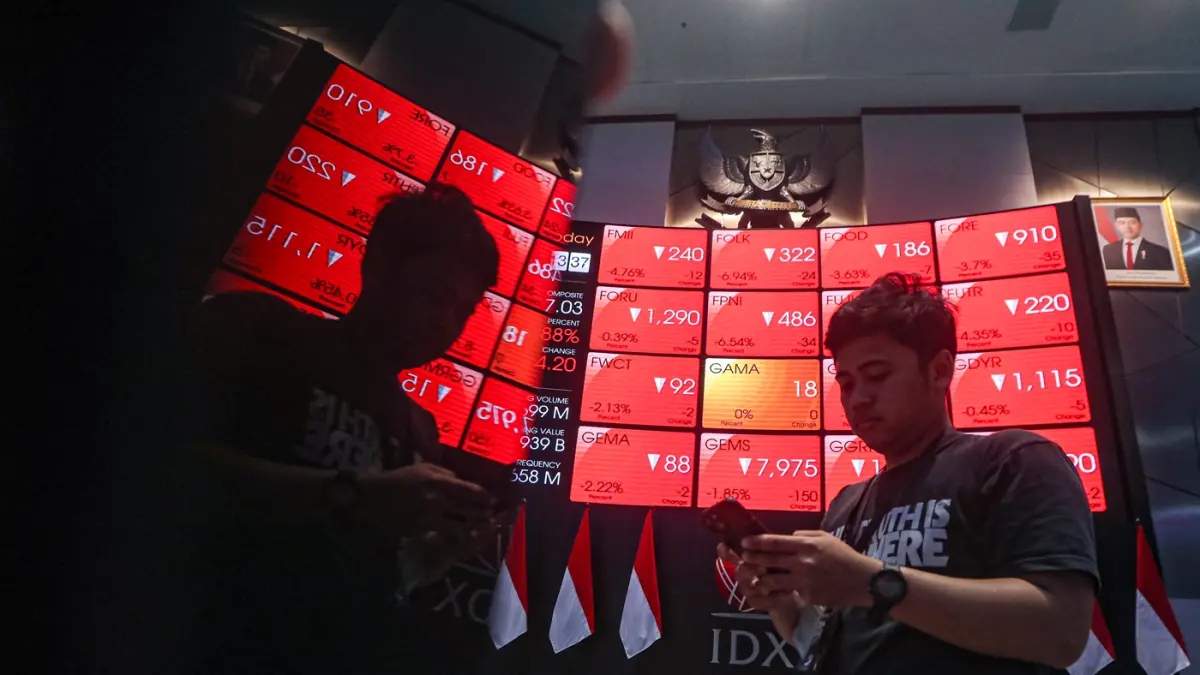

The Indonesia Stock Exchange (IDX) experienced a significant downturn during Tuesday’s (19/5) trading session, with the Jakarta Composite Index (IHSG) closing down by 228.56 points, or 3.46 percent, at the 6,370.68 mark. This bearish trend was mirrored by the LQ45 index, which tracks the 45 most liquid stocks, as it shed 16.27 points (2.50 percent) to end at 634.82.
The sharp decline was primarily fueled by market jitters surrounding rumors that the government plans to establish a dedicated agency to regulate the export of strategic commodities. Ratna Lim, Head of Research at Phintraco Sekuritas, noted that the sell-off intensified as word spread about a state-formed body designed to manage exports. According to reports from Antara, the commodities rumored to fall under this new regulatory umbrella include coal, Crude Palm Oil (CPO), and metallic minerals.
“This has sparked concern among investors regarding potential price controls, which could ultimately erode corporate profit margins,” Ratna explained. The market is particularly sensitive to regulatory shifts that might impact the profitability of Indonesia’s major commodity exporters.
Adding to the market’s cautious stance is the scheduled appearance of President Prabowo Subianto at the House of Representatives (DPR) Plenary Meeting on Wednesday (20/5). The President is set to deliver a speech on the Macroeconomic Framework and Fiscal Policy Principles (KEM-PPKF) for the 2027 Fiscal Year. This marks a significant departure from tradition, as the KEM-PPKF document is typically presented by the Minister of Finance rather than the Head of State.
Simultaneously, investors are bracing for the outcome of the Bank Indonesia (BI) Board of Governors’ Meeting, also due for announcement on Wednesday. Market consensus suggests that the central bank may raise the BI Rate by 25 basis points to 5 percent in a strategic move to stabilize the Rupiah against global pressures. Despite the market volatility, credit growth for April is projected to rise to 9.7 percent year-on-year (yoy), up from 9.49 percent in March 2026.
The IHSG remained firmly in the red from the opening bell through to the final closing. Sectoral data from IDX-IC revealed a universal decline across all eleven sectors. The basic materials sector took the hardest hit, plunging 7.54 percent, followed closely by the energy and transportation & logistics sectors, which dropped 6.89 percent and 6.60 percent, respectively.
In terms of individual stock performance, the top gainers of the day included LCKM, RELI, ASPR, UDNG, and CINT. Conversely, the stocks facing the steepest declines were DSNG, ELPI, TAPG, ICON, and DFAM. Total trading activity reached 2,804,569 transactions, involving 46.07 billion shares valued at Rp25.80 trillion. The day’s breadth was decidedly negative, with 612 stocks declining, only 112 advancing, and 94 remaining unchanged.
The downturn in Jakarta contrasted with a mixed performance across regional Asian markets. While Japan’s Nikkei edged down 75.45 points (0.12 percent) to 60,740.50, other major indices found support. The Hang Seng rose 122.67 points (0.48 percent) to 25,797.85, the Shanghai Composite climbed 38.01 points (0.92 percent) to 4,169.54, and the Straits Times Index in Singapore surged 75.59 points (1.51 percent) to close at 5,072.34.
Summary
The Jakarta Composite Index (IHSG) dropped 3.46% to close at 6,370.68 on Tuesday, driven by investor fears over rumors of a new government agency to regulate coal, CPO, and metallic mineral exports. Market analysts suggest that these potential export controls sparked concerns regarding reduced corporate profit margins, leading to a broad sell-off across all eleven industrial sectors. The basic materials, energy, and transportation sectors experienced the most significant declines during the trading session.
Market sentiment remains cautious ahead of President Prabowo Subianto’s upcoming speech on fiscal policy and the highly anticipated Bank Indonesia meeting, where a potential interest rate hike is expected. While Indonesian stocks faced widespread losses, regional Asian markets showed mixed results. Despite the volatility, total trading volume remained high, with over 46 billion shares exchanged as investors processed the looming regulatory and macroeconomic shifts.