
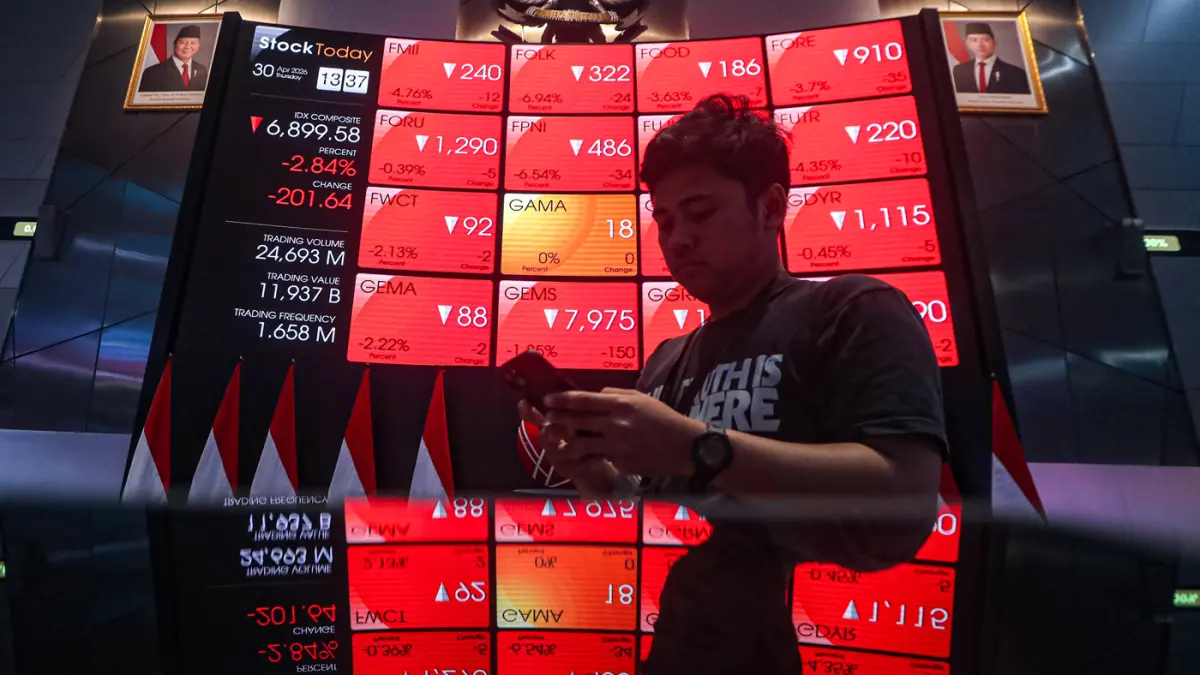

Flooring Guide by Cinvex — The Indonesia Stock Exchange (IDX) Composite Index (IHSG) closed sharply lower on Thursday, dragged down by heavy losses in the basic materials and energy sectors.
The index plummeted by 223.56 points, or 3.54 percent, settling at 6,094.94. Similarly, the LQ45 index, which tracks the 45 most liquid stocks, fell by 14.28 points, or 2.26 percent, to 616.40.
According to Lionel Priyadi, Fixed Income and Macro Strategist at PT Mega Capital Indonesia, the primary catalyst for the market rout was the government’s plan to centralize commodity exports through a state-owned enterprise (BUMN). This proposal has triggered negative sentiment among both domestic and international investors, who fear it could negatively impact corporate performance and shareholder value.
Market participants are closely watching the upcoming government regulation regarding the governance of natural resource commodity exports, which includes provisions to designate a specific BUMN as the sole exporter for strategic commodities. This anxiety has been compounded by the formation of PT Danantara Sumberdaya Indonesia (DSI), a new entity tasked with overseeing exports in the natural resources sector.
Market Reaction: IHSG Plummets Following BUMN Export Agency Formation; Purbaya Urges Calm Amid Uncertainty
PT DSI operates under the Danantara Investment Management Agency (BPI) and is mandated to strengthen the governance of exports for strategic commodities, including crude palm oil (CPO), coal, and ferroalloys. The government claims this initiative is necessary to combat under-invoicing practices in commodity exports, which it estimates have cost the state Rp15,400 trillion over the past 34 years.
The negative sentiment took hold early in the trading session, with the IHSG remaining firmly in the red throughout both the morning and afternoon sessions. The broader market correction was reflected in the IDX-IC sectoral indices, where all eleven sectors recorded declines. The basic materials sector suffered the steepest drop at 6.96 percent, followed by the energy sector at 6.74 percent and the non-cyclical consumer goods sector at 5.70 percent.
Despite the overall market downturn, some stocks managed to buck the trend, with SOTS, BOBA, ENAK, APLI, and KOBX leading the gainers. Conversely, BUKK, IRSX, ENRG, POLU, and RAJA saw the most significant price declines.
The trading volume was substantial, with 2,145,783 transactions recorded, involving 35.77 billion shares valued at Rp18.49 trillion. Market breadth remained weak, with only 88 stocks advancing, 663 declining, and 69 remaining unchanged.
Regional market performance showed mixed results. While Japan’s Nikkei index climbed 1,853.59 points, or 3.10 percent, to 61,658.00 and the Singapore Strait Times index edged up 0.02 percent to 5,045.71, other Asian markets struggled. The Shanghai index fell 2.04 percent to 4,007.28, and the Hang Seng index dipped 1.03 percent to 25,386.52.
Summary
The Indonesia Stock Exchange (IHSG) closed significantly lower on Thursday, dropping 3.54 percent to 6,094.94. The decline was largely driven by heavy losses in the basic materials and energy sectors, with all eleven market sectors recording a downturn. Market sentiment was negatively impacted by government plans to centralize commodity exports through a new state-owned enterprise, PT Danantara Sumberdaya Indonesia.
Investors expressed concern that this centralization could negatively affect corporate performance and shareholder value. Despite the widespread market correction, trading volume remained high with over 35 billion shares exchanged. While regional performance was mixed, the domestic market struggled throughout the session as investors reacted to the policy uncertainty surrounding commodity export governance.