

Warning: This article contains distressing details.
As dawn breaks over Chaghcharan, the capital of Afghanistan’s Ghor Province, hundreds of men are already crowding the dusty town square.
Lining the roadsides, they wait in hope of a miracle. They are searching for any form of manual labor, desperate to earn enough for a single meal to bring home to their families.
However, the odds of finding work are tragically low.
Juma Khan, 45, has managed to find only three days of work in the last six weeks. His meager daily wages range from 150 to 200 Afghani (approximately $2 to $3).
“For three nights, my children have gone to sleep hungry. My wife cries, and so do my children,” he says.
“I have been reduced to begging my neighbors for loans just to buy flour. I live in constant fear that my children will starve to death.”
In today’s Afghanistan, Juma Khan’s suffering is a common reality rather than an isolated incident.
According to UN data, three-quarters of the Afghan population can no longer afford basic necessities. United Nations reports paint a bleak portrait of a nation grappling with rampant unemployment, a collapsing healthcare system, and a near-total withdrawal of international humanitarian aid.
Read also:
- ‘A very expensive disaster’ – The fate of countries in the Middle East and Africa intervened by the US military
- Pakistan attacks Afghanistan, ready to ‘destroy’ Taliban – What are the known facts?
Afghanistan is currently experiencing its highest levels of hunger in history. Approximately 4.7 million people—more than a tenth of the population—are estimated to be just one step away from mass starvation.
Ghor Province is among the hardest-hit regions.
For the men here, hope is a vanishing resource.
“I received a call telling me my children haven’t eaten in two days,” says Rabani, his voice trembling with emotion.
“I felt like ending my own life. But then I thought, how would that help my family? So, I am here, looking for work.”

Before he can even finish a sentence, Khwaja Ahmad breaks down in tears.
“We are starving. My older children have already died, so I must work to feed my family. But I am old, and no one wants to hire me,” he explains.
Nearby, a local bakery opens its doors. The owner begins distributing scraps of dry bread to the waiting crowd. Within seconds, the bread vanishes as men scramble to grab whatever small portion they can find.
Suddenly, a new commotion erupts. A man on a motorcycle arrives looking for a laborer to move bricks. Instantly, dozens of men surround him, desperately competing to offer their services.
During the two hours a BBC team monitored the site, only three men managed to secure work.

The devastating impact of high unemployment is visible in the surrounding settlements—clusters of dilapidated homes scattered across arid, brown hills set against the backdrop of the snow-capped Siah Koh mountains.
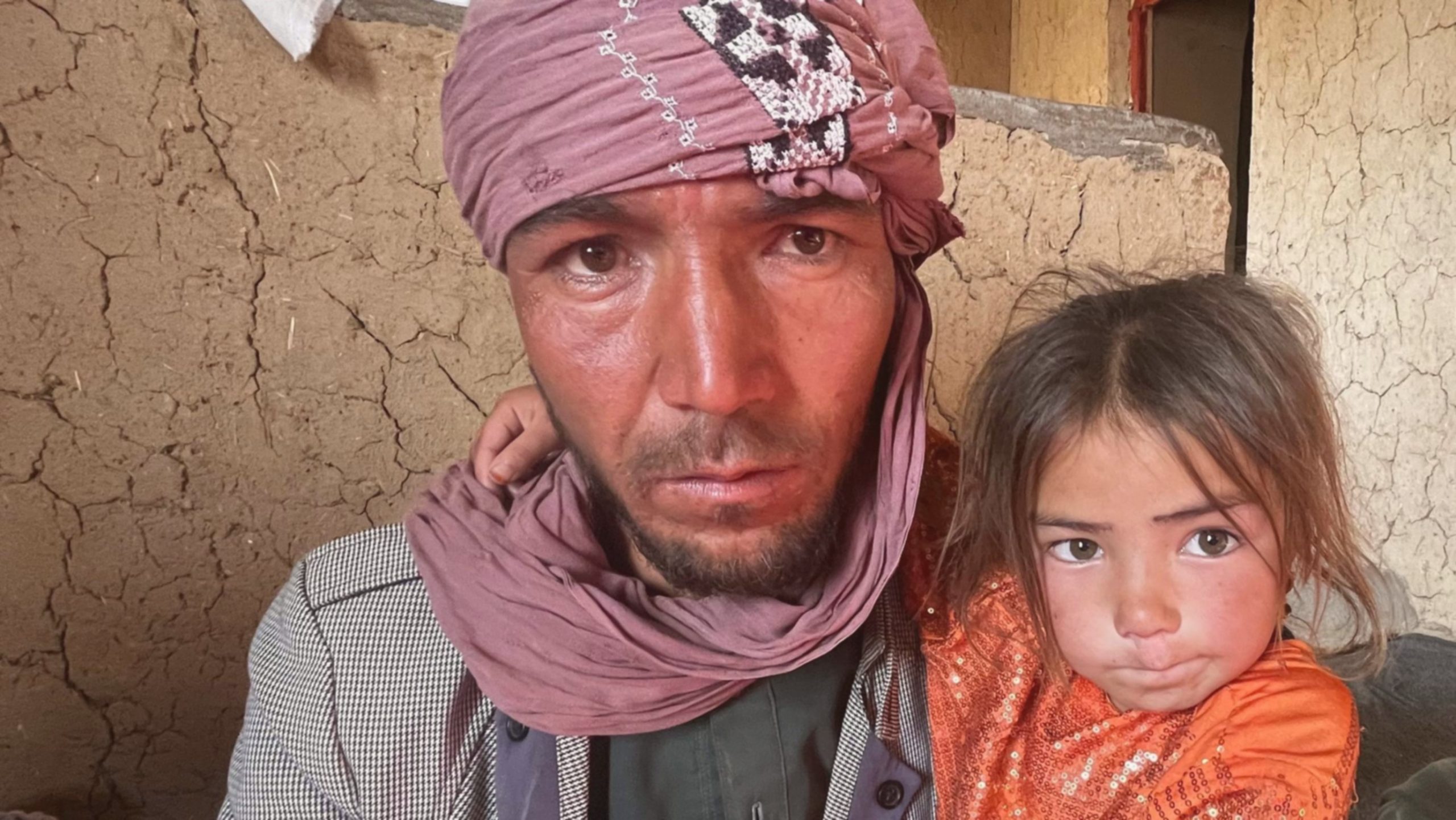
Abdul Rashid Azimi invites us into his home and brings out his two children—seven-year-old twins named Roqia and Rohila. Holding them close, he tries to stay strong while recounting a heartbreaking decision he feels forced to make.
“I am willing to sell my daughters,” he says through tears.
“I am poor, drowning in debt, and powerless. I return from work with parched lips, hungry, thirsty, and confused. My children come to me saying ‘Baba, give us bread.’ But what can I give them? Where is the work?”
Abdul admits he is preparing to give his daughters away for marriage or as domestic servants.
“If I sell one child, the money could support my other children for at least the next four years,” he explains. Sobbing, he kisses Rohila deeply. “My heart is breaking, but this is the only way out.”
“Our daily food is just bread and hot water; we don’t even have tea,” says their mother, Kayhan.
Her two teenage sons survive by working as shoe polishers in the city center, while another child collects trash for Kayhan to use as cooking fuel.
In another corner of the settlement, Saeed Ahmad shares another tragic story. He was forced to sell his five-year-old daughter, Shaiqa, after she was diagnosed with appendicitis and liver cysts.
“I had no money at all for medical expenses. So, I sold my daughter to a relative,” he says.
Shaiqa’s surgery was successful, paid for with the 200,000 Afghani (approximately $2,800) from her sale.
“If I had taken all the money then, she would have been taken away immediately. So I told the relative to give me enough for the surgery now, and the rest can be paid in installments over the next five years. Only after that can they take her,” Saeed explains.
Little Shaiqa wraps her small arms around her father’s neck. Their bond is palpable, yet in five years, she will have to leave her home forever.
“If I had the money, I would never have made this decision,” Saeed says quietly. “But I thought, what if she dies because she doesn’t have the surgery? At least this way, she stays alive.”

Just two years ago, Saeed still had access to some support. At that time, his family, like millions of other Afghans, regularly received food aid including flour, oil, beans, and nutritional supplements for children.
However, massive budget cuts to aid programs over the last few years have stripped away this crucial lifeline for the majority of society.
The United States, once the largest donor to Afghanistan, cut nearly all its aid last year. Many other major donors, including the UK, followed suit by significantly reducing their contributions. Recent UN data shows that aid received this year has plummeted by 70% compared to levels seen in 2025. This crisis is further exacerbated by extreme drought affecting more than half of the country’s provinces.
“We receive no help from anyone—not from the government, nor from NGOs,” laments a villager named Abdul Malik.
The Taliban government, which seized power in 2021, blames the previous Afghan administration for the collapse. “During 20 years of occupation, the economy was artificial, driven by the influx of US dollars,” Hamdullah Fitrat, a deputy Taliban spokesperson, told the BBC.
“After the occupation ended, all we were left with was poverty, misery, unemployment, and countless other problems.”
However, the Taliban’s own internal policies, particularly the severe restrictions on women’s rights, are the primary reason international donors have withdrawn their support. When questioned, the Taliban government refused to take responsibility for the departure of donors, asserting that “humanitarian aid should not be politicized.”
Fitrat highlighted Taliban plans “to eradicate poverty and create jobs through the implementation of large-scale economic projects,” citing ongoing infrastructure and mining initiatives. But for the millions currently on the brink of survival, long-term projects provide no relief for immediate hunger.
This tragic reality struck Mohammad Hashem, who lost his 14-month-old daughter just a few weeks ago.

“My child died from hunger and a lack of medicine… When a child is sick and starving, death is inevitable,” he says bitterly.
A local community leader noted that child mortality rates, largely driven by malnutrition, have “surged sharply” in the last two years. While official death records are non-existent in the region, cemeteries serve as silent witnesses to the tragedy.
Upon examining the local burial grounds, the evidence is staggering: the number of small graves for children is nearly double the number of adult graves—a stark indicator that children are dying at a far higher rate than adults.
Read also:
- Hundreds of thousands of Afghan girls banned from school by the Taliban
- ‘Our voices will not be silenced’ – Two sisters in Afghanistan defy the Taliban by singing in burqas
The sorrow continues at the provincial hospital in Chaghcharan. The neonatal unit is the busiest part of the facility. Every bed is full, with some holding two infants at once. Most are born with low birth weights, and many struggle just to breathe.
A nurse pushes a small cart carrying newborn twin girls born two months premature. One weighs 2 kilograms, while her sister weighs only 1 kilogram. Their condition is critical, requiring immediate oxygen support.
Their 22-year-old mother, Shakila, is recovering in the maternity ward. “She is very weak because, during her pregnancy, she had almost nothing to eat but bread and tea,” explains Gulbadan, the twins’ grandmother. “That is why my grandchildren are in this condition.”
Tragically, just hours after we left the hospital, the heavier twin passed away before she could even be named.
“The doctors tried their best to save her, but it was not meant to be,” the grandmother said the following day. “I wrapped her tiny body and took her home. When her mother found out, she fainted.”
Gulbadan points to the surviving twin. “I only hope that at least this one can survive,” she says.
Nurse Fatima Husseini reveals that there are dark days when three babies die in a single day. “At first, my heart broke every time I saw a child die. But now, it has become almost normal for us,” she says sadly.
Dr. Muhammad Mosa Oldat, head of the neonatal unit, states that the infant mortality rate there has climbed to 10%, a figure he calls “unacceptable.”
“Due to rampant poverty, the number of patients increases every day,” he explains. “Meanwhile, we lack the resources to care for these babies properly.”
The same scene plays out in the pediatric intensive care unit (ICU), where a six-week-old baby named Zameer is fighting meningitis and pneumonia. While both conditions are treatable, doctors need an MRI for proper diagnosis—a machine the hospital does not possess.
Furthermore, medical staff reveal that the state-run hospital lacks medicine for most of its patients. Families are forced to buy their own supplies from outside pharmacies. “Sometimes, if there is leftover medicine from a baby whose family is more affluent, we use it for babies whose families have nothing,” Fatima says.
The lack of funds eventually forces families into impossible choices. Gulbadan’s surviving grandchild initially showed improvement, but her family was eventually forced to take her home because they could no longer afford the costs associated with her hospital stay.
For the same reason, baby Zameer was also taken home by his parents. Now, these fragile lives must continue their struggle for survival outside the hospital walls, without any medical equipment to help them.
Imogen Anderson, Mahfouz Zubaide, and Sanjay Ganguly contributed to this report.
- ‘My three sons starved to death, I hope the angels take them home’ – Testimony of a mother who lost three children to malnutrition in Afghanistan
- Stories of women trapped in Afghanistan’s mental health system
- Fate of thousands of Afghans deported from Iran on accusations of spying for Israel
- Stories of young Afghan girls becoming carpet weavers after being banned from school by the Taliban
- Afghan women ‘banned from attending midwifery courses’ by the Taliban
- Famine strikes Afghanistan, 3.2 million babies suffer acute malnutrition – ‘It’s like the apocalypse’
Summary
Afghanistan is currently facing a catastrophic humanitarian crisis marked by extreme poverty and widespread starvation. In Ghor Province, desperate fathers are struggling to find work, often earning only enough for minimal food, while many others remain unemployed. This dire situation has forced some families to make heart-wrenching decisions, including selling their children into marriage or domestic servitude to afford basic necessities and medical care for their remaining family members.
The crisis is exacerbated by a 70% reduction in international aid and severe drought, leaving millions on the brink of mass starvation. Healthcare facilities are overwhelmed and under-resourced, resulting in soaring child mortality rates due to malnutrition and a lack of essential medicine. As international donors remain hesitant to support the Taliban-led government due to restrictive policies, families are left without a safety net, leading to devastating consequences for the nation’s most vulnerable population.