
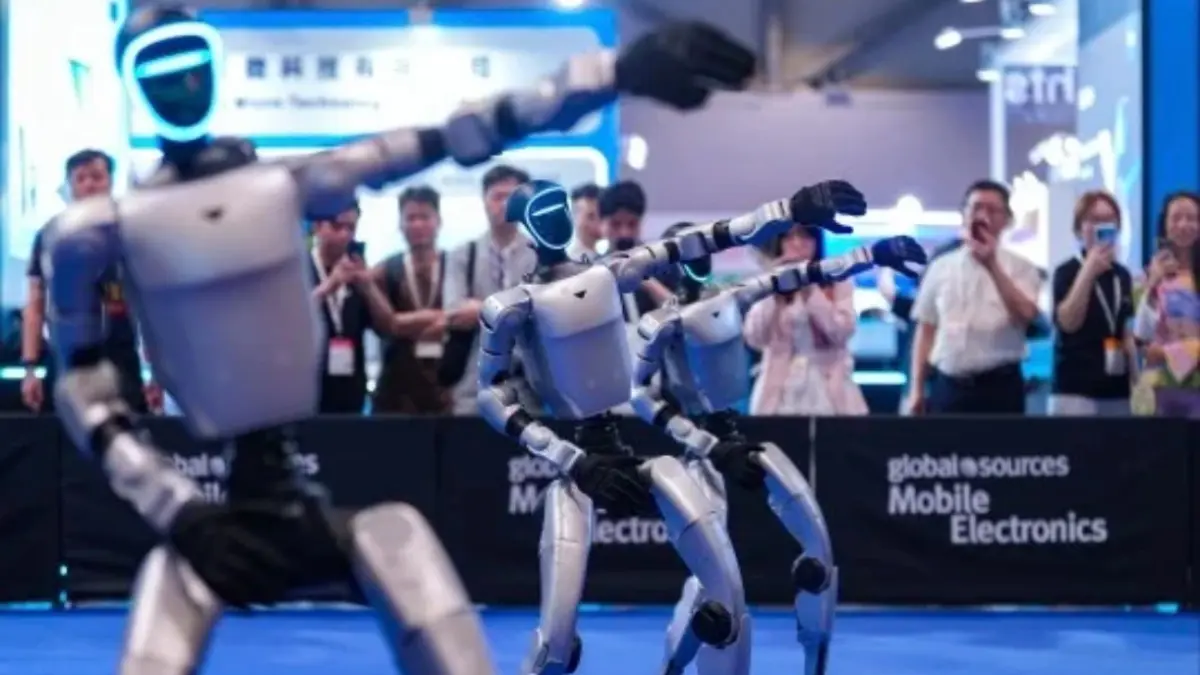

Flooring Guide by Cinvex — Unitree Robotics is moving closer to a major milestone in its journey toward a public listing on the Shanghai Stock Exchange. As the global race to dominate the artificial intelligence-driven humanoid robotics market intensifies—pitting emerging players against giants like Elon Musk’s Tesla—Unitree has officially cleared a critical hurdle in its initial public offering (IPO) process.
The Hangzhou-based company reached a pivotal turning point on Monday, June 1, 2026, after successfully passing its listing committee hearing. This achievement serves as a vital bridge toward entering the Shanghai capital market, signaling a new chapter for the high-tech manufacturer.
According to reports from the South China Morning Post on Tuesday, June 2, 2026, Unitree Robotics officially submitted its plan to list on Shanghai’s STAR Market on March 20. Following two rounds of rigorous regulatory review and on-site inspections, the committee’s approval paves the way for the company to move into the final registration and share issuance phases.
Unitree aims to raise 4.2 billion yuan (approximately 11.92 trillion rupiah) through this offering. The plan involves floating at least 40.4 million shares, representing a minimum of 10 percent ownership of the company.
Financially, Unitree has demonstrated strong operational efficiency during the early stages of the humanoid robot industry. While its annual revenue of 1.7 billion yuan last year landed slightly behind the Hong Kong-listed UBTech, Unitree reported the highest net profit among its direct competitors at 590.8 million yuan.
However, the company faced margin pressures in the first quarter of this year. Although revenue grew by 68 percent year-on-year to 422.8 million yuan, adjusted net profit saw a decline of over 52 percent, dropping to 40.3 million yuan from 84.8 million yuan in the same period last year. This dip has been attributed to surging research and development costs coupled with a cooling market sentiment toward the initial hype surrounding humanoid robotics.
To maintain its competitive edge, Unitree is doubling down on its investment in the “brains” of its robots, specifically developing World-Model-Action (WMA) and Vision-Language-Action (VLA) technologies. These advancements are designed to allow robots to better interpret their physical surroundings and translate human instructions into precise, adaptive actions.
The sector is becoming increasingly crowded as global heavyweights like Tesla’s Optimus project and various Chinese automotive and electronics firms pivot toward humanoid robotics. Morgan Stanley analyst Zhong Sheng noted that the wave of IPOs in the humanoid sector is likely to heighten market interest in robotics stocks, reflecting a significant uptick in investor attention toward this burgeoning field.
From a global perspective, UBS forecasts that shipments of humanoid robots will hit 30,000 units by 2026. Despite this growth, UBS analyst Phyllis Wang emphasized that significant challenges remain, stating, “AI brains and data limitations remain the primary hurdles. Meaningful mass production will require breakthroughs in both areas.”
Wang further added that the push for increased production capacity and integration will bolster demand for components, which remains a positive signal for firms within China’s supply chain. Even while true mass production of humanoid robots remains on the horizon, the underlying component market is expected to continue receiving a substantial boost.
Between rising global competition, the necessity for massive capital investment, and the race to refine physical AI, Unitree’s IPO is more than just a financial filing. It stands as a definitive marker that the humanoid robot race has transitioned from a futuristic experiment into a strategic, ongoing battle for dominance in the global technology landscape.
Summary
Unitree Robotics has successfully cleared a critical regulatory hurdle for its initial public offering on Shanghai’s STAR Market. The company plans to raise 4.2 billion yuan by offering at least 10 percent of its shares to the public. Despite reporting strong annual profits compared to its competitors, Unitree recently experienced a decline in quarterly net earnings due to increased research and development costs and shifting market sentiment.
To remain competitive in the intensifying global race for humanoid robotics, the company is prioritizing advanced artificial intelligence, including World-Model-Action and Vision-Language-Action technologies. While industry analysts acknowledge that significant challenges remain regarding AI integration and mass production, the sector continues to attract substantial investor interest. Unitree’s IPO underscores the transition of humanoid robotics from experimental technology into a highly strategic and competitive global industry.