
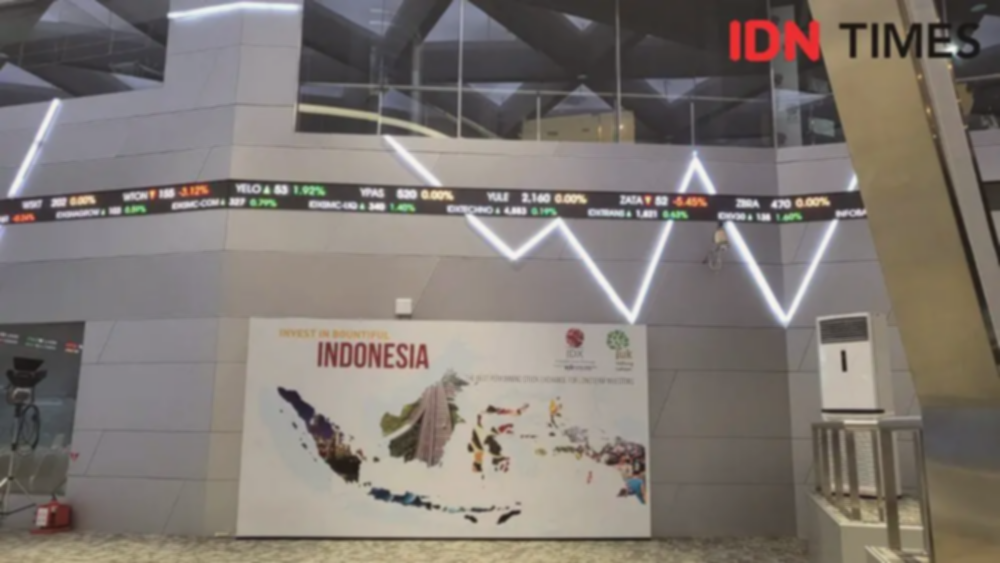
IHSG Battered During Midday Break, Plunges Nearly 5 Percent, Leaving 6,000 Level; Moody’s Assigns Baa2 Rating to Danantara Investment, Negative Outlook
The Jakarta Composite Index (IHSG) on the Indonesia Stock Exchange (BEI) experienced a significant downturn, plummeting by almost 5 percent at the close of the first trading session on Wednesday, June 3, 2026. Data from RTI Business revealed that the IHSG settled at 5,889.483, marking a sharp decline of 305.943 points, which translates to a 4.94 percent drop from its previous closing position.
During the first half of the trading day, stock transaction volume reached an impressive 26.375 billion shares, with a total transaction value hitting Rp14.891 trillion. The market also saw substantial activity, recording 1,798,806 individual transactions. This period was marked by widespread selling pressure, as 714 stocks weakened, while only 35 managed to strengthen. Another 64 stocks remained stagnant, reflecting the overall cautious sentiment. The IHSG’s market capitalization for this half-day stood at Rp10,357.197 trillion.
Several factors contributed to the IHSG’s sharp correction, creating a challenging environment for investors. A primary trigger was Moody’s Ratings’ decision to assign a Baa2 rating to Danantara Investment Management (DIM), accompanied by a negative outlook, which immediately sent ripples through the market. Concurrently, the weakening of the Indonesian rupiah against the US dollar also significantly hampered the index’s performance.
M Nafan Aji Gusta, Senior Technical Analyst at Mirae Asset Sekuritas, highlighted additional pressures. “Beyond the rupiah’s weakening against the US dollar, currently touching 17,922, the shrinking trade balance surplus in April 2026 to US$89.1 million—its lowest level in six years—signals a slowdown in external sector contributions, acting as a major impediment to the IHSG’s strengthening momentum,” he elaborated on Wednesday, June 3, 2026. Furthermore, he noted that market participants are closely monitoring and preparing for potential new volatility stemming from the FTSE Russell index rebalancing, scheduled to take effect on June 22, 2026.
Global dynamics also played a role in the market’s cautious stance. Escalating tensions between Washington and Tehran in recent weeks, coupled with Israeli military operations in Lebanon, threatened to disrupt existing ceasefires among the warring parties. On the domestic front, the highly anticipated release of the US Nonfarm Payrolls for May later this week is also keenly awaited, as it will likely influence expectations regarding the future direction of the Federal Reserve’s interest rates.
David Kurniawan, Equity Analyst at PT Indo Premier Sekuritas (IPOT), further explained the multifaceted pressures. He pointed to substantial capital outflow linked to the MSCI rebalancing, a current account deficit in Q1 2026 reaching US$4 billion (equivalent to 1.09 percent of GDP), and seasonal foreign exchange demand for dividend payments and foreign debt obligations in Q2. “Adding to these factors is the strengthening of the US dollar, primarily driven by the Federal Reserve’s persistently hawkish stance,” he stated in his remarks, also quoted on Wednesday, June 3, 2026.
As June 2026 progresses, investor attention is expected to shift from the immediate impact of the MSCI rebalancing towards the authorities’ capability to maintain rupiah stability and restore crucial foreign investor confidence. David Kurniawan emphasized that exchange rate stability will be the most critical factor in determining the future direction of the market.
Despite Bank Indonesia’s proactive measure of raising interest rates to 5.25 percent to mitigate external pressures, the market remains watchful, eager to assess whether this policy will prove sufficiently effective in curbing rupiah volatility and stemming further capital outflow. If the rupiah can demonstrate signs of stabilization in the coming weeks, market sentiment has the potential to improve significantly, creating an opportune environment for the return of foreign funds to both domestic stock and bond markets.
Beyond domestic influences, the direction of the United States’ monetary policy is also a central concern for market participants. The Federal Open Market Committee (FOMC) meeting in mid-June is poised to be the most significant catalyst for the month. Investors will be closely scrutinizing any new signals regarding the future path of US interest rates and the overall inflation outlook.
David Kurniawan concluded that a continued hawkish stance from the Federal Reserve could potentially sustain the strength of the US dollar, thereby limiting capital flows towards emerging markets like Indonesia. Conversely, if there are indications that inflationary pressures are beginning to subside and the likelihood of interest rate cuts increases in the second half of the year, risk assets, including the Indonesian stock market, could benefit from a significant positive sentiment boost.
Summary
The Jakarta Composite Index (IHSG) plummeted by almost 5 percent, closing at 5,889.483 on June 3, 2026, amidst widespread selling pressure. This sharp decline was primarily triggered by Moody’s Ratings assigning a Baa2 rating with a negative outlook to Danantara Investment Management, alongside a weakening Indonesian rupiah against the US dollar. Other contributing factors included a shrinking trade balance surplus, substantial capital outflows linked to MSCI rebalancing, and a current account deficit.
Global dynamics, such as escalating geopolitical tensions and the strengthening US dollar driven by the Federal Reserve’s hawkish stance, also exerted significant pressure. Investors are now closely monitoring the upcoming FOMC meeting for signals on US monetary policy, which heavily influences emerging markets. The market’s future direction hinges critically on the authorities’ capability to maintain rupiah stability and restore crucial foreign investor confidence.