
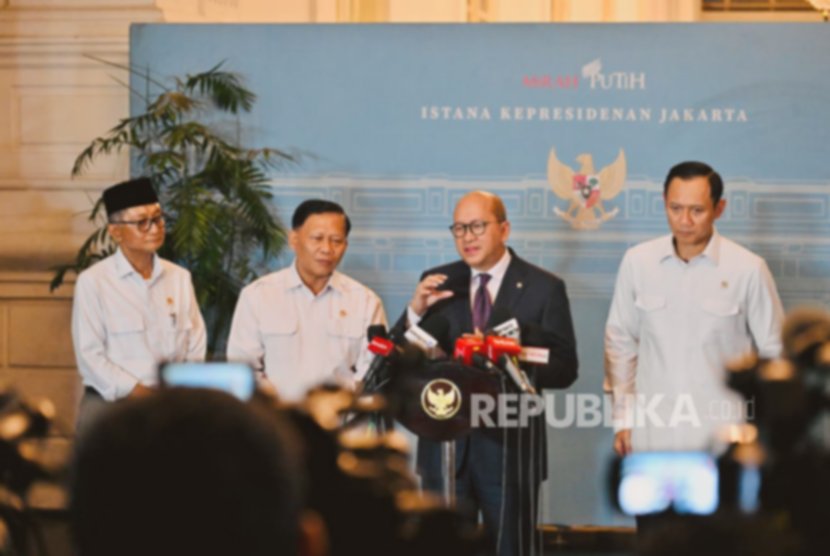

JAKARTA – Danantara Indonesia is actively exploring strategic investment opportunities, including the potential acquisition of stakes in foreign-owned entities to bolster the nation’s economic landscape. Chief Executive Officer (CEO) Rosan Roeslani confirmed the organization’s openness to such moves, addressing reports regarding Danantara’s potential interest in acquiring shares held by French mining giant Eramet in PT Weda Bay Nickel (WBN), located in North Maluku. According to Roeslani, Danantara remains prepared to forge strategic alliances and execute corporate actions that align with national interests.
“We are fundamentally open to discussions and negotiations regarding investments within Indonesia. Danantara is positioned to serve as a strong local partner,” Roeslani stated at the Presidential Palace Complex in Jakarta on Tuesday, May 12, 2026.
He clarified that current talks are still in the preliminary stages, with no final decision yet reached concerning the acquisition plan. Roeslani expressed optimism that Danantara’s involvement would significantly strengthen Indonesia’s position in various National Strategic Projects. “We are open. We are indeed in discussions with Eramet,” he added.
This initiative follows statements made in 2025 by Eramet Indonesia CEO Jerome Baudelet, who noted that strategic investment cooperation in the nickel sector was being intensively discussed with both Danantara and the Indonesia Investment Authority (INA). The three entities have been exploring the formation of a strategic investment platform covering the entire nickel value chain, from upstream mining to downstream processing.
Pandu Sjahrir, Chief Investment Officer (CIO) of Danantara, previously noted that this collaboration aims to develop a sustainable and integrated electric vehicle (EV) battery ecosystem in Indonesia. Under this partnership, Danantara and INA are expected to manage long-term financing to support investment growth, while Eramet provides technical expertise and a proven track record in managing large-scale mining projects that adhere to international sustainability standards.
Strategic investment is viewed as a primary catalyst for achieving Indonesia’s ambitious eight percent economic growth target amidst global uncertainty and geopolitical tensions. “Investment plays a significant role, contributing approximately 1.79 percent to the overall economic growth of 5.61 percent,” Roeslani explained during the Kadin Monthly Economic Diplomatic Breakfast in Jakarta.
During the first quarter of 2026, the Indonesian economy grew by 5.61 percent, with investment accounting for 31-32 percent of the total national economic growth. This figure represents a notable increase compared to previous periods, where the contribution typically hovered between 27 and 28 percent. While domestic consumption remains the primary driver of the economy, investment has solidified its position as the second-largest contributor.
To reach the eight percent growth milestone, the government is pushing for a significant surge in investment realization. The target for 2026 has been set at $123.7 billion. Looking further ahead, the government aims for a total investment realization of approximately $789.9 billion over the next five years, a substantial jump from the $552.6 billion achieved between 2014 and 2024.
“To reach that eight percent growth, we must hit the $789.9 billion mark over the next five years. This is achievable if we all work together through collaboration and synergy,” Roeslani remarked. He noted that in Q1 2026 alone, investment realization reached $30.2 billion, creating roughly 706,659 jobs. Singapore remains Indonesia’s largest source of Foreign Direct Investment (FDI), followed by Hong Kong, China, the United States, Japan, South Korea, and the Netherlands.
A significant portion of national investment—approximately 30 percent—is currently driven by the downstreaming (hilirisasi) program, particularly in the mineral and energy sectors. Consequently, the government is expanding these efforts into other industries, including forestry, oil and gas, fisheries, maritime sectors, and agricultural commodities.
Highlighting Indonesia’s resource wealth, Roeslani pointed out that the country holds approximately 42 percent of the world’s nickel reserves, providing a massive opportunity to increase value through industrial processing. “Why do we focus on downstreaming nickel? Because 42 percent of global reserves are here. When you look at bauxite and copper, we also rank second in the world,” he concluded. This downstreaming strategy is designed not only to boost commodity exports but also to enhance the added value of national industries and strengthen Indonesia’s economic resilience on the global stage.
Summary
Danantara Indonesia is exploring strategic investment opportunities, including potential acquisitions of foreign-owned entities, to strengthen the national economy. CEO Rosan Roeslani confirmed openness to such moves, specifically addressing reports of Danantara’s interest in acquiring shares of French giant Eramet in PT Weda Bay Nickel. Danantara aims to act as a strong local partner, fostering alliances and corporate actions that align with national interests. Discussions with Eramet are in preliminary stages, with optimism that Danantara’s involvement will enhance Indonesia’s position in National Strategic Projects and support the development of a sustainable electric vehicle battery ecosystem.
Strategic investment is identified as a key driver for achieving Indonesia’s economic growth targets, aiming for eight percent growth amidst global uncertainties. Investment contributed significantly to the 5.61 percent economic growth in Q1 2026, solidifying its role as the second-largest economic contributor after domestic consumption. To reach the eight percent growth milestone, Indonesia targets $123.7 billion in investment realization for 2026 and approximately $789.9 billion over the next five years. A significant portion of national investment, around 30 percent, is driven by the downstreaming program, particularly in minerals and energy, with plans to expand this strategy to other sectors to enhance national industrial added value and economic resilience.