
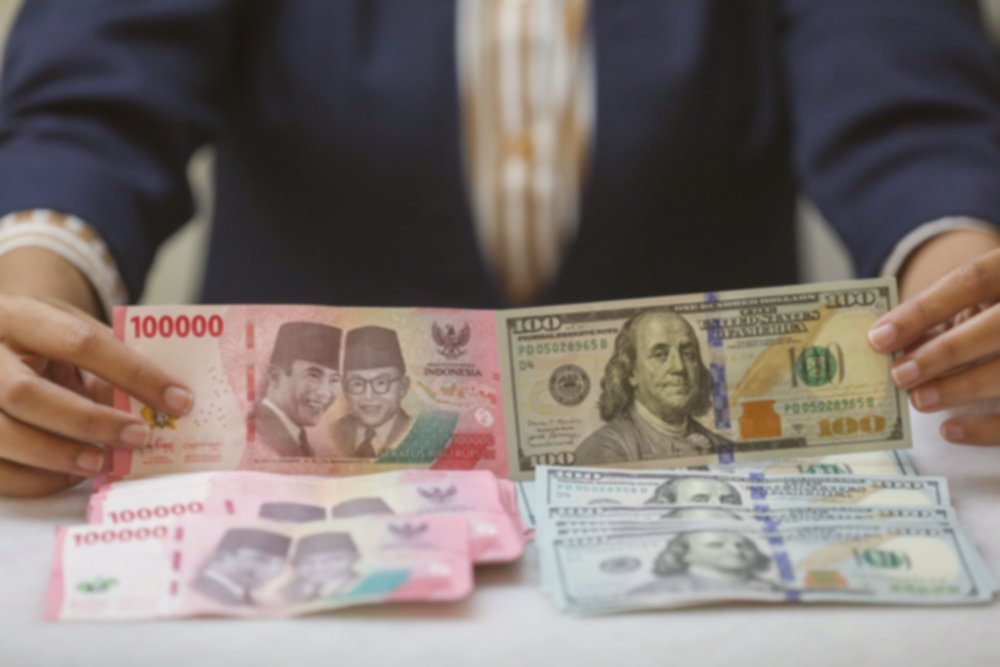
The Indonesian Rupiah’s depreciation, now widely considered to have overshot its fundamental value, is poised to trigger significant ripple effects across the nation’s real sector. According to data from Bank Indonesia’s Jakarta Interbank Spot Dollar Rate (Jisdor), the rupiah stood at Rp17,789 per US dollar on Tuesday, May 26, 2026. This weakening currency presents formidable challenges for businesses, exacerbated by Bank Indonesia’s recent decision to raise its benchmark interest rate, the BI Rate, by 50 basis points to 5.25% in its May 2026 Board of Governors meeting.
Fakhrul Fulvian, Chief Economist at Trimegah Sekuritas Indonesia, highlighted the concurrent “double pressure” businesses are currently enduring. He explained, “On one hand, the weakening rupiah inflates the costs of imported raw materials, energy, machinery, and logistics. On the other, the hike in interest rates and high yields drive up financing costs.” This creates a challenging economic landscape where companies face escalating operational expenses from multiple directions.
However, not all sectors are responding to the rupiah’s depreciation in the same manner. Export-oriented commodity sectors, for instance, are finding an unexpected advantage. Their US dollar-denominated revenues provide a natural hedge against the local currency’s decline, allowing them to book profits and potentially thrive amidst the volatility.
Conversely, domestic-oriented sectors face a much tougher outlook. Fakhrul elaborated that the combined burden of increased import costs and the elevated cost of funds is severely straining several key industries. He pointed to the manufacturing sector, heavily reliant on imported raw materials and machinery, as well as the property and construction sectors, which are particularly sensitive to interest rate fluctuations. The retail industry and businesses with high debt-to-equity ratios are also feeling intense pressure from these adverse economic conditions.
Should these conditions persist for an extended period, the implications for companies could be severe. Fakhrul warned that businesses would not only contend with squeezed profit margins but also begin to curb expansion plans, scale back investments, and adopt a more defensive stance towards hiring new employees. This conservative approach could stifle growth and broader economic activity.
Beyond individual companies, the specter of an investment slowdown looms large over the national economy. While foreign investors still perceive Indonesia as a market with significant long-term potential, the surge in the cost of capital, driven by high bond yields and currency volatility, could compel them to defer planned capital injections. Investors, Fakhrul noted, might tolerate elevated interest rates temporarily, but they are highly averse to prolonged periods of uncertainty, which undermine confidence and hinder decision-making.
In navigating this environment of policy uncertainty and global volatility, Fakhrul advises businesses to pivot towards more defensive strategies to bolster operational resilience, rather than pursuing aggressive expansion. He outlined four critical areas for company management to prioritize. Firstly, maintaining positive cash flow is paramount to ensure day-to-day operations remain viable. Secondly, strengthening the company’s liquidity position provides a crucial buffer against unforeseen shocks. Thirdly, management should actively work to reduce currency mismatches between their liabilities and revenues, mitigating foreign exchange risks. Lastly, businesses are strongly cautioned against taking on excessive foreign currency-denominated debt during periods of intense exchange rate turbulence.
Despite the seemingly bleak outlook, Fakhrul maintains that this overshooting phase doesn’t completely eliminate opportunities for profit. In fact, he believes it could present a golden chance for financially healthy companies to accumulate assets at more rational valuations. As he concluded, “Every overshooting phase typically also creates asset accumulation opportunities for prepared businesses.” This perspective offers a glimmer of optimism, suggesting that strategic and well-capitalized firms might yet find ways to thrive in a challenging market.
Summary
The Indonesian Rupiah’s depreciation to Rp17,789 per US dollar, coupled with Bank Indonesia’s 50 basis point interest rate hike to 5.25%, creates a “double pressure” for businesses. This scenario inflates costs for imported raw materials and logistics due to the weak rupiah, while simultaneously raising financing costs because of higher interest rates. Domestic-oriented sectors like manufacturing, property, and retail face significant strain, although export-oriented commodity sectors benefit from their US dollar-denominated revenues.
Should these conditions persist, companies could experience squeezed profit margins, reduced expansion, and an investment slowdown as foreign investors defer capital injections. Businesses are advised to adopt defensive strategies, focusing on maintaining positive cash flow, strengthening liquidity, and reducing currency mismatches. Despite the challenges, financially robust companies might find opportunities for asset accumulation at rational valuations during this market overshooting phase.