
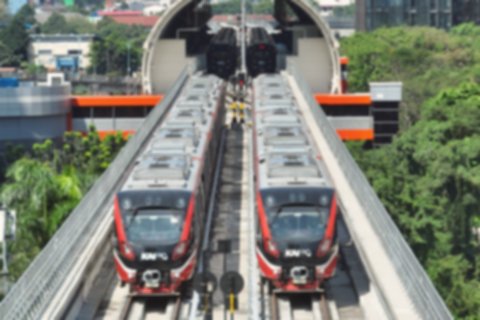

The weakening of the Jakarta Composite Index (IHSG) and the Indonesian rupiah stood out as key topics for kumparanBISNIS readers throughout Friday, May 22. Additionally, KAI’s ongoing feasibility study regarding the LRT extension to Bogor captured significant attention. Below is a summary of these market and infrastructure developments.
Market Overview: IHSG and Rupiah Performance
The Jakarta Composite Index (IHSG) opened with a notable decline on Friday, May 22, dropping 2.02 percent—a loss of 122 points—to settle at 5,972. This downturn occurred despite a generally bullish trend across most other major Asian stock markets.
Currency markets reflected a similar trend, with the Indonesian rupiah weakening against the US dollar. Bloomberg data indicates that the currency fell by 47 points, or 0.27 percent, reaching 17,714 per US dollar. In the precious metals sector, the price of gold from PT Aneka Tambang Tbk (Antam) fell by 12,000 to 2,788,000 per gram, with a buyback price set at 2,592,000 per gram. Conversely, Galeri24 gold prices saw an increase, rising to 2,788,000 per gram from the previous 2,756,000, with a buyback price of 2,615,000 per gram.
KAI Explores LRT Expansion to Bogor
PT Kereta Api Indonesia (KAI), in collaboration with the Ministry of Transportation’s Directorate General of Railways (DJKA), is currently evaluating the feasibility of extending the LRT line to Bogor, with a proposed terminus in the Baranangsiang area. This study seeks to justify the substantial investment costs by analyzing projected passenger growth and the potential for Transit Oriented Development (TOD) in the region.
I Gede Darmayusa, Director of Portfolio Management and Information Technology at KAI, noted that the Bogor line currently accounts for approximately 50 percent of the 1.1 million daily passengers served by KAI Commuter. Beyond the LRT extension, KAI is exploring additional rail projects, including expanding KRL tracks toward Sukabumi and constructing emplacement 678 in Bogor. These infrastructure enhancements are expected to increase daily capacity by roughly 80 train sets.
Furthermore, KAI is carefully weighing the operational differences between transport modes; a 12-carriage KRL train offers double the carrying capacity of a four-carriage LRT set. These strategic assessments underscore KAI’s ongoing commitment to reducing congestion and enhancing passenger comfort along the high-traffic Bogor Line.
Summary
The Jakarta Composite Index (IHSG) experienced a significant decline on May 22, dropping 2.02 percent to 5,972, while the Indonesian rupiah weakened against the US dollar by 0.27 percent to 17,714. Market volatility was also evident in the precious metals sector, where Antam gold prices saw a decrease, though Galeri24 gold prices experienced a slight increase. These figures contrast with the generally positive performance observed in other major Asian stock markets during the same period.
PT Kereta Api Indonesia (KAI) is currently conducting a feasibility study on extending the LRT line to the Baranangsiang area in Bogor to address heavy commuter traffic. The project aims to justify infrastructure costs by evaluating passenger growth and Transit Oriented Development (TOD) potential, while also considering the capacity differences between LRT and KRL systems. Alongside this study, KAI is exploring additional track expansions to Sukabumi and improvements to the Bogor emplacement to increase overall rail capacity.