
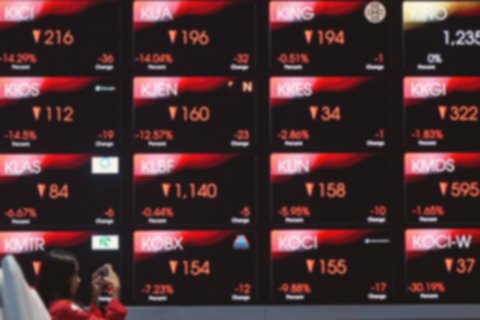
The Indonesia Stock Exchange (BEI) reported a challenging performance for the Composite Stock Price Index (IHSG) during the week of May 11-13, 2026. The key barometer of Indonesia’s equity market concluded the period at 6,723.320, marking a notable 3.53 percent decline from its previous week’s close of 6,936.396.
This significant dip in the IHSG was mirrored by a decrease in overall market capitalization. Kautsar Primadi Nurahmad, the Corporate Secretary of BEI, confirmed that market capitalization dropped by 4.68 percent, settling at Rp 11,825 trillion, down from Rp 12,406 trillion in the preceding week.
Delving deeper into trading activity, the average daily transaction frequency also experienced a slight adjustment. It decreased by 0.56 percent, recording 2.53 million transactions compared to 2.55 million transactions a week earlier, as Kautsar explained in a statement released on Saturday (May 16).
Furthermore, market liquidity indicators revealed a more pronounced shift. The average daily transaction value saw a substantial reduction of 18.78 percent, falling to Rp 18.82 trillion from Rp 23.05 trillion previously. Concurrently, the average daily transaction volume also declined by 22.01 percent, reaching 35.76 billion shares compared to 45.86 billion shares in the prior week.
Adding to the market’s headwinds, foreign investors registered a net sell of Rp 1.531 trillion on that day alone. This activity contributed to a year-to-date net sell by foreign investors totaling Rp 40.823 trillion for 2026, Kautsar further elaborated.
Amidst these market fluctuations, on Wednesday (May 13), BEI, in collaboration with PT Kliring Penjaminan Efek Indonesia (KPEI), PT Kustodian Sentral Efek Indonesia (KSEI), and the Financial Services Authority (OJK), provided a crucial update on the developments within the Indonesian capital market concerning the MSCI index rebalancing.
The BEI firmly asserted that domestic stock trading continues to operate in a controlled manner, with no indications of panic selling. Kautsar underscored that market stability remains evident through the relatively consistent transaction frequency and volume, even when navigating dynamic global market conditions.
He clarified that the current market weakening is largely perceived as an anticipated and natural adjustment within global investor portfolios. Importantly, this period also presents unique opportunities for investors, as stock valuations have become more attractive compared to their levels at the start of the year.
Addressing the recent exit of several listed companies from the MSCI Global Small Cap index, BEI views this development as a reflection of the potential for increased market capitalization among the affected issuers. However, any potential promotion to higher indices is currently delayed due to MSCI’s policy freeze on adding new constituents from Indonesia.
Despite these ongoing challenges, Kautsar emphasized the robust commitment from both regulators and market participants to continuously enhance market transparency, governance, and integrity. This dedicated effort aims to ensure that Indonesian listed companies remain fiercely competitive within global indices.
Further bolstering confidence, Jeffrey Hendrik, the Acting President Director of BEI, characterized MSCI’s latest statement as a positive development. He highlighted its potential to alleviate an element of market uncertainty, particularly given the high global volatility currently influenced by geopolitical turmoil, fluctuating commodity prices, and currency movements.
Jeffrey conveyed optimism that this newfound certainty will establish a solid foundation for the future growth of Indonesia’s capital market, fostering stronger collaboration among all market participants and issuers.
The findings from the MSCI Review in May 2026, coupled with insights from the free float methodology, reaffirm that each global index provider maintains its unique quantitative factor-based methodologies, all of which warrant respect.
In this context, Kautsar reiterated BEI’s strategic focus: prioritizing the strengthening of market reforms and fostering orderly, fair, and efficient market mechanisms, rather than engaging in any form of “engineering” related to index evaluations. The overarching objective is to naturally meet index requirements by reinforcing the fundamental strengths and health of the market.
Summary
The Indonesia Stock Exchange (IHSG) closed the week of May 11-13, 2026, at 6,723.320, marking a 3.53 percent decline. This dip was mirrored by a 4.68 percent decrease in market capitalization, which settled at Rp 11,825 trillion. Additionally, average daily transaction value saw a significant 18.78 percent reduction, while foreign investors registered a net sell of Rp 1.531 trillion for the day.
Despite these fluctuations, BEI affirmed that domestic stock trading operates in a controlled manner, with no signs of panic selling, viewing the market weakening as a natural adjustment offering investment opportunities. The exchange, alongside other regulators, remains committed to enhancing market transparency and governance to ensure Indonesian companies stay competitive in global indices, particularly following developments related to MSCI index rebalancing.