
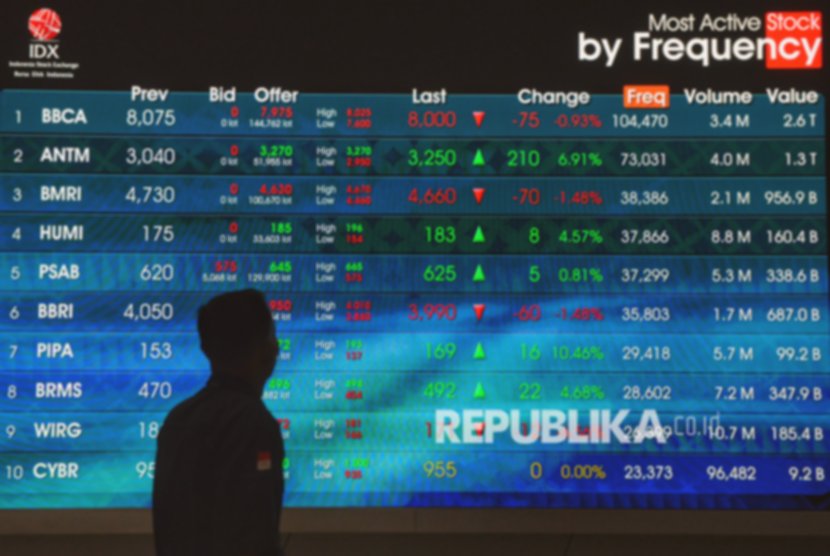
JAKARTA – The Jakarta Composite Index (IHSG) at the Indonesia Stock Exchange (IDX) closed weaker on Tuesday afternoon (November 18, 2025), as optimism faded regarding a benchmark interest rate cut by the Federal Reserve at its upcoming December 2025 meeting. The IHSG closed down 54.95 points, or 0.65 percent, to 8,361.93. Meanwhile, the LQ45 index, which comprises 45 leading stocks, fell 6.41 points, or 0.75 percent, to 843.51.
“Unease is beginning to spread through the market, and hopes for an interest rate cut in December 2025 are fading. Now seems like an opportune time for investors to take profits from investment strategies that have been quite profitable this year, including buying (long) stocks and selling (short) the US dollar,” Phillip Sekuritas Indonesia’s Research Team stated in its analysis in Jakarta on Tuesday.
From the international front, market participants are expressing doubt about a benchmark interest rate cut by the US central bank, the Fed, in December 2025. Currently, market players estimate a 45 percent chance of a Federal Funds Rate (FFR) decrease, compared to 62 percent last week.
On another note, market participants are awaiting the resumption of economic data releases this week, following the reopening of the US government after a prolonged government shutdown.
The market is particularly eager to gain an official picture of the US labor market through the release of the Non-Farm Payrolls (NFP) data for September 2025 on Thursday (November 20th).
The US NFP data release will be under intense scrutiny, given the recent more cautious (hawkish) statements made by high-ranking Fed officials, which have fueled doubts about an interest rate cut in December 2025.
Domestically, market players are closely monitoring Bank Indonesia’s (BI) policy regarding its benchmark interest rate, which is projected to remain at 4.75 percent. BI is holding its Board of Governors (RDG) meeting this week on November 18–19, 2025.
After opening stronger, the IHSG moved into negative territory until the close of the first trading session. In the second session, the IHSG remained in the red zone until the close of trading.
Based on the IDX-IC Sectoral Index, one sector strengthened: the property sector, which rose by 2.17 percent.
In contrast, ten sectors weakened, with the energy sector falling the most, by 2.27 percent, followed by the non-primary consumer goods sector and the basic materials sector, which fell by 1.58 percent and 0.40 percent, respectively.
The stocks that experienced the biggest gains were PEGE, JATI, ESTA, OILS, and CBPE. Meanwhile, the stocks that experienced the biggest losses were POLU, PJHB, PURI, LUCK, and UANG.
The frequency of stock trading was recorded at 2,523,376 transactions, with a total of 40.91 billion shares traded, worth Rp 19.67 trillion. A total of 230 stocks rose, 418 stocks declined, and 162 remained unchanged in value.
Other Asian regional stock markets this afternoon saw the Nikkei index fall by 1,595.41 points, or 3.17 percent, to 48,728.50; the Hang Seng index fell by 454.25 points, or 1.72 percent, to 25,930.03; the Shanghai index fell by 32.22 points, or 0.81 percent, to 3,939.81; and the Straits Times index fell by 37.77 points, or 0.83 percent, to 4,506.54.
Summary
The Jakarta Composite Index (IHSG) closed lower on Tuesday, falling 0.65% to 8,361.93, driven by fading optimism for a Federal Reserve interest rate cut in December 2025. Market participants are expressing doubt about a December rate cut, with estimations dropping from 62% to 45%. Investors are taking profits from previously successful strategies amidst this uncertainty, according to Phillip Sekuritas Indonesia.
Market participants are also awaiting the release of US economic data, including the Non-Farm Payrolls (NFP) data, following the end of the US government shutdown. Domestically, Bank Indonesia’s (BI) policy regarding its benchmark interest rate is being closely monitored, with expectations that it will remain at 4.75%. Most sectors weakened, except for the property sector, while other Asian markets also experienced declines.