
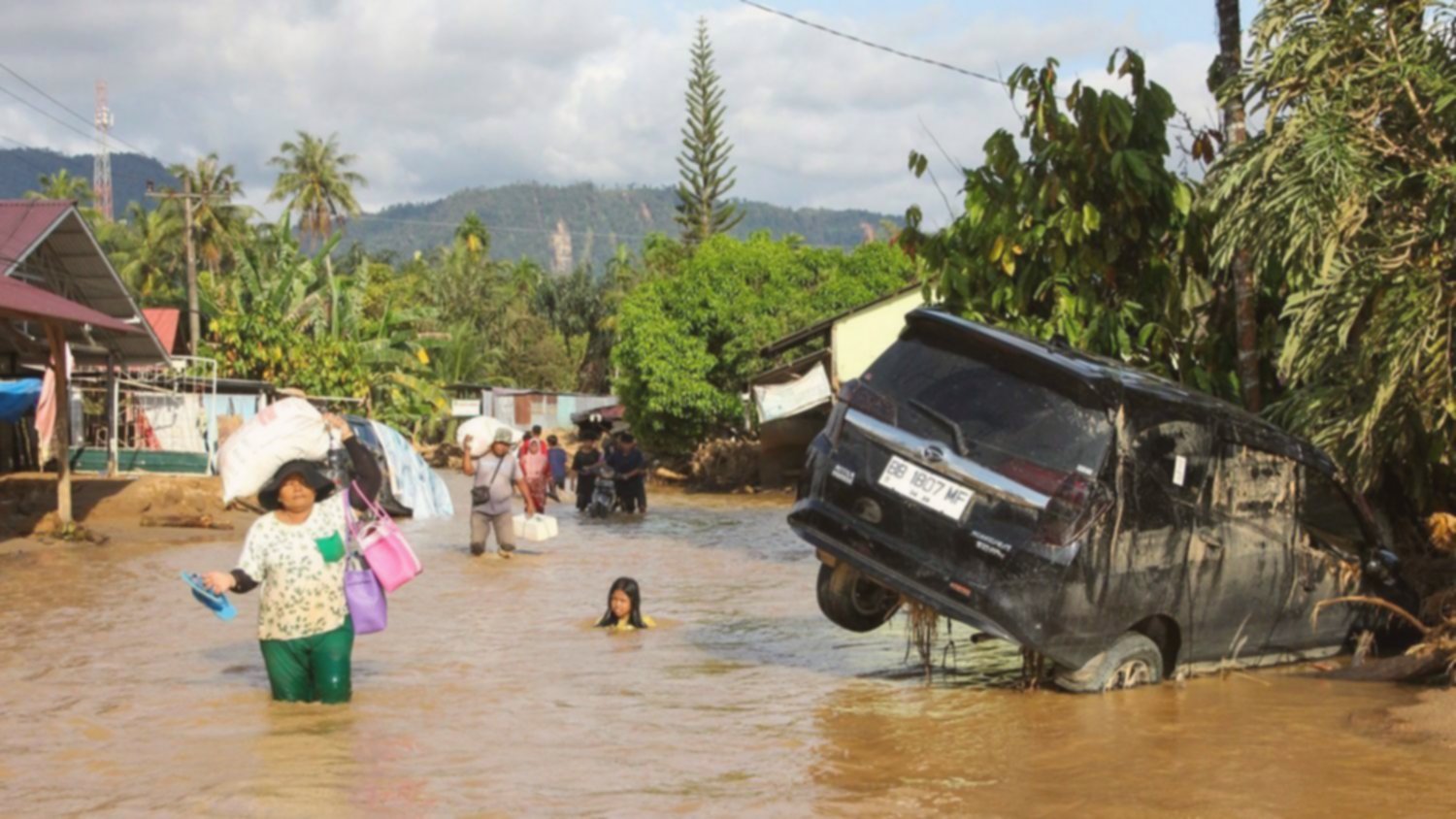

Floods and landslides have dramatically reconfigured the river systems across Sumatra, transforming once-distant waterways into immediate threats alongside residential areas. This altered landscape now leaves communities acutely vulnerable to recurrent inundations, a danger further underscored by the Indonesian Agency for Meteorology, Climatology, and Geophysics (BMKG)’s warning of heavy rainfall expected over the coming week.
The impact is starkly evident in Hutanabolon Village, Central Tapanuli Regency, North Sumatra. Here, devastating floods and landslides in late November annihilated approximately three kilometers of asphalt road, converting it into an improvised riverbed that surges whenever rain descends.
In this village of 3,000 inhabitants, many residents stoically remain in their homes, despite the persistent threat of further flooding. For them, the rivers they once knew as distant features now flow directly before their eyes, a constant, menacing reminder of the disaster’s profound shifts. Adding to their anxieties, the BMKG has reiterated its severe weather alert, forecasting more heavy rains across Sumatra in the days ahead.

Amidst this precarious reality, 60-year-old Delinca Pangabean epitomizes the community’s unyielding struggle. Day after day, she battles the encroaching mud, laboriously pushing it out of her home with a simple wooden stick. ‘Clean it. It comes back in. Clean it. It comes back in. Last night’s [rain] was the worst,’ Delinca recounted on a Monday morning (December 8) from her mud-stained residence in Lorong 1, Hutanabolong, Tukka District.

This relentless cycle has become Delinca’s routine since the major floods and landslides ravaged parts of Sumatra in late November. The invasive mud permeates every corner, reaching ankle-deep into her kitchen, where an overturned refrigerator and mud-caked chairs bear witness to the deluge. Even her precious food stock—two sacks of rice, placed higher in a desperate attempt to save them—suffered damage, and her family’s paddy fields have been utterly destroyed.
The relentless influx of mud into homes like Delinca’s is a direct consequence of the transformed landscape. Every downpour causes the asphalt road outside to submerge, morphing into a powerful river that channels a torrent of mud directly into residential properties.

Delinca represents a resilient minority who choose to remain in their damaged homes, even as many others have abandoned their mud-swamped properties. ‘It’s just me and my grandchild living here,’ she explained, her voice tinged with defiance. ‘I’m staying here, like this, let God… If I die, I’ll die here. I can’t stand going back and forth [to evacuation shelters] walking all over the place.’

However, when water levels rise significantly, Delinca does seek temporary refuge at her child’s home ‘behind’ her current dwelling. Similarly, Lanaria Tambunan, another elderly resident, stated that she would only evacuate if her extended family made a collective decision to move. ‘If they move, we will follow,’ she affirmed.

Indeed, significant stretches of asphalt road crisscrossing Hutanabolon in Tukka District have been irrevocably converted into river channels. Following the major floods and landslides of late November, the original river flows ruptured, forcing the overflowing water to carve new pathways through fields, plantations, and even residential areas.

During BBC News Indonesia’s visit to Hutanabolon, hours of moderate rainfall swiftly submerged the roads, creating strong currents that made footing precarious. Houses lining these makeshift waterways were heavily impacted, with even sacks of mud painstakingly collected and piled in front of homes proving insufficient to halt the water’s relentless advance.
Anwar Pangabean, coordinator of the communal kitchen in Lorong 2 Hutanabolon, candidly described his area as ‘very vulnerable’ due to the ‘very frequent rainfall.’ He lamented, ‘Every day there’s heavy rain. The river flows channeling towards the remaining settlements are almost constantly on high alert, virtually undirected.’

Residents are urgently appealing to the government for the immediate deployment of heavy equipment to reroute the water from the roads back into the riverbeds. ‘We need maximum, productive equipment. It’s been almost 12 days, and the equipment only arrived today. It’s very slow,’ Pangabean told BBC News Indonesia on Monday (December 8), underscoring the critical need for a swifter response.
Tukka is merely one of eight districts in Central Tapanuli that bore the brunt of the floods and landslides. In Hutanabolon alone, electricity remained cut off until Wednesday (December 10), and communication signals were sporadic, further isolating affected communities.
Threat of Latest Extreme Weather
The threat of recurrent flooding is far from over. The BMKG has forecasted the potential for torrential rains to persist across parts of Sumatra in the coming days, with extreme weather conditions specifically anticipated for Wednesday (December 10). This dire warning stems from the emergence of tropical cyclone seed 91S, which is influencing the formation of rain clouds across western Indonesia.
North Sumatra and West Sumatra are particularly expected to face severe heavy rainfall, even as both provinces are still grappling with the arduous recovery efforts following the intense floods and landslides that struck in late November.
The Central Tapanuli Regency administration reported that Hutanabolon in Tukka District is just one of eight severely impacted areas, alongside Sitahuis, Tapian Nauli, Kolang, Sorkam, Pasaribu Tobing, Sosor Gadong, and Manduamas, all reeling from the extensive floods and landslides.
Masinton Pasaribu, the Regent of Central Tapanuli, acknowledged the severe shortage of heavy equipment. He stated that all 24 available units—belonging to both the local government and private entities—have been deployed for post-disaster operations, including opening isolated routes and searching for missing victims. ‘And we are now trying to rent heavy equipment to expedite the removal of logs in the river, so that the river flow can return to normal,’ he explained.

The proposed rental of additional heavy equipment from outside the region will require funding from the central government, as the local budget (APBD) is insufficient. Once these crucial resources are secured, the next priority will be the normalization of rivers, many of which have become significantly shallower due to heavy siltation.
Beyond normalization, the Regent stressed the urgent need for embankment construction, especially in residential areas, to prevent future overflows. He also put forth a plan for upstream rehabilitation, calling for central government intervention to regulate palm oil plantations. ‘Regulating forest companies and changes in forest function, as well as changes in hill function. Because many trees are cut down and planted with palm oil,’ he elaborated.

Regent Masinton Pasaribu firmly asserted, ‘In my opinion, the [central] government must undertake efforts to prevent and, if necessary, take action against those who plant palm oil in forests without proper permits.’ This highlights the deep-rooted environmental issues believed to be exacerbating the disaster’s impact.
The Central Tapanuli Regency administration has extended its second phase of emergency response for another 14 days, following the massive floods and landslides on November 25. ‘Because there are still victims who haven’t been found. Searches are ongoing. Additionally, 19 villages remain isolated and inaccessible,’ the Regent confirmed, underscoring the protracted nature of the crisis.
‘We Need Additional Volunteers’
Lodewik Marpaung, a youth leader in Central Tapanuli actively involved in post-disaster efforts, emphasized the critical need for external volunteers. ‘If we rely on local volunteers today, they are still preoccupied with how to live, how to deal with their damaged homes,’ he noted, highlighting the immense burden on local residents.
Additional volunteers are urgently required to assist residents in locating missing family members, clearing massive logs, stones, and mud, cleaning homes, and reopening isolated access routes. The presence of heavy equipment in the affected locations is equally vital. Furthermore, immediate material aid is desperately needed, including food, clothing, underwear, baby and child necessities, rubber boots, and flashlights for nighttime illumination.

Lodewik passionately appealed, ‘So, today we truly need the attention of all parties. We urge many volunteers to come down and heavy equipment to be deployed so that access can be restored.’ This underscores a widespread call for comprehensive support.

The National Disaster Management Agency (BNPB) had previously identified Central Tapanuli and Sibolga City as two areas ‘requiring serious attention.’ In these two North Sumatra regions, BNPB reported 163 fatalities, with another 96 individuals still missing and actively being searched for.
Across North Sumatra, West Sumatra, and Aceh, the floods and landslides that struck in late November have collectively claimed 969 lives, left 262 people missing, and injured approximately 5,000. The disaster has also damaged 156,900 homes and displaced nearly one million people, creating a humanitarian crisis of immense scale.
Two weeks after the devastating floods and landslides ravaged parts of Sumatra, conditions in many areas remain chaotic and dire. Homes continue to be inundated with mud, electricity supply is intermittent or non-existent, waste is strewn everywhere, the search for missing persons is far from over, logs are scattered across the landscape, and the looming threat of infectious diseases adds another layer of profound concern.
- Following Sumatra Floods and Landslides, Residents Forced to Wash in Ditches – Threat of Infectious Diseases Looms
- Government Pledges to Investigate Corporations Contributing to Sumatra Disaster – What is the Fate of Prabowo-Affiliated Companies in Aceh?
- Prabowo Agrees to Allocate IDR 60 Million Per Severely Damaged Home Due to Sumatra Floods – What Are the Conditions?
Summary
Devastating floods and landslides in late November severely impacted parts of Sumatra, particularly North Sumatra’s Central Tapanuli Regency, transforming asphalt roads into riverbeds and inundating homes with mud. Communities like Hutanabolon Village face daily struggles, with residents battling persistent mud intrusion and a reconfigured landscape. The Indonesian Agency for Meteorology, Climatology, and Geophysics (BMKG) continues to warn of heavy rainfall, increasing the threat of further inundation in already vulnerable areas.
Local authorities have deployed available heavy equipment, but additional resources are critically needed for clearing debris, normalizing rivers, and constructing embankments, requiring central government funding. There is an urgent appeal for more volunteers and material aid to assist in search efforts, home cleaning, and reopening isolated routes. The disaster has caused hundreds of fatalities, missing persons, and displaced nearly a million people across the affected provinces, with environmental issues like illegal palm oil plantations cited as exacerbating factors.