
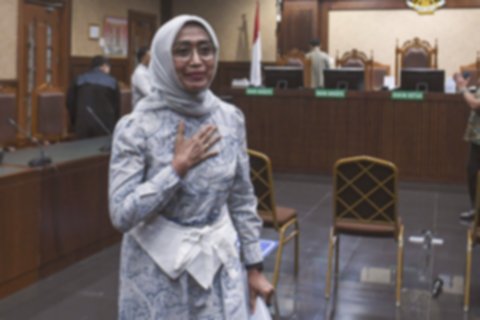

Ira Puspadewi, the former President Director of PT ASDP Indonesia Ferry, has been sentenced to 4.5 years in prison following her conviction in a corruption case involving the acquisition of PT Jembatan Nusantara (JN) by ASDP. The verdict was handed down by the Jakarta Corruption Court (Tipikor Jakarta Pusat).
In addition to the prison term, Ira Puspadewi was ordered to pay a fine of Rp 500 million. Should she fail to pay this fine, the penalty will be commuted to an additional 3 months of imprisonment. This sentence is notably lighter than the 8.5 years in prison and Rp 500 million fine (with a 4-month substitute imprisonment) that prosecutors had originally demanded.
The court also delivered verdicts for two other defendants implicated in the case. Harry Muhammad Adhi Caksono, the Director of Planning and Development at PT ASDP from 2020-2024, and Muhammad Yusuf Hadi, the Director of Commercial and Services at PT ASDP from 2019-2024, each received a sentence of 4 years in prison.
Interestingly, the court’s decision was not unanimous, as one of the judges believed Ira Puspadewi should have been fully acquitted. This dissenting opinion has sparked considerable discussion regarding the complexities of the case.
No Personal Gain: A Key Argument for Acquittal
The dissenting judge argued that Ira Puspadewi did not personally benefit from the alleged corruption surrounding the acquisition of PT JN by ASDP. This crucial assessment emerged from a thorough review of witness testimonies, expert opinions, physical evidence, and the statements provided by all three defendants throughout the trial.
Judge Mardiantos, a member of the judicial panel, explicitly stated, “Considering that, based on the statements of witnesses, expert opinions, evidence, and the defendants’ statements in court, it was revealed that Defendant I, Defendant II, and Defendant III did not obtain any assets from the criminal act of corruption in the business cooperation process and the acquisition process of PT Jembatan Nusantara by PT ASDP Indonesia Ferry (Persero).” This finding meant that Ira Puspadewi and her co-defendants were not mandated to pay restitution, despite their prison sentences.
However, a contrasting perspective was voiced by the Presiding Judge, Sunoto, who maintained that Ira Puspadewi should have been acquitted. Judge Sunoto asserted that the actions taken by Ira Puspadewi and her colleagues were purely business decisions, protected by the business judgement rule, rather than constituting criminal offenses.
Consequently, Judge Sunoto concluded that the defendants should be released from all legal charges. He declared, “The elements of corruption as charged were not convincingly met,” further adding, “Therefore, based on Article 191 paragraph 2 of the Criminal Procedure Code, the defendants should be declared free from all legal charges or ontslag.”
Three Substantial Doubts in Ira’s Verdict
In his dissenting opinion advocating for Ira’s acquittal, Presiding Judge Sunoto highlighted three substantial, material, and fundamental doubts that he believed undermined the corruption charges.
First, Sunoto pointed to a significant doubt regarding mens rea, or criminal intent. He noted that Ira Puspadewi and her co-defendants did not gain any personal profit, nor was there any conflict of interest or clear economic motive. Furthermore, the business outcomes of the acquisition for PT ASDP had actually shown positive achievements, questioning the notion of malicious intent.
Second, substantial doubt was raised concerning the calculation of state losses. Judge Sunoto emphasized that the KPK team, according to a Supreme Court Circular, was not authorized to calculate state losses. He also noted that BPKP (the Financial and Development Supervisory Agency) had declined to calculate the state losses, the calculation methodology itself contained fundamental flaws, and the BPK (Supreme Audit Agency) had concluded that the acquisition was carried out in accordance with regulations. Adding to the uncertainty were extremely divergent expert opinions on the matter.
Third, Sunoto highlighted the inherent doubt in defining the precise boundary between a suboptimal business decision and a criminal act of corruption. This ambiguity made it difficult to definitively classify the actions as criminal.
Given these substantial doubts, Judge Sunoto stressed that any decision must ultimately favor the defendant. “The Supreme Court affirms that if two equally strong conclusions can be drawn from evidence, the conclusion favoring the defendant must be chosen,” Sunoto explained. He reiterated, “These substantial doubts must be interpreted in favor of the defendants according to the principle of in dubio pro reo.”

Ira Puspadewi: “We Are Not Corrupt At All”
Following her verdict, Ira Puspadewi publicly underscored the statement made by some members of the judicial panel that she, along with the two other former ASDP directors, was not corrupt. Speaking to reporters after the trial, Ira stated, “We want to slightly underscore that, as stated by the Panel of Judges, we are not corrupt at all.”
She further asserted that the acquisition carried out by PT ASDP was a highly strategic move for Indonesia. “We want to state that this acquisition is very strategic, not just for ASDP, but for the Indonesian nation,” she emphasized. Ira explained the broader impact, “Because why? Because with this acquisition, ASDP’s position in serving remote, outer, and frontier (3T) regions will become stronger.”
Seeking Legal Protection from President Prabowo
In the same address, Ira Puspadewi made a direct appeal to President Prabowo Subianto for legal protection in her case. She argued that such protection is vital for professionals within State-Owned Enterprises (BUMN) who are committed to delivering significant breakthroughs for Indonesia.
“We seek legal protection from the President of the Republic of Indonesia for professionals, especially BUMN professionals who make major breakthroughs for the nation, not just for the company, but for the Indonesian nation,” Ira stated passionately. She stressed the importance of preventing the criminalization of dedicated BUMN professionals who contribute substantially to national progress. “Please pray for us and we ask for legal protection for BUMN professionals so that significant breakthroughs are appreciated, not criminalized,” she concluded.
The ASDP Case Details
The three former directors of PT ASDP were originally charged with alleged corruption stemming from the business cooperation and acquisition of ships from PT JN. Prosecutors claimed that Ira Puspadewi and her co-defendants enriched other parties through their actions, which purportedly caused state financial losses amounting to an astounding Rp 1.27 trillion.
During her plea of defense (pleidoi), Ira Puspadewi countered these claims by arguing that the calculation of state financial losses was conducted by internal KPK forensic accountants and based on calculations provided by a shipbuilding construction lecturer. Ira highlighted that neither of these individuals possessed the necessary competence or official certification as public assessors, as required by Ministry of Finance regulations. She also reminded the court that the then Minister of BUMN, Erick Thohir, had expressed pride in the acquisition at the time. Reaffirming her stance, Ira reiterated that she never received any personal benefit from the acquisition process, asserting that she “did not take a single penny.”
Summary
Ira Puspadewi, former President Director of PT ASDP Indonesia Ferry, received a 4.5-year prison sentence and a Rp 500 million fine for corruption in the acquisition of PT Jembatan Nusantara, with two co-defendants also sentenced. However, one judge dissented, arguing for her acquittal, stating that Ira did not personally benefit from the alleged corruption and her actions were legitimate business decisions protected by the *business judgement rule*. The court also noted that the defendants did not obtain assets from the alleged crime, leading to no restitution order.
The dissenting judge highlighted substantial doubts regarding criminal intent, as there was no personal profit and the acquisition yielded positive business outcomes. Questions were also raised about the calculation of state losses and the clear distinction between suboptimal business decisions and criminal acts. Following the verdict, Ira Puspadewi maintained her innocence, stressing the strategic importance of the acquisition, and appealed to President Prabowo for legal protection for BUMN professionals.