
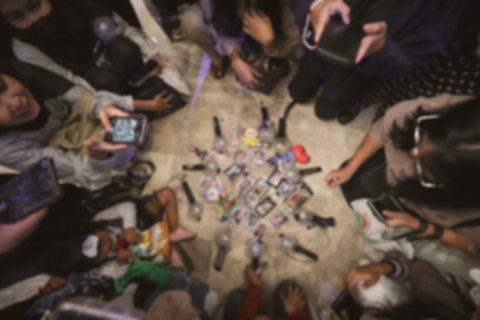
K-pop fandoms in Indonesia have exploded in popularity, fueled by increasing internet access, the proliferation of social media platforms, and the ever-growing entertainment industry in South Korea. But the world of fandom extends far beyond simply adoring idols; it’s a complex phenomenon with its own dynamics and nuances.
For Kerigit, a young woman in Jakarta, it was Kim Seok-jin, a member of the globally renowned group BTS (Bangtan Boys), who first captured her attention.
Her fondness for BTS began with Jin’s solo song “Epiphany.” Initially, Kerigit was drawn to the song’s musicality, even though she didn’t understand the Korean lyrics.
Driven by curiosity, she used a translator to decipher the meaning behind “Epiphany.”
“As soon as I understood it, I immediately loved it and moved on to Jin’s other songs,” Kerigit explains. It was at this point that she truly discovered BTS.
According to her, “Epiphany” is about “learning to love yourself.” The song resonated deeply with her.
“Maybe it was the right moment. I was feeling really down, going through some personal problems,” Kerigit told BBC News Indonesia.
Jin and “Epiphany” served as her gateway to BTS. Kerigit explains that she began to understand the close relationships between the members of the vocal group.
Although the members of BTS were still very young when she first encountered them, she saw them as figures of wisdom.
She cites Jin as an example, noting that he taught her “we don’t need to chase the approval of others.” What’s most important is that “we acknowledge ourselves as best we can.”
“Among all the BTS members, Jin had the least background to become an idol. He couldn’t sing, he couldn’t dance. But he learned, and now, during concerts, for example, Jin’s voice is the most stable,” Kerigit observes.
“So, I learned from that. I mean, I’ve done my job, and I’ve done my best. That’s it,” she says.
Kerigit believes that BTS, through their music, encourages listeners and fans to reflect on various aspects of life, especially personal perspectives. For her, listening to and following BTS’s work is akin to a spiritual experience.
She claims that BTS saved her from despair. If she hadn’t discovered them, Kerigit says, “I might have fallen into the deepest abyss.”
“Why? Because their songs were there when I found happiness, when I found peace, when I felt they were present in almost every situation I experience daily,” she explains.
“And that’s what made me even more into BTS, becoming an ARMY,” Kerigit adds.
ARMY is the name for BTS’s dedicated fanbase, or fandom.
Kerigit describes ARMY as more than just a fandom; it’s a representation of solidarity and connection among fans. They have a saying: “ARMY protects ARMY.”
This mutual support is evident during BTS concerts, where ARMY members freely distribute necessities like water, food, and accessories to fellow fans.
If a pregnant ARMY member is present at a concert, others will create a special lane to ensure she can safely enter the venue.
These small acts, according to Kerigit, demonstrate how ARMY puts the messages conveyed through BTS’s music into practice.
“Often, fans who act negatively idolize a member to the point of not seeing the overall message conveyed by BTS. There are even those who, for example, end up trash-talking each other,” she says.
Kerigit notes that a passion for K-pop, or in her case, a love for BTS, is often perceived as fanaticism, blindly defending an idol or group.
Despite admitting to being “in love with BTS,” she often reminds other ARMY members “to remain rational and sane.”
“I always tell my friends: they [BTS members] are human. Like humans in general, they can also make mistakes,” Kerigit states.
‘K-pop Fandoms are Closely Tied to Stigma’
According to research by social media researchers at Drone Emprit, K-pop fan groups were a driving force behind trending hashtags throughout 2019 and 2020.
During those two years, widespread demonstrations took place in Indonesia under the banners of ‘Reformasi Dikorupsi’ (Reform Corrupted) and ‘Mosi Tidak Percaya’ (Motion of No Confidence).
The former responded to revisions to the KPK Law (Corruption Eradication Commission), while the latter targeted the enactment of the Job Creation Law.
Drone Emprit’s findings indicate that the hashtag #MosiTidakPercaya was amplified by accounts featuring photos of K-pop idols.
According to Drone Emprit, these accounts “quickly united to promote the hashtag and others, making them worldwide trending topics.”
A study titled Break the Structure: BTS ARMY Digital Activism and State Surveillance in Indonesia’s Omnibus Law Protest, authored by Karlina Octaviany, explains that this phenomenon occurs because K-pop fandoms can dismantle social system hierarchies, thus facilitating participatory culture in practicing collective values.
“K-pop fandoms, predominantly female, grow like an egalitarian rhizome, without command structures, and within anonymous internet identities,” Karlina told BBC News Indonesia.
She explains that K-pop fandoms in Indonesia have undergone localization with easily recognizable characteristics.
Beyond digital activism, such as during the ‘Reformasi Dikorupsi’ protests and the opposition to the Job Creation Law, K-pop fandoms are known for jokes, memes, soap opera-style fan edits, and donations for Palestine. However, Karlina believes the presence of K-pop fandoms is often misunderstood.
“Like K-pop fandoms in general, they are closely tied to patriarchal stigmas and gender discrimination, labeled as hysterical, obsessive, crazy kids, and lonely spinsters,” she says.
“K-pop fandoms also frequently experience Online Gender-Based Violence (OGBV). Indonesian media often perpetuate these stigmas in their reporting.”
According to Karlina, the public should not blame fandoms without criticizing patriarchy and the lack of community protection on social media.
Her observations indicate that K-pop fandoms, largely composed of women, are often in a precarious situation.
Social media, Karlina says, fosters algorithms based on high content engagement, including “recommending fan wars and hate speech against certain fandoms.”
Various topics involving K-pop also become opportunities for netizens and brands to gain virality, “including negative comments,” she notes.
“Social media platforms continuously recommend exposure to negative content due to its potential for virality, making it difficult to see the root cause,” Karlina explains.
“Only the surface is visible when a fan war occurs, for example, and that content continues to dominate.”
This situation, she says, “is increasingly difficult to stop due to the involvement of buzzers who mimic the anonymity of K-pop avatars to manipulate trending narratives.”
“My research found that when fake K-pop avatars appear, fandoms can detect them because they are well-versed in the lingo and context of their idols. But it’s difficult to explain when misinformation circulates outside the community, especially when fueled by negative stigma against certain fandoms,” Karlina states.
Karlina’s concerns are amplified by the position of K-pop fandoms in Indonesia, which she believes “have become non-state actors with significant cyber power, given their large numbers on social media.”
The active participation of K-pop fandoms in various political events indicates that their role extends beyond K-pop discussions or issues alone.
The phenomenon of digital activism within K-pop fandoms raises the possibility of systematic surveillance, content manipulation to provoke anger (rage baiting), and doxxing or structured bullying.
“In fact, fandoms can be safe spaces for freedom of expression and emotional expression, regulating emotions without fear of judgment,” Karlina argues.
‘I Was Accused of Provoking Attacks Against ARMY’
Prasetya views conflict among K-pop fans as commonplace. He has witnessed K-pop fandoms engaging in lengthy debates on social media, defending their respective idols, on numerous occasions.
He considers it part of the “group dynamics when a community forms.”
“But as long as it’s just bickering on social media, it shouldn’t have a significant impact on the real world. I don’t worry too much about that,” says Prasetya, a worker in Jakarta, in an interview with BBC News Indonesia.
However, Prasetya was mistaken.
Recently, platform X was abuzz with commotion involving ARMY—BTS supporters—and netizens.
The cause was accusations from ARMY that netizens were bullying BTS’s leader, Kim Nam-joon, commonly known as RM. Netizens vehemently denied these accusations.
The debate spread to other platforms when a skincare brand held a live session on TikTok. Prasetya happened to be watching the live stream, hoping to find discounts. He noticed something strange.
“I saw the number of participants increase dramatically. Initially, there were only dozens, but it reached hundreds. And the comments were filled with anger. They mentioned BTS,” he says.
Prasetya then turned to X to understand the source of the anger. ARMY members believed the brand was mocking RM. However, Prasetya found no evidence to support these claims.
“When I read it again, there was no mockery. Because for a brand, in my opinion, to market themselves, they will try to be relevant [to what’s trending],” he explains.
The commotion during the brand’s live session continued. Prasetya became uncomfortable as the comments disrupted the host, who, in his opinion, had nothing to do with the conflict on X.
The host even apologized to the accounts that joined the live stream.
At that point, Prasetya recorded the disruptions and posted them on X, urging ARMY not to harass the host. His post went viral, further escalating the situation.
Unexpectedly, Prasetya’s post on X prompted some ARMY members to report him to his workplace, accusing him of manipulating public opinion. Prasetya’s superiors were asked to reprimand him. In addition to emails, ARMY members also called Prasetya’s office, with the same objective.
“In the beginning of the email, the sender claimed to be an ordinary individual who felt very disturbed. But afterwards, a statement appeared saying that my behavior caused unrest and provoked attacks against the ARMY and BTS communities,” Prasetya explains.
“Then, in the email, I also checked that the recipients included BIGHIT and Hybe, both labels and agencies of BTS.”
Prasetya was bewildered by the email. He maintains that he only wanted to de-escalate actions that he considered counterproductive.
Prasetya’s workplace responded to the report by conducting an internal investigation to determine the truth behind the accusations of “provocation” and “manipulation of public opinion.”
The investigation concluded that Prasetya did not engage in the alleged conduct.
Prasetya could only laugh.
Outside of the emails bearing the ARMY label, discussions on X continued, even leading to doxxing (revealing personal information) between the two sides: netizens and those claiming to be ARMY members.
‘If You Want to Go Viral, Just Criticize K-pop’
Nabiri Tata’s introduction to the world of K-pop began over a decade ago, in 2011. At that time, Tata, as she is known, watched a BIGBANG music video and was immediately captivated by the group’s unique sound.
It didn’t take long for her to become a BIGBANG fan, known as a ‘V.I.P.’ Her involvement in the K-pop world gradually increased as she interacted with other fans.
Tata, along with other V.I.Ps, actively discussed BIGBANG’s albums, individual members’ projects, concerts, and even rumors surrounding them.
At times, communication between fans could lead to heated debates, with the scope of these actions targeting two areas, according to Tata.
“In the past, most wars were between fandoms. But wars could also happen within the same fandom,” she explains to BBC News Indonesia.
In this type of war, the triggers were never singular and usually revolved around “quality.”
“For example, BIGBANG fans felt that the coolest songs were [by] BIGBANG. What about Super Junior who only danced around,” Tata recalls.
“But if you look at it, these two groups are different. You can’t compare them. The war was like that.”
In Tata’s experience, fandoms in her era “rarely debated over physical appearance.” Physical appearance in this context refers to claims about which K-pop singer is the most attractive.
Tata also channeled her love for K-pop into her academic work, writing her final assignment on fan fiction, a medium used by fans to create fictional stories with their idols as characters.
Over time, Tata’s focus shifted away from K-pop. Work and family commitments, she admits, “made the euphoria towards K-pop disappear.”
“Now I just like to listen. But to know which group is which, I don’t know anymore,” she says, followed by laughter.
However, there is one group she is still familiar with: BTS.
In Tata’s view, the dynamics within the K-pop fandom world have not undergone significant changes from when she first became involved. Conflicts between fandoms or with outsiders often surface.
Tata believes that the “commotion” within K-pop fandoms, often perceived negatively, is driven by at least three factors.
The first factor is the fandom’s tendency to “react too quickly” to insults directed at their idols.
“Because they feel ownership, because they feel they have to defend, they still have a lot of energy to do that,” she argues.
Tata categorizes these fans as “early-stage fans.” The explosive nature of fans in the initial phase of joining a K-pop fandom will diminish with age, she explains.
The second factor is the increasing number of social media platforms available. Tata recalls that in the past, communication between fans was primarily built on Facebook and Twitter (X). Now, “there’s Instagram, YouTube, even TikTok,” Tata says.
“Now it even goes to live features,” she adds.
With the existence of diverse platforms, the distribution of conversations involving fandoms reaches a wider audience, leading to virality.
And finally, third, Tata sees that the reactive nature of K-pop fandoms is “exploited by many parties to gain exposure.” In short: provoke K-pop fans and ‘fame’ will be within reach.
“If you want to go viral in Indonesia, just criticize religion or K-pop fans. That’s the formula, from my perspective,” she says.
When BIGBANG was very popular among Indonesian youth, Tata recalls that a stand-up comedian “picked a fight” by ‘snubbing’ BIGBANG fans. Shortly after, attention towards the comedian increased.
“Now, the one that’s ‘hit’ is ARMY. Why? Because it’s the biggest fandom and their reaction is quite fast,” Tata explains.
Tata does not deny that she was once in a position she describes as “excessive fanaticism.” She believes it can lead to harmful actions such as bullying or unauthorized disclosure of personal information (doxxing).
She hopes that K-pop fans can restrain themselves from getting trapped in a recurring cycle: endless debates or conflicts on social media.
In Tata’s view, K-pop fans “must start seeing the world more broadly and from many perspectives.”
“I myself admit that K-pop reacts too quickly. We get baited too easily,” she emphasizes.
“The bottom line is that if you like something too much, whatever it is, it’s not good.”
Not only to K-pop fandoms, Tata also reminds “outsiders who don’t like K-pop” that—first of all—there is no need to respond to fandoms aggressively.
Because “we are in different shoes,” Tata says.
“For example, if you think they’ve been too much from the start, it might be too much for you, but it’s normal for them,” she explains.
“If, for example, fangirling activities can be a person’s way to heal, to get entertainment, for someone to calm their heart, then just let them be. We have our own worlds.”
Fandoms Between Hallyu and ‘Shared Values’
The origins of today’s K-pop fandom culture can be traced back to 1996 with the debut of the boyband H.O.T. under the agency SM Entertainment, according to Annisa Pratamasari, a lecturer in International Relations at Airlangga University.
“Even though [K-pop] songs may have existed since Seo Taiji and Boys from 1992 to 1996, but in terms of the prototype of fandom culture with distinctive characteristics, such as writing fan fiction or pairing up members, it started with H.O.T.,” Annisa explains to BBC News Indonesia.
The development of fandoms can be said to follow a period-based division. So far, there are at least five generations of fandoms.
The first generation emerged in the early 1990s to 2002 with groups like H.O.T., SECHSKIES, and SHINHWA.
Then in the second generation, whose debut period began from 2004 to 2011, there are musical groups such as BIGBANG, Girls Generation, KARA, SHINee, Super Junior, and Secret.
The third generation includes BTS, EXO, Blackpink, Red Velvet, and NCT. The era of the third generation began from 2011 to 2017.
Meanwhile, the fourth generation, from 2018 to 2023, features NewJeans, Aespa, TREASURE, and Rocket Punch.
And finally, the fifth generation includes names such as BABYMONSTER, BOYNEXTDOOR, and ZEROBASEONE. The emergence of this generation is believed to be in 2023.
The birth of fandoms, at the same time, is inseparable from the hallyu wave, when South Korean popular culture products—films, music, series—are exported abroad. Indonesia is no exception.
The positive reception of hallyu is attributed to cultural proximity, cultural closeness. The public perceives that Indonesian and South Korean cultures are not very different because they both originate from Asia.
In the context of K-pop, Annisa continues, “the music itself has actually been combined with hip-hop and influences from Western genres, so Indonesian audiences don’t find it difficult to accept.”
“There is something called cultural hybridity. So, even though this culture is South Korean, even though they sing in Korean, it looks like Hollywood,” Annisa says.
Annisa, who also researches the phenomenon of South Korean pop culture, sees that fandoms then and now are quite similar.
Communication between fans is formed based on a fondness for boybands. They diligently collect albums, attend concerts, and do not hesitate to clash with other fandoms.
The increasingly massive growth of fandoms, according to Annisa, is driven by the emergence of social media technology.
“I see it as because most Indonesians have access to social media. That way, it becomes easier for us to access information or join a particular fandom,” she argues.
A report by We Are Social in 2024, for example, shows that internet users in Indonesia reached 185.3 million people, up 0.8% from the previous year.
The use of smartphones (and the internet) for social media is at 97.8%, the highest compared to other needs such as streaming, news, or music.
The phenomenon of fandoms, in Annisa’s perspective, should not be placed in different boxes. The emergence of K-pop fandoms is basically “the same as fans in other fields,” Annisa says.
The existence of any fandom, be it football, music, or film, “is bound by a common value that makes them united,” Annisa explains.
“If people like Manchester United, even though they keep losing, fans will still be there because that’s the model of fans,” Annisa says.
‘Everything is Deliberately Designed by the K-pop Industry’
Data compiled by Chartmetric in 2024 shows that Indonesia is the largest K-pop market in the world, at around 18.47%. Indonesia leads the United States, the Philippines, and the country of origin of K-pop itself: South Korea.
Research by Katadata Insight Center conducted in June 2022 shows that K-pop is in the second and third positions of Korean entertainment enjoyed by respondents in Indonesia. The figures are 55.1% for boybands and 50.5% for girlbands. Above K-pop is K-drama with 60.3%.
If we break it down further, BTS is the most popular boyband (46%), ahead of NCT (26%), EXO (21%), Super Junior (14%), and Seventeen (11%). From the girlband side, Blackpink is the champion with 46.3%—surpassing TWICE (17.4%), Girls’ Generation (17.3%), Red Velvet (16.6%), and ITZY (11.8%).
Meanwhile, from the fandom aspect, ARMY is the most dominant (32.3%), followed by BLINK (Blackpink), EXO-L (EXO), and NCTZen, still referring to Katadata Insight Center’s findings. All four are fans of third-generation idols.
In addition to them, fandoms from second-generation idols that made it into the top 10 are E.L.F (Super Junior) and SONE (SNSD). The rest are filled by fourth-generation fandoms: STAY (Straykids), MOA (TXT), MY (aespa), and Teume (Treasure).
The massive presence of K-pop fandoms in Indonesia is influenced by the K-pop industry’s profit-oriented design, according to Amalia Nur Andini, a lecturer in International Relations at Brawijaya University.
The K-pop industry, Andini explains, provides various elements in their marketing to attract as many people as possible to become fans.
“They sell merchandise such as lightsticks or offer memberships. Both seem mandatory if we join NCT, Super Junior, or BTS’s fanbase,” says Andini, who has researched K-pop several times.
“The more we collect these trinkets, the more we strengthen our identity as true K-pop fans.”
Another indicator is presented through the construction of an emotional “closeness” between the idol and the fandom, which from the beginning, again, is designed to be an entry point for gathering masses in large volumes, Andini adds.
The relationship between idols and fandoms is often defined as parasocial. This means, Andini says, that fans “feel an emotional connection to their idols.”
“Even though the idol doesn’t even know who we are. They don’t know us. But here, we feel so close to the idol,” she says.
The way the K-pop industry fosters this emotional side is by offering content outside of the idol’s profession, such as daily activities or behind the scenes, to further strengthen the closeness with the fandom.
“In the early days of the second generation, I saw idols doing dance practice. From there, we could see what the idol’s life was like off-stage. Know how they talk, what their hobbies are, what their favorite foods are, even what their favorite colors are,” Andini says.
“Things like this, which then make fandoms become obsessive, are deliberately done by the K-pop industry.”
Andini adds that looking at K-pop fandoms should not solely rely on the individuals within them.
All the consequences generated by fandoms, positive and negative, are outputs from the management, or capitalization, of the K-pop industry.
Andini believes that fandom dynamics will always evolve, including the possibilities of conflict, bullying, or “excessive defense.”
Even so, preventive measures can still be taken, according to Andini.
“One way to prevent this is by strengthening digital relations and relationships within the fandom itself, and I see the importance of the role of admins [fandom groups] because they are the ones who moderate incoming information,” she argues.
“From social media platforms, we can be responsive to report when there are accounts that, for example, incite emotions or have the potential to commit bullying.”
Summary
K-pop fandoms in Indonesia have experienced immense growth, fueled by increasing internet access and the expanding South Korean entertainment industry. Many fans, like Kerigit, find deep personal meaning, emotional support, and life lessons, particularly on themes of self-love, through their idols’ music. These fandoms also demonstrate strong solidarity, mutual support, and engage in significant digital activism and charitable efforts beyond simple adoration.
However, K-pop fandoms often contend with patriarchal stigmas, being labeled as irrational or obsessive, and face online gender-based violence. Internal conflicts (“fan wars”) and external exploitation for virality are prevalent, sometimes escalating to real-world issues like doxxing. Experts highlight that the K-pop industry deliberately fosters parasocial relationships and commercial loyalty, shaping these powerful communities’ dynamics and widespread influence in Indonesia, the world’s largest K-pop market.