

The Indonesian Green Industrial Park (KIHI): A “Green” Dream Built on Dispossession?
The Indonesian government is constructing what it claims will be the world’s largest green industrial zone, the Kawasan Industri Hijau Indonesia (KIHI), or Indonesian Green Industrial Park. Spanning over 30,000 hectares and designated as a National Strategic Project (PSN), this ambitious undertaking is touted as both environmentally friendly and a catalyst for domestic economic growth, benefiting local communities in the process.
But not everyone shares this rosy vision.
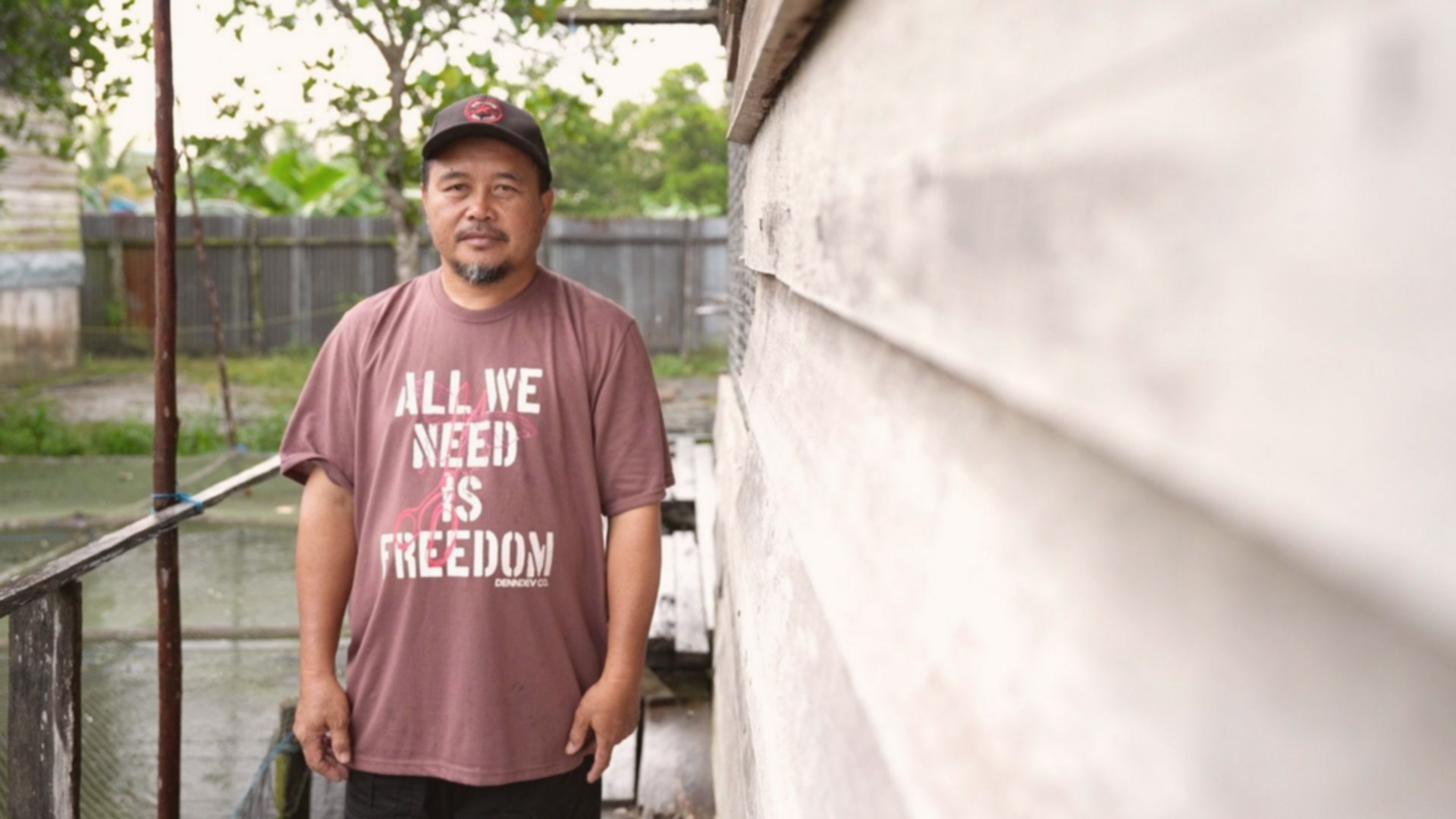
Amran, a resident of Kampung Baru in Mangku Padi, North Kalimantan, vehemently disagrees. For him, the KIHI represents a blatant seizure of rights.
“The KIHI is stealing our rights. When our rights – our right to life, our right to work, our right to a healthy environment – are simply taken away, what does independence mean for us?” he asks, his voice heavy with disillusionment.
He pauses, his gaze unwavering. “We are being colonized,” he says, a short sentence encapsulating his deep-seated anxieties and disappointments.
Amran’s home in Kampung Baru, Mangku Padi, sits a mere five kilometers from the KIHI. From his doorstep, the industrial park’s presence is starkly visible, punctuated by the towering chimneys of coal-fired power plants.
I met Amran in early October after a three-hour speedboat journey from Tarakan, a bustling port city in North Kalimantan.
Amran is an adventurer in the truest sense of the word. Born and raised in South Sulawesi, he ventured to Malaysia before finding his way to Kampung Baru, Mangku Padi, in 2006.
“Most Bugis people are fishermen and farmers,” he explains, outlining his background. “We look for places where we can easily make a living, especially through fishing.”
Kampung Baru wasn’t initially on his radar. He learned about the area from relatives who had already settled there. Convinced of its potential, Amran decided to follow.
“Back then, there were no roads here. We reached this area by sea from Tarakan, using fishing boats with dompeng engines [a local term for diesel engines],” he recalls. “It took about six hours from Tarakan to reach Kampung Baru.”
Amran describes Kampung Baru as a wilderness of thick shrubs and towering trees. Signs of civilization were almost nonexistent, as “electricity and network connectivity were unavailable.”
Only a handful of houses dotted the landscape, including those built by his relatives. Besides them, the majority of Kampung Baru’s inhabitants were former migrant workers from Sulawesi who had returned from Malaysia to clear land and rebuild their lives.
Amran initially stayed with his relatives before constructing his own home.
Life in Kampung Baru, he says, was “very, very simple.”
Once his house was complete, Amran began the process of obtaining legal documentation for his land, applying through the National Agrarian Operation Project (PRONA) in 2009.
PRONA is a government program offering free land certification, implemented by the National Land Agency (BPN). Amran and other residents successfully secured their land titles (SHM).
Six years later, in 2015, Amran once again sought to formalize his land ownership through the Comprehensive Systematic Land Registration (PTSL) program initiated by the Ministry of Agrarian Affairs and Spatial Planning/National Land Agency (ATR/BPN).
The government touted PTSL as the first-ever simultaneous registration of all land plots.
Amran believed the PTSL process would be smooth, similar to his experience with PRONA. He was wrong.

“In 2015, the certificates were ready, but the BPN refused to distribute them to us,” Amran reveals. “They claimed that the land we occupied was already included in the company’s HGU [Cultivation Rights Title].”
The company in question was PT Bulungan Citra Agro Persada (PT BCAP), an oil palm plantation company.
Amran was shocked.
“And you only found out then?” I ask.
“Yes, we only found out then,” Amran replies.
“If we had known beforehand that it was PT BCAP’s land,” Amran continues, “we would not have applied for certification.”
PT BCAP obtained its HGU for oil palm cultivation in 2011, covering over 13,000 hectares.
Amran and the residents of Kampung Baru believed PT BCAP’s concession was only around 4,000 hectares and did not include their settlement areas. The BPN’s statement was a nightmare.
The claim by PT BCAP over the community’s settlement area led to negotiations. In one forum, PT BCAP stated that they “unintentionally included residents’ land in their HGU,” according to Amran.
“They promised to release the land, either through compensation or by enclave [excluding it from the HGU],” Amran recalls.
The company’s promise never materialized. No resolution was reached for the residents of Kampung Baru. Dialogue resumed in 2021, resulting in a similar agreement: the residents’ land would be promptly removed from the HGU.
But once again, no action was taken. The residents were left hanging, their homes and land still part of the 7,800 hectares claimed by the company.
“That’s what we don’t understand. How could this happen?” Amran wonders.
Before the issue of land legality and PT BCAP’s claims could be resolved, the community of Kampung Baru faced an even greater challenge.
“If that continues, we’re doomed.”
The sudden claim of their land by PT BCAP left Samsu deeply disappointed. So much so that he no longer believes that the presence of industry – or any company – will improve the lives of the local community.
Samsu greeted me warmly at his home, located not far from the Kampung Baru pier. He is a respected elder in the community, serving as the head of the neighborhood association (RT). People in Kampung Baru call him “Pak RT.” I followed suit.
“Pak RT, when did you start speaking out?” I begin.
Samsu’s relaxed expression turns serious.
“Since this company came in. We were deceived. We were promised that the community would prosper. Instead, our land was claimed,” he states firmly.
The company he refers to is PT Kalimantan Industrial Park Indonesia (PT KIPI). PT KIPI took over more than 10,000 hectares of land from PT BCAP.
The land is being used to realize the government’s ambition of “economic transformation through industrial downstreaming and the utilization of green energy.”
In December 2021, under the leadership of then-President Joko Widodo (Jokowi), the groundbreaking ceremony for the project was held.
The name given to the project: Kawasan Industri Hijau Indonesia (KIHI).

According to the government, KIHI “can have a broad impact on the national economy.”
The KIHI project is planned to be built on 30,000 hectares of land, making it – according to the government – the largest green industrial park in the world.
So far, the government has prepared 13,000 hectares to meet the needs of “green-based” industries in the KIHI, ranging from electric vehicle (EV) batteries and petrochemicals to aluminum.
Unsurprisingly, KIHI has been designated as a National Strategic Project (PSN).
“Then suddenly this thing called PSN appeared. We don’t understand what PSN is,” says Samsu.
Samsu explains that the KIHI project will displace at least 300 households (KK). Of the 13,000 hectares allocated, the majority is former PT BCAP land taken over by PT KIPI.
Four areas, according to the Lingkar Hutan Lestari Association (PLHL), are most likely to bear the brunt of this transfer of ownership: Tanah Kuning, Mangku Padi, Sajau Timur, and Binai.
Just two days before I visited his home, Samsu attended a public hearing (RPD) at the North Kalimantan Regional People’s Representative Council (DPRD).
The hearing brought together PT KIPI and affected communities. At the hearing, PT KIPI stated that it had purchased 7,800 hectares of land from PT BCAP.
“But that 7,800 hectares belongs to the community. It includes schools, plantations, everything is under the company’s HGU,” he states.

Many of the residents’ lands claimed by PT KIPI are certified. Samsu’s two plots, for example, each have a Land Ownership Certificate (SKT) and a Freehold Title (SHM).
A dormitory for workers now stands on the SKT-certified land. Samsu once tried to enter but was prohibited. He experienced the same thing on his SHM-certified land: security guards told him to turn back because it was company property.
“So we are afraid to plant anything. Because it says there that we can be subject to [violations of] the law. Because they [the company] claim they own the land,” he adds.
In the hands of PT KIPI, the land status has now changed to Building Use Rights (HGB). Construction, according to Samsu, is slowly progressing. He estimates that 800 hectares have been transformed, most notably by the construction of a coal-fired power plant (PLTU).
“If that [PLTU] continues [to be built], we [who live] nearby are doomed,” says Samsu, deeply concerned.
“We feel like we are being colonized by the Dutch.”
Refusing to Give Up Land, Imprisonment, and Release with One Condition
I feel unfairly treated. We were carrying wood in two cars. Why was I the only one arrested?
Just call me Herman, not my real name, because my wife asked me not to use my real name. She said it would add more pressure. My wife still hasn’t fully ‘recovered’ from the experience I faced, or rather, my whole family faced.
The wood I was carrying was already on the ground. We usually call it fallen wood. It was in a plantation managed by the community. People here like to collect fallen wood. They use it to build houses.
When I arrived at the police station, I was processed. The police told me that if I wanted to get out, I had to release the land. You have to help with this release, a police officer emphasized to me.
Since the community first learned about the construction plan by PT KIPI, I have been against it. I believe the compensation offered by the company is not ideal.
I have 6 hectares of land. It’s already certified. The company offered Rp 50 million for one hectare. I refused. How could I accept that?

In principle, I have never held back land from being released. Because they said it was for national development. I am not holding it back. I said that it was important to have a fair price. The company stated that one of the goals of this project is to improve the welfare of the community.
But when my family visited me at the police station, when my child cried and asked me to come home, when my wife started getting sick, I gave up. For me, family comes first. I can’t be stubborn. I promised them: whatever happens, I will come home.
That’s when I told the police that I would surrender my land.
After I was released, I kept getting calls from the police station. They asked when I was going to hand over the letter. I told them to wait. The next day, they called me again, and so on.
Then I thought about it. About two or three days before I was arrested, I was visited by company representatives. This was the umpteenth time they had come to my house, asking about the release of the land. I answered: if the price is right, we might sell it.
The company representatives replied that if I did not hand over my land immediately, the court would take over. Compensation would be paid in court. I didn’t understand what they meant.
Was I being hunted by them because I didn’t want to hand over my land at a cheap price?
In the end, I went through with the land surrender. The company stated that this was not a sale, but a transfer of power. We gave the company the power to manage the land.
In my opinion, it’s the same thing. I lost my land. In my heart, I feel sad, disappointed, and traumatized.
This construction project, they say, is a National Strategic Project (PSN). A project that the government says can bring prosperity to the people. We have never felt that prosperity.
On the contrary, we feel terrorized. We feel hunted. We feel cornered. We feel forced to hand over our land in various ways. We are intimidated. We are threatened.
Looking at the events that have befallen the community, like in Kampung Baru, we seem to be being evicted, expelled, slowly.
We are even forbidden to enter our own land, land that we have managed for decades. They have put up signs: no activities are allowed on company-owned land.
When we gather with other residents, I often ask the question: who is this development for? Is it really being done for the benefit of the wider community? For the welfare of the community? To keep people out of poverty? Or for what and for whom?
Because, if I may be honest, we don’t see that development as being for us. We feel like we’re just watching. We are not allowed to voice what we want. We are asked to accept and trust the government or the company.
We, as small people, want to say to the government. Please look at us. Give us a way out. Don’t let the law be sharp only to the small people. Don’t let the government be firm with us, but with other parties as if nothing is wrong. As if everything is as it should be.
That’s not justice.
The Network of Capital Behind KIHI
The Indonesian Green Industrial Park (KIHI) originated as a proposal from the North Kalimantan Provincial Government to create a Special Economic Zone (KEK) in 2015. At that time, two areas were proposed: Mangku Padi and Tanah Kuning.
The Provincial Government of North Kalimantan also wanted to build an international port, so the name attached was the Indonesian Industrial and Port Zone (KIPI).

A year later, Jakarta gave its approval by including the Tanah Kuning-Mangku Padi KEK, followed by its designation as a National Strategic Project in 2017. The name was also changed to the Indonesian Green Industrial Park (KIHI).
KIHI is said to represent the central government’s efforts to fulfill at least two aspects: anticipating global demand for environmentally friendly products and increasing the export value of raw mineral materials through downstreaming.
Therefore, KIHI will be filled with various downstream industrial factories (tenants), ranging from nickel and aluminum smelters, battery production, solar panels, iron and steel, to petrochemical processing.
There will also be supporting infrastructure such as Hydroelectric Power Plants (PLTA), Solar Power Plants (PLTS), and Coal-Fired Power Plants (PLTU).
After being approved as a PSN, prospective investors began to pay attention to this project. In 2018, five companies registered to manage KIHI: PT Adhidaya Suprakencana, PT Indonesia Dafeng Heshun Energi, PT Inalum Persero, PT Kayan Patria Propertindo, and PT Indonesia Strategis Industri.
As time passed, the KIHI management rights fell to three corporations: PT Kalimantan Industrial Park Indonesia (PT KIPI), PT Indonesia Strategis Industri (PT ISI), and PT Kayan Patria Propertindo (PT KPP).

PT Kalimantan Industrial Park Indonesia (PT KIPI), according to AHU (General Legal Administration) documents as of March 2025 accessed by BBC News Indonesia, is a company whose majority shares are owned by coal giant PT Alamtri Bangun Indonesia—PT Alamtri Resources Indonesia; formerly PT Adaro Energy Indonesia.
Among the top executives of PT Alamtri Resources are Edwin Soeryadjaya and Garibaldi Thohir.
The first name, Edwin, is the son of William Soeryadjaya, the founder of Astra International. In 1997, Edwin built an investment company called Saratoga Investama Sedaya. Saratoga then invested in many corporations, including Adaro.
The second, Garibaldi, is a businessman and the brother of the Minister of Youth & Sports, Erick Thohir. In 2005, Garibaldi acquired shares in Allied Indocoal and bought Adaro with his partners.
Back in 1997, he founded the motor credit company Wahana Ottomitra Multiartha (WOM Finance).
Both Edwin and Garibaldi are in the top 50 richest people in Indonesia in 2024 according to Forbes. Edwin is ranked 33rd; Garibaldi is 17th.
Outside of KIHI, Garibaldi and Edwin’s business partnership (with Saratoga) is intertwined in Merdeka Copper Gold, a metal and mineral company.
Merdeka Copper Gold’s subsidiary, Merdeka Battery Materials (PT MBMA), formed a joint venture with Tsingshan Group to build and manage the 3,500-hectare Indonesia Konawe Industrial Park (IKIP) in Konawe, Southeast Sulawesi. Its business focus: electric battery providers.
IKIP was included by the government in the PSN.

The next shareholder corporation in PT KIPI is PT Kalimantan Energi Hijau, which is directly connected to PT Adaro Clean Energy Indonesia and PT Alamtri Resources Indonesia.
The President Director of PT KIPI is Justarina S.M. Nairbohu. While the President Commissioner is Michael W. Soeryadjaya.
Justarina once sat in the President Director’s chair at PT Toba Bara Sejahtera (TBS), a company formed by Luhut Binsar Pandjaitan in 2007. Then Michael is the son of Edwin Soeryadjaya and President Director of Saratoga.
The names Michael and Justarina are written as commissioners in PT Kalimantan Energi Hijau—AHU data December 2024.
Now move to the second manager, PT Indonesia Strategis Industri (ISI). This company is engaged in port construction. Its shares are owned by PT Elang Mas Propertindo, PT Garuda Mulia Properti, and PT Garuda Mulia Realti.
The third, or last, manager is PT Kayan Patria Propertindo. Citing AHU, Lauw Juanda Lesmana is listed as one of the four shareholders. Juanda himself is known as a local businessman in North Kalimantan.
Seven years ago, his name appeared in the trial of a gratuity case worth almost Rp500 billion involving the former Regent of Kutai Kertanegara, Rita Widyasari.
“The defendant received gratuities from permit applicants and project implementing partners at the Kukar Regency Office, as well as from Lauw Juanda Lesmana,” said the prosecutor.
The network of large investors does not stop at the level of KIHI managers. The KIHI’s tenants are equally interconnected.
PT Kalimantan Aluminium Industry (PT KAI) will manage the aluminum smelter in KIHI. PT KAI’s shares are divided into three entities: PT Alamtri Indo Aluminium, Aumay Mining (Singapore), and PT Cita Mineral Investindo.
PT Cita Mineral Investindo is a subsidiary of Harita Group, which is engaged in the bauxite industry. At the same time, Harita Group mines nickel in Obi, South Halmahera, through PT Trimegah Bangun Persada.
Many of Harita Group’s business lines are run by the second generation of the Hariyanto family, such as Lim Gunawan at Harita Group and Christina at Bumitama Agri—oil palm. Their father, Lim Hariyanto Wijaya Sarwono, is in the position of 15th richest person in Indonesia 2024.
The electricity supply in KIHI itself, one of which, is contributed by PLTA. The government plans to build two PLTAs at once: PLTA Mentarang and PLTA Kayan. Both are on the Mentarang River and Kayan River.
PLTA Kayan will be worked on by PT Kayan Hydro Energy (KHE) with a planned capacity of 9,000 MW. In 2024, a pair of major investors who could potentially support this project, PowerChina and Sumitomo, were reportedly withdrawing. PT KHE ensures that the PLTA construction continues, even though the number of investors is shrinking.
PT KHE’s capital is supported by Central Asia Capital Limited, PT Kayan Elektrik Indonesia, Great Eagle Indonesia, and PT Indonesia Great Power. Lukas Limanjaya’s name is seen in the President Commissioner.
In September 2025, Lukas was summoned by the KPK as a witness in a bribery case regarding the Mining Business License (IUP) 2013-2018.
The next PLTA is Mentarang Induk, which is carried out in a joint venture between PT Alamtri Resources Indonesia, Sarawak Energy Berhad (Malaysia), and PT Kayan Patria Pratama, under PT Kayan Hydropower Nusantara (PT KHN). The target is for PLTA Mentarang Induk to be able to supply 1,375 MW to KIHI.
The composition of PT KHN’s shareholders is divided into PT Kayan Energi Internasional and PT Mentarang Tirta Energi. In the ranks of commissioners, the names Justarina Naiborhu and Lauw Juanda Lesmana appear.

In addition to domestic corporations, there are also foreign investors who are investing in KIHI. Tsingshan Holding Group, a giant from China, is said to be building a jetty through PT Taikun Petrochemical.
Tsingshan, before plunging into KIHI, had already expanded its business wings in Weda (North Maluku) and Morowali (Central Sulawesi). In Weda, Tsingshan is the majority shareholder in PT Weda Bay Nickel (WBN), the largest nickel supplier in Indonesia Weda Bay Industrial Park (IWIP).
Then in Morowali, Tsingshan is in partnership with Bintang Delapan Group in managing Indonesia Morowali Industrial Park (IMIP).
IWIP and IMIP, which involve Tsingshan, were decided by the government to be National Strategic Projects (PSN).
The Provincial Government of North Kalimantan stated that land acquisition in KIHI has reached 90%. As written in the initial section, the land for KIHI was “contributed” from the HGU of PT Bulungan Citra Agro Persada (BCAP), which does business in the oil palm sector.
The main shareholder of PT BCAP, referring to the AHU document as of August 2025, is a Malaysian company, TSH Logistics Sdn Bhd. After that, Garibaldi Thohir’s name emerged with ownership of series A and B shares totaling 2,100 shares—Rp2.1 billion.
A report compiled by the Nugal Institute for Social and Ecological Studies together with the Mining Advocacy Network (JATAM) East Kalimantan (2023) revealed that the government and company are allied to facilitate the continuity of this project—by any means.
In the making of the Regional Spatial Plan (RTRW), the report highlights how the Provincial Government of North Kalimantan and the Bulungan Regency Government went through a revision process several times.
The revision targets the point of expanding the industrial area for KIHI, from the originally set 3,800 hectares (2013) then changed to 25,000 hectares and 30,000 hectares.
On the other hand, still referring to research by Nugal and JATAM Kaltim, companies and the government allegedly seized community land by using eight tactics, such as the use of the term ‘replacement profit,’ criminalization, manipulation of land size, unilateral determination of compensation, to a decrease in the Tax Object Sale Value (NJOP).
“We are surrounded on land and at sea.”
Jumar, a fisherman in Mangku Padi, promised to show me his floating fish trap when the tide was right. I visited his house on a hot afternoon last October. Jumar hadn’t been out to sea for several days.
“Now it’s difficult. Just being able to bring enough home is good. Sometimes we don’t bring [fish] at all. That’s what it’s like out there. Usually, it’s not that little,” he says.
I then looked outside, observing what Jumar had mentioned. Small fish were being dried in the sun. Not too many. These fish were placed on the ground with tarpaulin as a base. The rest were placed on a wooden board the size of a ping-pong table.
“Since the company came in, we have been squeezed,” Jumar said again, summing up the situation he—and other fishermen—faced.

The clock showed almost 4 o’clock. Jumar said the tide was starting to rise. He prepared his boat. Together with Roni, his good friend, the boat we were on initially split the river. In the middle of the trip, there was a half-finished concrete construction.
“In the past, the government planned to build a bridge, connecting Mangku Padi with Kampung Baru. So, later vehicles will pass on the edge of the beach. Cutting travel time,” Roni explained.
“For some reason, that construction was not continued.”
Entering the sea waters, Jumar revved the engine of his boat. The boat was moving at a constant speed. The wind swept hard across our bodies. Jumar didn’t seem to be disturbed. His hands were calmly controlling the steering. His gaze was straight into the ocean.
About an hour later, the boat we were on stopped at a floating fish trap. Jumar leaned the boat, tying it with a rope to the support wood of the trap. The wood was very sturdy.
“It’s safe, Bang, just go up,” asked Jumar as if he had caught my anxiety.
From above, the view of dozens of traps was presented, stretching from end to end. The KIHI area is clearly visible. The position of the two is facing each other.

Jumar told me that the trap is the life of the fishermen in Mangku Padi, an important element in the world of fishing. In the past, before industrial activities entered, fishermen’s traps were able to catch and collect large numbers of fish, Jumar recalled.
“We can get tens of millions,” Jumar emphasized.
The proceeds from the sale of fish from the trap—known as “mengandang” or harvest—are then used for children’s school fees and to repair the trap itself.
The cost of making the trap—and its maintenance—is not cheap. Once built, it takes tens of millions to cover the cost of wood and transportation.
“Now how can we? It feels very bleak,” he said, softly.

The existence of the industrial area is suspected to be the cause. The sea has become noisy with barges passing by, transporting the needs of business actors in KIHI. The sea water is also turbid, causing the fish to run away.
The impact is received by fishermen. The catch of fish, “dropped drastically,” said Jumar. With the plummeting fish catch, it automatically affects the income generated by fishermen. The less money they bring home, the narrower the flexibility to meet their needs.
Not to mention when the “menyulam” season arrives when the fishermen in Mangku Padi flock to repair and strengthen the trap.
“The time for ‘menyulam’ is an opportunity for us to take care of the trap so that it is sturdy against the waves,” explained Roni, who also works as a fisherman.
“Now where’s the money to repair the trap when our catches are declining?”

Another concern arises: it’s not the ocean waves that hit the trap, but the barges. Hamzah, a fisherman in Kampung Baru, accused a passing barge of hitting his trap, causing it to be damaged.
Hamzah first heard the news from his neighbor. The incident occurred around 2 or 3 in the morning.
“My neighbor saw it. But, [he] didn’t know which boat it was,” said Hamzah.
The absence of evidence immediately closed Hamzah’s opportunity to sue the alleged collision.
Just like Roni and Jumar, Hamzah admitted that he was confused by the plunging fish catches. Before the industrial area stirred, Hamzah said “in one month he had gotten 2 tons of dried fish.”
“If now, aduh, we can’t say. It’s hard to even eat, let alone make a living,” he continued.
Fishing either with a close or medium distance, about 14 to 24 kilometers from the mainland, “we don’t get anything,” said Hamzah.
“The sea is full of mud. The place where the fish are is turbid. Even though that’s where they grow,” Hamzah explained.
“It’s like if we get ash, we must have run away. Especially this fish.”

The effect of the lack of fish catches at sea also crashes into the domestic affairs of the community, said Rostanti, a resident of Kampung Baru.
Usually, when fish are abundant, people can meet each other’s needs, at least for stomach affairs. That no longer applies.
“If it’s just for eating, we don’t need to buy it. We just ask the neighbors. After the industry, we have to buy it outside at a high price,” she explained.

Rostanti hopes that the existence of companies and national-scale construction activities can “improve our economy.”
Between hope and reality, they often walk with their backs to each other. And Rostanti, it seems, understands this contradiction very well.
“The more it goes here, the more it goes here, in the end that hope is gone,” she concluded.
Before the noise of the boat engine broke the attention and hearing, Roni, when we got off the trap, threw out his confusion.
“We seem to be surrounded on land and at sea.”
Company: “We support law enforcement.”
PT AlamTri Resources Indonesia, in its statement, stated that the Indonesian Green Industrial Park (KIHI) project was developed “with the hope of encouraging growth and equitable development in Indonesia,” especially North Kalimantan.
Regarding the alleged conflict with the community, PT AlamTri Resources, or Adaro Group, ensures that it “always follows the laws and regulations” and “has good faith towards the community” to “conduct discussions and deliberations to protect the rights of each party.”
On the other hand, the company also “fulfills the requirements and follows the procedures required and regulated in the applicable laws and regulations.”
“In order to achieve legal certainty in carrying out its business activities,” wrote PT AlamTri Resources Indonesia.
Then, PT AlamTri Resources Indonesia denied allegations of intimidation or other actions that are of a violent nature and matters outside the provisions of the laws and regulations.
“We support law enforcement,” they said.

PT AlamTri Resources realizes that the company’s business and operational activities are “exposed to various risks.”
Therefore, the company always prepares a series of effective risk management strategies that can be implemented in a “structured, systematic, and consistent” manner in all lines within the organization.
The company added that every business activity undertaken is based on a code of ethics.
First, regarding responsibility to the community, the company routinely organizes programs that can empower communities around the company’s operating locations.
Second, the company implements “best practices” in environmental aspects.
Third, the company prevents any transactions that could create a conflict of interest with the company.
Challenging the Government’s Claims
The industrial park approach in the implementation of PSN in KIHI, as well as other development projects, is used because of its integrated nature, explained CELIOS researcher, a non-governmental organization that focuses on economic issues, Fiorentina Refani.
By being centralized in one area, Fiorentin continued, there is a reduction and simplification of permits. Plus: it stimulates various investments.
In the context of KIHI, the government, said Fiorentina, wants downstreaming in one area to create “supply chain efficiency.”
“So from the provision of energy, the PLTU is there. Other resources such as mines must be sought or accommodated from the closest coal mines. Everything is integrated,” she said.

The problem is, the government’s target to improve the economy, especially for local communities, is often hampered by circumstances.
The government’s claim that industrial areas wrapped in PSN are able to advance the community needs to be tested and criticized, said Fiorentina.
CELIOS research illustrates that the economic impact of activities in industrial areas—nickel processing—on local communities is not maximal. CELIOS takes the example in North Maluku, Central Sulawesi, and Southeast Sulawesi.
“On the one hand, the nickel industry is able to boost the rate of exports, especially ferronickel and NPI products. However, the calculation of the economic impact needs to look at various aspects,” wrote CELIOS.
In the current scenario, or on a business-as-usual basis, according to CELIOS calculations, the operation of the nickel processing industry in Central Sulawesi, Southeast Sulawesi, and North Maluku only generates a positive GDP (Gross Domestic Product) of US$4 billion (equivalent to Rp62.8 trillion) in the 5th year—or the construction stage.
“Then it decreases after the environmental and health impacts begin to show negative effects on the total output of the economy,” CELIOS continued.
At the same time, nickel processing industry activities have little effect on reducing inter-regional inequality. Although the achievement of economic growth at the local level is creeping up, it is “still followed by an increase in poverty rates in the nickel smelter industrial area,” added CELIOS.
In North Kalimantan, referring to data from the Central Statistics Agency (
Summary
The Indonesian government is developing the Kawasan Industri Hijau Indonesia (KIHI), a 30,000-hectare “green” industrial park in North Kalimantan designated as a National Strategic Project. This ambitious project, meant for green-based industries, has led to significant land dispossession for local communities. Residents, some with certified land titles, report their properties being claimed by companies like PT Bulungan Citra Agro Persada (PT BCAP) and subsequently PT Kalimantan Industrial Park Indonesia (PT KIPI), which now manages a large portion of the industrial zone. Many communities have been barred from their own lands and face displacement.
Local residents describe feeling their rights are being stolen, with some reporting forced land acquisition under pressure and intimidation, despite offers of what they consider unfair compensation. Fishermen’s livelihoods have also drastically declined due to increased industrial activity, noise, and turbid waters, leading to reduced catches and economic hardship. While PT AlamTri Resources Indonesia states the project adheres to laws and aims for equitable development, external research challenges the government’s claims of significant economic benefits for local populations, pointing to potential increases in poverty in such industrial areas.