
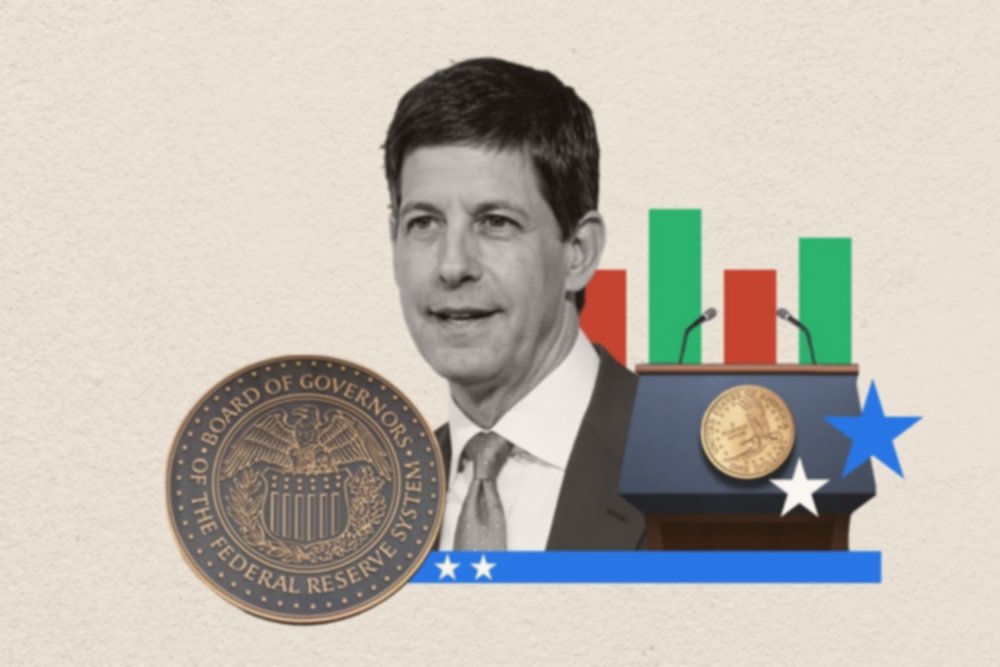

Bisnis.com, JAKARTA — Kevin Warsh was sworn in as the Chairman of the Board of Governors of the Federal Reserve (The Fed) today, Friday, May 22, 2026.
According to The Hill, Warsh was scheduled to be inaugurated by President Donald Trump as the new head of the United States (US) central bank, taking over the leadership of The Fed from Jerome Powell, who had served for two terms.
After years of criticizing previous Fed Chairs, Trump had emphatically stated before Warsh’s nomination that he would only consider candidates he trusted to cut interest rates. However, a surge in inflation and divergent views among Fed officials could make it challenging for Warsh to simultaneously fulfill the president’s wishes and uphold his mandate as the central bank’s leader.
Joe Brusuelas, Chief Economist at RSM, noted that Kevin Warsh begins his tenure as Fed Chair with what some perceive as a presidential mandate to cut interest rates. Yet, Brusuelas cautioned, “the latest rise in market-based inflation expectations indicates that Warsh and the Federal Open Market Committee (FOMC) must be prepared for the possibility of inflation continuing to increase, necessitating a shift in the Fed’s policy direction.”
Here are some of the principal challenges Warsh will confront upon officially assuming office.
Political Pressure from Trump
Beyond the myriad economic and financial challenges facing The Fed, there is the palpable political pressure from Trump, who has openly asserted that US interest rates should be significantly lower. The Fed’s refusal to cut interest rates close to zero for much of Trump’s first term was a primary source of tension between him and Powell, a Republican whom Trump appointed as Fed Chair in 2017.
Despite this, Warsh has maintained that Trump never asked him to commit to cutting interest rates, pledging instead to make decisions based solely on prevailing economic conditions. Earlier this week, Trump himself sought to temper concerns about potential intervention, stating that Warsh would be given the freedom “to do what he wants to do.” Trump lauded Warsh, saying, “He’s a very talented guy. He’ll be fine. He’ll do a great job.” Nevertheless, Trump’s recent comments stand in contrast to his previous stance, where he consistently emphasized his desire for a Fed leader willing to aggressively cut interest rates.
Soaring Inflation Due to Iran Conflict
Trump’s aspiration for lower interest rates is likely to face significant hurdles, primarily due to the ongoing conflict in Iran, which has fueled an upward spiral in prices. Annual US inflation surged to 3.8% in April, according to the Consumer Price Index (CPI) released by the US Department of Labor, marking its highest level in three years. Concurrently, producer prices in April also saw their fastest increase in nearly three years, intensifying concerns about inflationary pressures.
Warsh has suggested that much of the inflation surge stemming from the Iran conflict is attributable to temporary increases in fuel and food prices, which are expected to subside once the conflict de-escalates. Several top government officials also believe prices will drop once the Strait of Hormuz reopens. However, with no clear signs of the conflict abating, The Fed is likely to maintain current interest rates, or even potentially raise them, for an indeterminate period.
Christian Floro, a Market Analyst at Principal Asset Management, noted that these higher-than-expected inflation data compel the new Fed chair to re-evaluate questions of price stability and the appropriate timing for policy easing. “For investors, the escalating risk is that they may have to wait until 2027 before seeing any further policy easing from The Fed,” Floro warned.
Shrinking Workforce and Rising Tariffs
Even before the Iran conflict erupted in February, The Fed was grappling with how to manage an economy contending with a shrinking labor force and rising import tariffs. Data from the US Department of Labor indicates that Trump’s immigration crackdown and increased deportations have resulted in over 600,000 individuals leaving the US workforce over the past year. Job growth has also slowed sharply since Trump’s return to office in January 2025, with very limited net gains during his second term.
A concurrent decline in job seekers and job openings has helped to contain a surge in unemployment. The unemployment rate has only risen by 0.3 percentage points since the start of Trump’s second term. “The labor market, I would say, is pretty stable. Maybe not good, but stable. Meanwhile, inflation is not stable,” remarked Austan Goolsbee, President of the Federal Reserve Bank of Chicago, in an interview with Fox Business Network on Monday. Goolsbee further highlighted that inflation appears to be accelerating across several sectors not directly linked to the Iran conflict, thereby complicating the challenges Warsh faces.
Internal Divisions within The Fed
Warsh’s challenges extend beyond complex economic conditions to the intricate internal dynamics of The Fed. He will assume leadership of an FOMC that has experienced increasingly sharp polarization over the past two years. As FOMC chair, Warsh will lead the rate-setting committee and wield significant influence in monetary policy discussions. However, he holds only one of 12 votes in the decision-making process, necessitating the arduous task of building consensus with other members to advance his policy agenda.
This task has become progressively difficult in recent months. In May, the FOMC voted 8-4 to maintain interest rates, marking the first time since 1992 that more than three officials dissented from a rate decision. “We doubt that Fed Chair Kevin Warsh can deliver the rate cuts President Trump desires if incoming economic data do not support it,” wrote Standard Chartered Bank strategists Steve Englander and John Davies in a research note.
Legal Challenges
Warsh will also lead The Fed amidst a series of legal challenges involving the Trump administration, including the gradual winding down of a criminal investigation into Powell. Additionally, The Fed awaits a Supreme Court ruling on whether the White House possesses the authority to dismiss a member of the Fed’s Board of Governors, Lisa Cook. This ruling is poised to have profound implications for the independence of The Fed as the US central bank.
Summary
Kevin Warsh has officially assumed the role of Chairman of the Federal Reserve, succeeding Jerome Powell amid a complex economic landscape. He faces immediate pressure from President Trump to lower interest rates, which conflicts with his mandate to maintain price stability during a period of surging inflation. Key external challenges include the economic fallout from the Iran conflict, a shrinking U.S. workforce, and the implementation of new import tariffs.
Beyond these macroeconomic hurdles, Warsh must navigate deep internal polarization within the Federal Open Market Committee, which recently saw a historic number of dissents regarding interest rate policy. He also inherits significant legal and institutional challenges, including ongoing investigations and a pending Supreme Court ruling regarding the independence of the Board of Governors. Consequently, analysts suggest that meaningful policy easing may be delayed until 2027 if economic data fails to stabilize.