
Trial for Acid Attack Suspects on KontraS Activist Delayed as Medical Experts Detail Victim’s Severe Injuries
A court hearing to read the charges against four defendants in the acid attack case involving KontraS activist Andrie Yunus was postponed on Wednesday, May 20th, following testimony from ophthalmology and plastic surgery experts at the Jakarta II-08 Military Court. The military court proceedings highlighted the stark contrast between Andrie’s grievous injuries and the minor wounds sustained by the defendants.
The session commenced with the military prosecutor’s request to present two expert witnesses from Cipto Mangunkusumo General Hospital. These witnesses were Dr. Parintosa Atmodiwirjo, a plastic surgeon and head of the medical team that treated Andrie Yunus, and Dr. Faraby Martha, an ophthalmologist. Both doctors had been attending to Andrie Yunus “since his initial arrival in the early hours of March 13, 2026.”
Dr. Faraby Martha testified that Andrie Yunus’s right eye could only perceive light. “He couldn’t even pass the largest letter vision test; he could only distinguish whether there was light or not,” she stated. Throughout the hearing, both the military prosecutor and the defense counsel repeatedly questioned the doctors about Andrie’s ability to see and read. Dr. Faraby revealed that the severity of his eye injury reached “scale three out of four, indicating the most severe.”
A panel judge pressed for clarity on whether Andrie Yunus’s vision would ever return to normal after the treatment. Dr. Faraby explained that it was “difficult to see again as before,” leading the judge to inquire if the condition could be considered permanent disability. “It can be said so,” Dr. Faraby confirmed.
The severity of Andrie’s burns was also detailed by Dr. Parintosa. He stated that Andrie Yunus suffered burns across “20%, or 1/5 of his body. The wounds affected the entire skin layer, extending above the fatty tissue, meaning there would be no skin regeneration to close [heal] the wounds.” Consequently, Andrie would require complete rest following skin grafting procedures.
Military Court Compares Andrie Yunus’s Injuries to Defendants’ Wounds
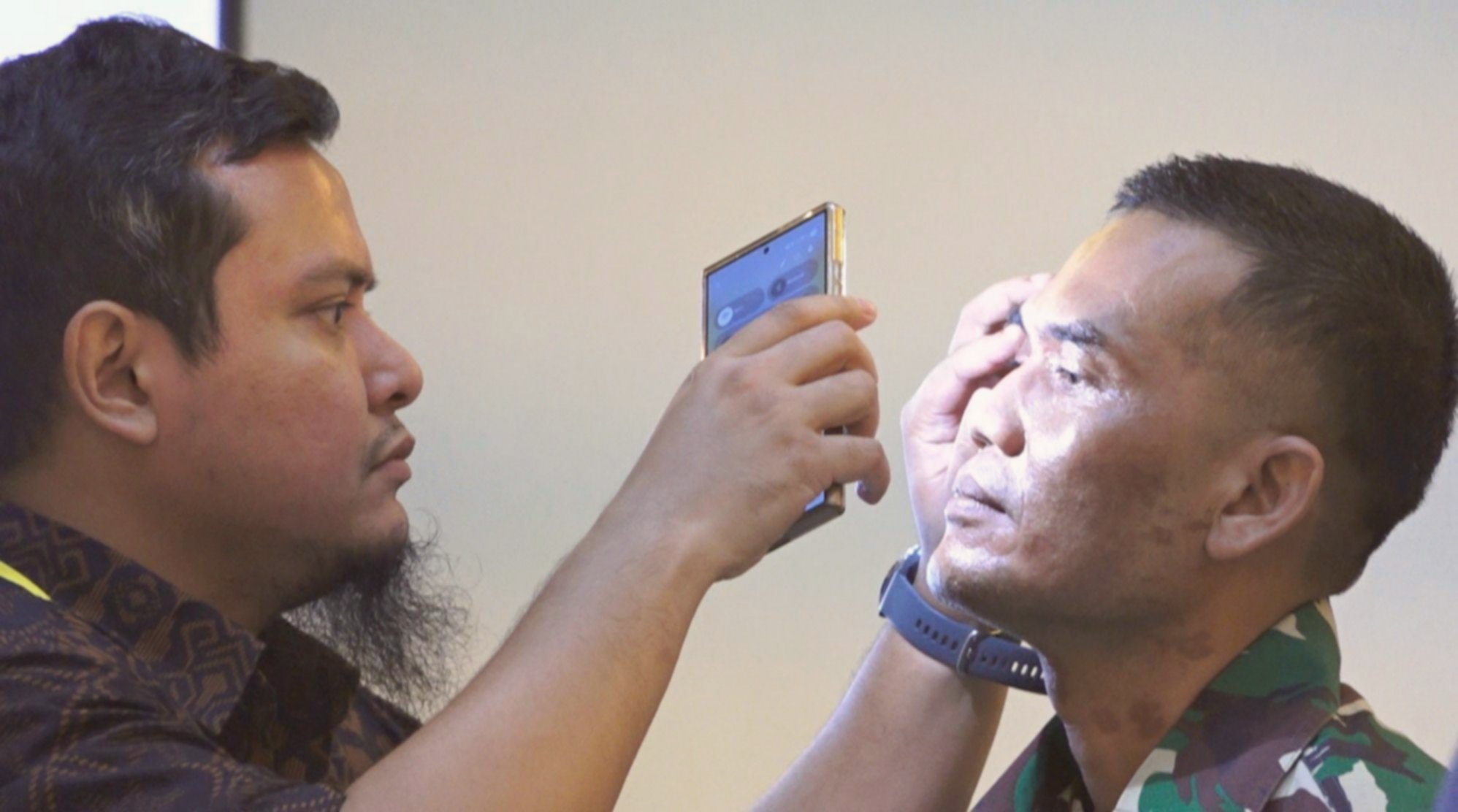
The defense team requested the expert witnesses examine the wounds of the first and second defendants and compare them to Andrie’s injuries. Dr. Faraby examined the defendants’ eyes, using a phone flashlight. She testified, “I cannot yet conclude, but the wounds are similar.” It was noted that the first and second defendants were the primary perpetrators of the acid attack and sustained splashes of the corrosive substance themselves during the assault.
Dr. Parintosa, who also closely examined the two defendants, stated that their injuries were clearly different. The defendants’ wounds were described as “shallow. They will heal if the wounds are not deep.”
In a previous hearing on Wednesday, May 13th, the military judge had requested Andrie Yunus’s presence in court to assess the severity of his injuries. However, according to the defendants’ legal counsel, the Witness and Victim Protection Agency (LPSK) had informed the court that “the concerned individual cannot provide testimony in the courtroom.” Consequently, the defense inquired about the medical reasons for the victim’s absence. Dr. Parintosa explained that Andrie Yunus was “under medical supervision with medication, and there is a risk of infection if the patient engages in activities where many people are present, such as in a trial. His eyes are vulnerable to external infections.”
An hour later, the presiding judge inquired if Andrie could participate via Zoom meeting, to which the witness responded, “Medically, yes.”
The military prosecutor was scheduled to read the charges against the four defendants on Wednesday, May 20th. However, the prosecutor will need to restructure the charges after hearing the expert testimonies. The indictment reading is now scheduled for Wednesday, June 3rd.
Allegations of Ethical Violations
On Monday, May 18th, the Tim Advokasi untuk Demokrasi (TAUD), representing Andrie Yunus, reported three judges presiding over the military trial to the Supervisory Chamber of the Supreme Court for alleged ethical violations. One alleged violation involved the panel of judges seemingly demonstrating the correct method for carrying out an acid attack. “There were inappropriate words in the trial, such as ‘stupid,’ and information was provided as if giving instructions on how to properly throw acid,” stated Daniel Winarta, a representative of TAUD. The judges were also accused of procedural violations, such as handling evidence without gloves. The alleged ethical breaches also extended to attempts to pressure the military prosecutor to present Andrie Yunus in court, even threatening legal action against Andrie if he failed to testify.
Major Chk Endah Wulandari, spokesperson for the Jakarta II-08 Military Court, responded by stating, “The report submitted by TAUD to the Supreme Court is their right to provide corrections to us at the Military Court.”
TAUD argued that the military justice system lacks guarantees of independence and impartiality, particularly when the military institution judges its own members. Previously, on Monday, May 11th, TAUD submitted a statement of the victim’s refusal of the military trial process in the acid attack case against Andrie Yunus. TAUD believes the trial process has failed to provide safety and recovery for the victim and risks deepening trauma, especially with an approach that disregards Andrie Yunus’s status as a victim of serious human rights violations.
The next step for TAUD is to file a pre-trial motion at the South Jakarta District Court. This lawsuit aims to challenge the alleged unjustified delay in handling the case and a “covert” halt to the investigation. TAUD also cited the slow progress by Polda Metro Jaya as the reason for seeking the pre-trial motion. According to TAUD, in the two months following the acid attack, the investigation showed no clear, transparent, or accountable progress. Polda Metro Jaya has also been accused of providing conflicting information regarding the case’s handling status and its alleged transfer to the TNI Military Police Center (Puspom TNI). This is despite the police reportedly having CCTV footage, identifying suspects, and releasing the initials of those allegedly involved. However, the investigation has not demonstrated serious or public follow-up.
One of TAUD’s demands is for Polda Metro Jaya to resume and conclude the investigation professionally, transparently, and accountably. A previous independent investigation by TAUD indicated that at least 16 individuals were involved in the acid attack on Andrie Yunus.
BBC News Indonesia also covered TAUD’s independent investigation, which identified at least 16 suspects in the alleged attempted murder of KontraS activist Andrie Yunus. (Link to the report can be found here).
* TAUD Rejects Transfer of Andrie Yunus Acid Attack Case to Military Court – ‘An Attempt to Protect the Mastermind’
* Why Was Acid Used to Attack Andrie Yunus and Two Other Activists?
* KontraS Activist Andrie Yunus Attacked with Acid, Drawing UN Human Rights Council Attention – ‘Horrific Attack’
Summary
The Jakarta II-08 Military Court recently heard expert testimony confirming that KontraS activist Andrie Yunus suffered permanent vision loss and severe full-thickness burns covering 20% of his body following an acid attack. Medical experts from Cipto Mangunkusumo General Hospital detailed that the victim’s right eye injury reached a grade three severity, rendering him unable to see beyond basic light perception. In contrast, the medical examination of the defendants revealed only shallow wounds, highlighting a significant disparity between the injuries sustained by the victim and those of the alleged perpetrators.
Due to the complexity of the medical evidence, the military prosecutor postponed the reading of charges against the four defendants until June 3rd. Meanwhile, the victim’s legal team has filed reports of ethical violations against the presiding judges, citing unprofessional conduct and procedural irregularities during the trial. These developments have fueled broader criticism regarding the impartiality of the military justice system, leading advocates to pursue further legal action to ensure a transparent and comprehensive investigation into the attack.