
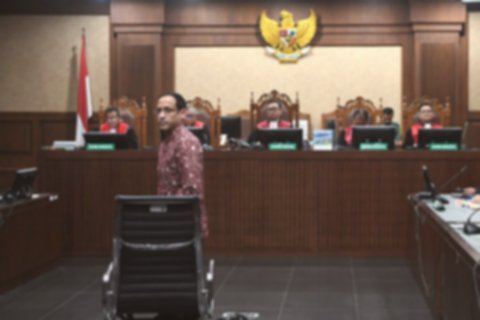

Former Minister of Education, Culture, Research, and Technology Nadiem Makarim faces a potential 18-year prison sentence and a Rp 1 billion fine after prosecutors demanded a conviction in the high-profile Chromebook procurement corruption case. During the hearing at the Jakarta Corruption Court on Wednesday (May 13), Public Prosecutor Roy Riady formally requested that the panel of judges find Nadiem legally and convincingly guilty of corruption.
Beyond the 18-year prison term, the prosecution has demanded that Nadiem pay Rp 809 billion in restitution, asserting that this sum represents the illicit gains he acquired through the procurement project. Furthermore, the prosecution is seeking an additional Rp 4.8 trillion, claiming this amount constitutes wealth that is disproportionate to his legitimate income and is suspected to be linked to the alleged criminal activities.
“We request the court to impose an additional penalty on the defendant, Nadiem Anwar Makarim, to pay restitution of Rp 809,596,125,000 and Rp 4,817,469,603,758, which represent assets not commensurate with his legal earnings,” stated the prosecutor. Failure to pay these amounts within one month of a final court ruling would result in the seizure and auction of his assets. Should those assets be insufficient, the prosecution has proposed a further 9-year prison sentence.
Emotional Scenes in Court
The courtroom atmosphere was heavy with emotion as Nadiem’s wife, Franka Franklin Makarim, and his father, Nono Anwar Makarim, attended the proceedings. Following the reading of the indictment, a visibly distraught Nadiem approached his family, breaking down in tears while embracing his wife. He was also seen sharing a poignant moment with his father, who witnessed the proceedings in support of his son.


Nadiem Expresses Deep Disappointment

Speaking to the media after the session, Nadiem did not hide his frustration, labeling the day as profoundly disappointing. He expressed deep distress over the situation, particularly citing the recent 4-year sentence handed down to his former special staff member, Ibrahim Arief. “There are no words to describe my feelings regarding the decision on Ibam yesterday—a 4-year guilty verdict that makes absolutely no sense,” Nadiem remarked.
Nadiem further criticized the cumulative sentencing, noting that if he is unable to pay the massive restitution totaling Rp 5.6 trillion, his total prison time could extend to nearly three decades. “The sentence is 18 years, plus 9 years for the restitution. This record is larger than those for various other major criminals,” he argued. He adamantly maintained that there was no evidence of fund diversion or administrative wrongdoing during the trial.
His legal counsel, Dodi S. Abdulkadir, echoed these sentiments, labeling the prosecution’s stance as unprofessional. He argued that the perceived growth in Nadiem’s wealth was primarily due to fluctuations in stock market prices rather than corruption, asserting that such legal interpretations pose a dangerous threat to the integrity of law enforcement.
Questioning the Rp 5.6 Trillion Restitution

Nadiem also expressed bewilderment at the staggering financial demands. He clarified that his total wealth at the end of his ministerial tenure was nowhere near the Rp 5 trillion mark. He characterized the prosecution’s reliance on his peak wealth valuation during his company’s IPO as misleading and “fictitious.” According to Nadiem, the assets in question were legitimately earned through his work with Gojek, established long before he entered public service.
No Regrets for Public Service

Despite the immense pressure, Nadiem stated he does not regret his decision to join the government. “To earn money, you have a lifetime. To help the next generation of our nation become better, that is a once-in-a-lifetime opportunity,” he said. He emphasized that he accepted his ministerial role fully aware of the potential risks, including legal challenges, stating that the future of Indonesia is far more important than his personal interests.
“I am disappointed and heartbroken. One only feels heartbreak when they love their country. That the state could do this to me after all my dedication—yes, I am hurt. But that does not mean I do not love this country,” Nadiem concluded.
Prosecution Defends Evidence

In response to the defense, the Attorney General’s Office emphasized that the 18-year demand was constructed systematically based on verified evidence rather than opinion. Prosecutor Roy Riady highlighted the importance of electronic evidence seized from the defendant’s technical team, including digital documents and communication records. “People can lie, but electronic evidence cannot. A May 27th document specifically mentions ‘based on the Minister’s directive,’ which clearly illustrates the coordination behind this project,” Roy asserted.
Summary
Former Minister Nadiem Makarim faces a potential 18-year prison sentence and a total of Rp 5.6 trillion in restitution following allegations of corruption in a Chromebook procurement project. Prosecutors argue that the restitution includes funds illicitly gained and assets disproportionate to his legal income, warning that failure to pay could result in an additional nine-year prison term. Makarim maintains his innocence, claiming the financial charges are based on misleading valuations of his pre-ministerial assets and stock holdings.
Makarim has expressed deep disappointment and heartbreak over the proceedings, describing the sentencing demands as illogical and unprofessional. His legal team contends that the prosecution’s claims are unfounded and ignore the legitimate origins of his wealth. Meanwhile, the Attorney General’s Office insists its case is built on verified electronic evidence and documents that implicate the former minister in direct coordination of the project.