
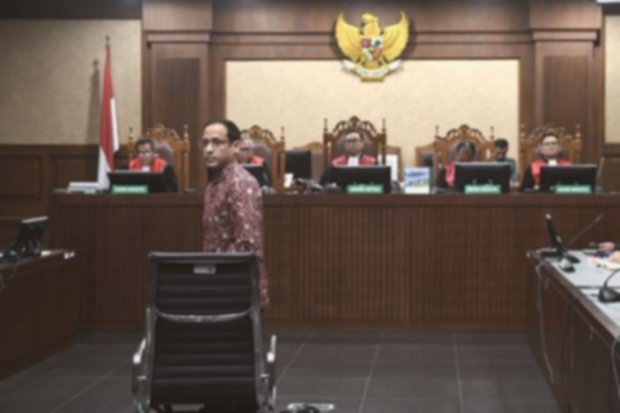

Legal representatives for former Minister of Education, Culture, Research, and Technology, Nadiem Anwar Makarim, have formally challenged the public prosecutor (JPU) to disclose the key evidence used to implicate their client in a high-profile corruption case. Defense attorney Ari Yusuf Amir argued that the severe charges brought against Nadiem stem from a fundamental misunderstanding of the facts by the prosecution.
Nadiem currently faces a daunting 18-year prison sentence, a fine of Rp 1 billion—with an additional 190 days of confinement—and a restitution order totaling Rp 5.6 trillion, which could result in a further 9 years of imprisonment if not paid. “In our assessment, these charges are driven by emotion and ambition rather than legal rationality and logic,” Ari stated in South Jakarta on Wednesday (May 20).
A primary point of contention, according to the defense, is the prosecution’s misinterpretation of the PT GoTo Gojek Tokopedia Tbk stock split. While the JPU points to a massive surge in Nadiem’s share count—rising from 58,416 in June 2021 to approximately 15 billion by October 2021—Ari emphasizes that this was a standard stock split designed to increase the number of shares without altering the total value of the investment. He clarified that the price per share was proportionally reduced, leaving the total market value unchanged.
Furthermore, the defense dismissed the digital communications between Nadiem and his staff, which the JPU frequently cites as incriminating evidence. Ari insisted that these exchanges merely reflect routine administrative coordination within the ministry and fail to provide any proof of criminal activity. “We have found no electronic evidence that cannot be contested,” he added.
The prosecution’s case hinges on allegations of corruption linked to the procurement of Chromebook laptops between 2019 and 2022. The JPU contends that Nadiem abused his authority by issuing Regulation of the Minister of Education and Culture Numbers 5 of 2021 and 3 of 2022, which set the operational guidelines for the Physical Special Allocation Fund for education during that period.
During a hearing at the Jakarta Corruption Court (Tipikor) on May 13, prosecutors alleged that these regulations facilitated personal enrichment for the defendant, totaling Rp 809 billion and Rp 4.87 trillion, while contributing to a state loss of Rp 1.56 trillion. The JPU identified three main pieces of evidence to support these claims: records from a May 27, 2020 meeting, and digital conversations involving Jurist Tan and Fiona Handayani, including messages within the “Mas Menteri Core” WhatsApp group.
The prosecution maintains that Nadiem is responsible for a total state loss of approximately Rp 2.1 trillion, supported by a Financial and Supervisory Agency (BPKP) finding that the procurement of Chrome Device Management (CDM) cost US$ 44.05 million, or roughly Rp 621.38 billion.
The JPU argues that the foundation for these alleged crimes was laid during a digital meeting on May 6, 2020, where Nadiem allegedly steered the ministry toward adopting Chromebooks and the CDM system. Citing witness testimony from Hamid, the prosecution claims Nadiem directed the ministry to transition from Windows to the Chrome platform, stating, “Go ahead with Chromebook,” a directive they believe confirms his role in the alleged scheme.
Summary
Legal counsel for Nadiem Makarim has formally contested the prosecution’s corruption charges, labeling them as emotional rather than legally grounded. The defense specifically refutes the prosecutor’s interpretation of a significant increase in Nadiem’s GoTo stock holdings, clarifying that the change resulted from a standard stock split rather than illicit gains. Furthermore, the defense maintains that digital communications cited by the prosecution represent routine administrative duties rather than evidence of criminal activity.
The corruption case centers on alleged state losses of Rp 2.1 trillion stemming from the procurement of Chromebooks and the implementation of Chrome Device Management between 2019 and 2022. Prosecutors argue that Nadiem abused his authority by issuing specific ministerial regulations to facilitate this procurement and enrich himself. Nadiem currently faces severe penalties, including an 18-year prison sentence and substantial financial restitution, while his defense team continues to challenge the validity of the prosecution’s electronic and testimonial evidence.