
North Java Coast Industrialization: Economic Boon or Environmental Disaster?
The Indonesian government touts its industrialization projects along the north coast of Java as engines of economic growth and prosperity for local communities. However, a closer look reveals a far more troubling reality: a cascade of losses that threaten the livelihoods of those who depend on the region’s natural resources. Economists predict that within the next decade, these projects will trigger a decline in community income and a sharp drop in productivity in the fisheries and agricultural sectors.
As President Prabowo Subianto approaches his first year in office, his ambitious goal of achieving rice self-sufficiency by October 2024 appears increasingly unattainable. A key obstacle is the rampant conversion of productive agricultural land into industrial zones. Indramayu, a coastal area in West Java, once celebrated as the source of over half of Indonesia’s national rice supply, is now witnessing its fertile fields transformed into concrete landscapes.
Indramayu, along with other north coastal regions of Java such as Batang and Kendal in Central Java, and Gresik in East Java, have become focal points for industrial development under the banner of National Strategic Projects (PSN) and Special Economic Zones (KEK).
Bhima Yudhistira, Executive Director of the Center of Economic and Law Studies (Celios), describes the multi-dimensional losses suffered by coastal communities amid this aggressive industrial expansion as a “downstream paradox.”
According to a Celios study, industrial projects along the Pantura (north coast) are projected to cause a staggering Rp219.39 trillion decrease in gross domestic product (GDP) and a Rp218.08 trillion drop in community income over the next 10 years. The agricultural, forestry, and fisheries sectors are also expected to suffer losses of Rp5.70 trillion during the same period.
This report represents the third and final installment of an in-depth investigation into what has been termed “ecocide”—the structured, massive, and systematic destruction of the environment—along the Pantura.
This final installment explores the contradiction between agricultural land being converted into industrial zones and the government’s ambition for self-sufficiency and food security, while the people bear the brunt of the losses.
This report series was produced in collaboration with the Pulitzer Center.
Farmland Transformed: Fields into Factories
In Losarang, Indramayu, a group of farmers can be seen diligently planting rice in their fields. The scene is starkly contrasted by excavators leveling rice paddies with sand brought in by a constant stream of trucks.
Nearby, concrete structures in the Losarang industrial zone stand amidst the remaining stretches of farmland. According to maps from Bhumi ATR-BPN and the Indramayu Spatial Plan (RTRW), the factory construction site is located on what is designated as Protected Rice Field Land (LSD).
“Yes, the agricultural land here is being transformed into an industrial area,” said Ruskiyah, a farmer encountered on her land on July 12th.
Ruskiyah, 54, is a farmer in Losarang and the secretary of the Puntang Village Farmer Group Association (Gapoktan) in Losarang District.
The industrial zone under construction on the agricultural land, Ruskiyah said, is planned to cover 1,000 hectares, located north of the Jalan Raya Pos (Great Post Road) built by Governor-General Herman Willem Daendels in the early 19th century.
The conversion of agricultural land into industrial zones is feared to have an impact on the decline in agricultural production.
One hectare of productive rice field typically produces six tons of rice per harvest. This means that approximately 6,000 tons of potential rice harvest will be lost if 1,000 hectares of rice fields in Losarang are converted into industrial areas.
About 30 minutes towards the north coast of West Java lies the rice fields of Mekarsari, Patrol District, Indramayu.
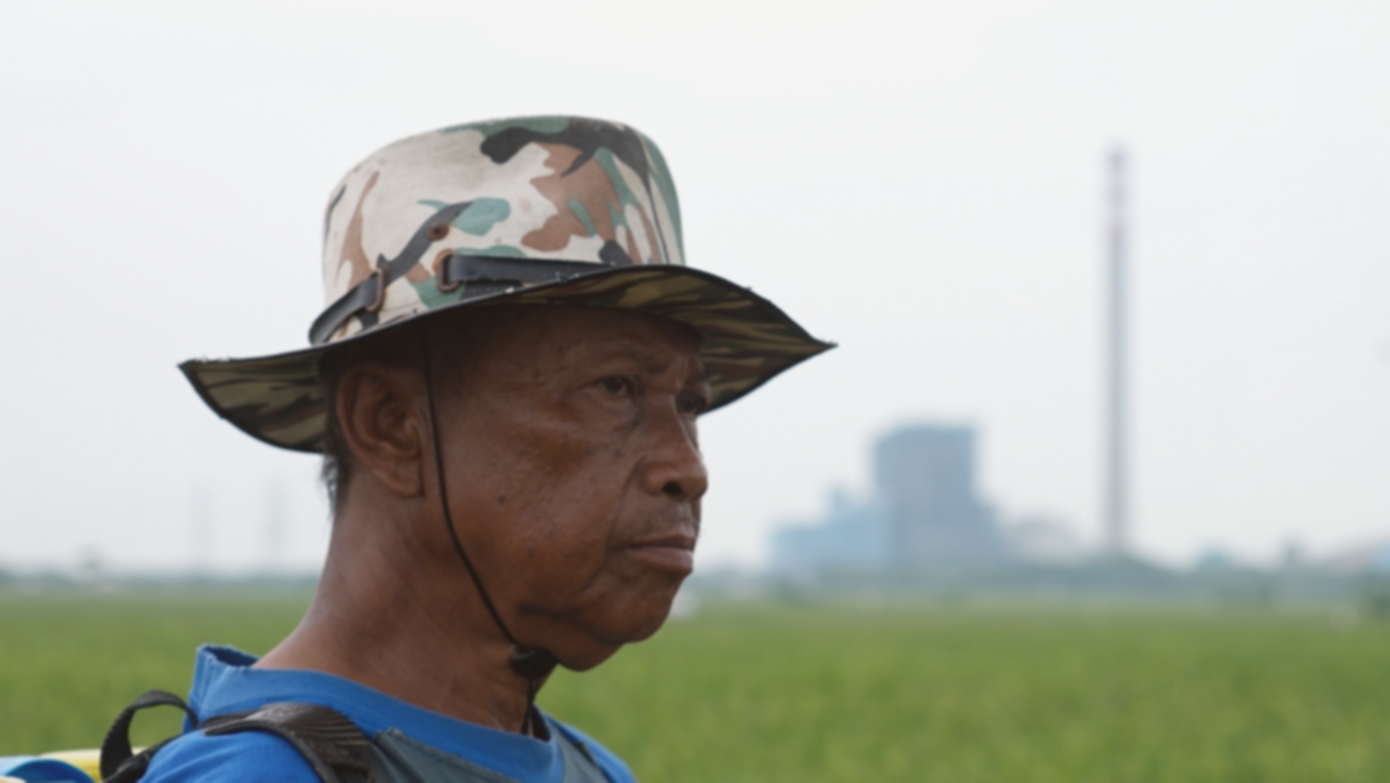
Rodi, 65, relaxes on the edge of a rice field, his long-sleeved shirt soaked with sweat. After wiping his brow, the man affectionately known as Mang Rodi takes off his cowboy hat and fans himself.
Mang Rodi is a farm laborer in Mekarsari. On the land he works, he plants rice and vegetables, just like other farm laborers.
From where he sits, his gaze sweeps across the expanse of rice paddies turning yellow. Green vegetables stretch as far as the eye can see. However, his view to the west is interrupted by a tall smokestack.
“That’s the Indramayu coal-fired power plant (PLTU),” said Mang Rodi.
The smokestack pointed out by Mang Rodi is located in Sumuradem, Sukra District, Indramayu.
The distance between PLTU Indramayu 1—built on 83 hectares, constructed in 2007, and operational since 2011—and the agricultural area in Mekarsari is quite close, about 1.5 km.
Mekarsari is known as a productive agricultural area where one hectare of rice field produces around 7-8 tons of rice. Besides being famous for its pure white rice, Mekarsari is also known as a producer of shallots.
But gradually, agricultural land in Mekarsari is being eroded by abrasion due to land subsidence and rising sea levels on the north coast of Indramayu.
Mang Rodi said that the situation in Mekarsari worsened after the Indramayu PLTU was built near his farmland. The soil became acidic, and the smoke from the PLTU affected the activities of farmers.
The smoke emitted from the PLTU’s chimney often causes farmers to experience shortness of breath, eye irritation, and “those who are not physically strong may faint,” said Mang Rodi.
However, instead of providing protection in agricultural areas eroded by abrasion, the government—in collaboration with Japan—plans to build PLTU 2 as an expansion of the previous PLTU, to be built in Mekarsari.
“The area is about 266 hectares,” said Mang Rodi, mentioning the area of land that has been acquired in Mekarsari.
This expansion, according to Mang Rodi, makes farm laborers even more miserable. The impact of PLTU 1 alone, said Mang Rodi, has harmed farm laborers. With the expansion of PLTU 2, which will seize agricultural land, the losses will increase.
Farm laborers who are members of the Indramayu Coal Ash-Free Network (Jatayu), staged protests all the way to Jakarta. Mang Rodi, who is the chairman of Jatayu, refuses to allow agricultural land to be cemented into a power plant complex.
The reason for Jatayu’s rejection is to maintain the land that is the basis of their lives, as well as the wider Indonesian community. And the land that will be cemented, said Mang Rodi, is rice field land that has been productive agricultural land for a long time.
Mekarsari agriculture also contributes to Indramayu’s position as a food granary. This is food security. And maintaining Mekarsari’s rice field land is a necessity for Jatayu farmers.
“This food security is important. It’s useless to have weapons defense if you don’t eat,” said Mang Rodi enthusiastically.
“The people’s food is rice and vegetables, not concrete,” is the reason why Jatayu rejects it.
Jatayu’s action was quite successful; in 2022, Japan withdrew from the funding cooperation for the construction of PLTU 2.
Mang Rodi and other farm laborers can still plant on the rice fields that are now controlled by the state because on that land, there is still an information board with the logo of the State Electricity Company (PLN), and it reads: STATE-OWNED LAND. CENTRAL JAVA REGION I DEVELOPMENT MAIN UNIT.
Although Mang Rodi and other farm laborers can now plant, the threat to the living space of Mekarsari farm laborers is not over.
There are still plans to build an industrial area located in Patrol, Sukra, and Kandanghaur Districts, which are included in the Patrol Industrial Allocation Zone (KPI).
As a farmer, Mang Rodi will reject anything that erodes the living space of farmers.
Food land must be maintained. He also questioned the meaning of a rice granary for Indramayu if the government only wants to erode and expel farmers from their living space.
“Building factories uses up land; why is there a phrase for food security, but the land is used up? What will be defended, does food come from the sky? Food also needs to be planted, planted on the earth, not on top of concrete,” said Mang Rodi, firmly.
The occurrence of land conversion in Indramayu is also recorded in BPS data, which shows that in the last 7 years, 2018-2024, there has been a decrease in land area followed by a decrease in rice production.
In 2022, Indramayu’s rice production had increased compared to the previous year, from 1,319,623.64 tons to 1,482,255.86 tons. However, this happened because the land area increased.
But in 2023, rice production fell again to 1,424,303.1 tons, triggered by the shrinking of agricultural land.
The decline in rice production also occurred in Kendal, Central Java. Many agricultural lands have been converted into ponds or left abandoned due to tidal flooding.
The ponds managed by one of the pond farmers in Kendal, Turmudzi, used to be rice fields. However, because they were always affected by tidal flooding and could no longer be planted, the land is now a pond.
Mororejo Village, which is adjacent to the Kendal KEK, is also experiencing the same thing. In the last 3-4 years, tidal flooding has started to enter the rice fields.
Rice can no longer be planted. Many farmers have turned it into ponds, and not a few have left it abandoned.
BPS data shows that rice production in Kendal Regency in the last seven years has fluctuated.
But the trend that has occurred is that the area of land and rice production has decreased. In 2018, the land area was 36,851 hectares, with rice production of 199,421 tons.
In 2024, the land area was 29,188.5 hectares, with a total rice production of 175,081.41 tons.
Meanwhile, agriculture in Batang Regency has also experienced a decline. Although it had increased in 2023, it fell again the following year.
The trend that has occurred in the last seven years is the shrinking of land area, followed by a decrease in rice production.
Referring to BPS data, in 2018 the area of rice crops was 34,393 hectares, with a total rice production of 165,666 tons.
And in 2024, the land area decreased to 25,536.62, with rice production also decreasing, to 139,924.97 tons.
As for agriculture in Gresik Regency, it has actually increased in the last seven years. But in 2024, rice production plummeted because the land area decreased by more than 10,000 hectares.
BPS data shows that the area of crops in Gresik Regency in 2018 was 57,721.64 hectares, with rice production of 351,702.39 tons. It continued to increase to 66,202.61 in 2023, and could produce 417,428.58 tons of rice.
However, in 2024, the land area became 54,057.45 hectares. The rice production also decreased to 328,959.53 tons.
The Utopia of Food Self-Sufficiency
The North Coast of Java is one of Indonesia’s food granaries, especially rice, with a contribution of 54.22 percent to national rice production. This is stated in Presidential Regulation Number 12 of 2025, signed by Prabowo after becoming president.
However, land conversion in the name of Special Economic Zones (KEK) and National Strategic Projects (PSN) has a significant impact on Indonesia’s food security.
The Executive Director of the West Java branch of the Indonesian Forum for the Environment (Walhi), Wahyudin, highlighted Presidential Regulation Number 87 of 2021, concerning the development of the Rebana Area and southern West Java.
According to Iwank, as he is affectionately known, the Presidential Regulation is a threat to national food security because many agricultural lands are being converted as a result.
The Presidential Regulation was strengthened by West Java Governor Regulation (Pergub) Number 14 of 2023 concerning the Rebana Area Development Action Plan for 2020-2030, issued when Ridwan Kamil was the Governor of West Java.
In the context of the Rebana Triangle, which includes Indramayu; Cirebon; and Subang, this policy automatically threatens Indramayu, which has been known as the largest rice granary in West Java.
Referring to the Action Plan Governor Regulation, the land needed for the development of the Rebana Area reaches 43,912 hectares. But in the RTRW of regencies and cities included in the Rebana area—Indramayu, Subang, Cirebon, Sumedang, and Majalengka—the total area is only 17,925 hectares.
This difference of 25,987 hectares, by Iwank from Walhi Jabar, is called a “mark up.”
“The area of the Rebana KPI (Industrial Allocation Zone) does not comply with the RTRW policies of the Regency/City,” said Iwank.
Referring to that data, continued Iwank, many agricultural lands and ponds in Indramayu will be lost.
“This not only threatens the conversion of agricultural areas but also threatens water availability,” he added.
In the Indramayu Regency RTRW 2024-2044 as stipulated in Regional Regulation Number 9 of 2024, the area of the industrial allocation zone (KPI) is only 14,110 hectares.
However, the Indramayu Regency government is preparing a KPI area of 20,000 hectares. There is a difference of 5,890 hectares exceeding what is stipulated in the RTRW.
Of this land, 85 percent is located in the coastal area. Therefore, many Protected Rice Field Lands (LSD) are threatened with loss due to land conversion for industry.
The Regent of Indramayu, Lucky Hakim, has been asked for comment regarding this land issue, but has not responded as of the publication of this report.
Instead of protecting agriculture, continued Iwank, the current Prabowo Subianto administration is continuing the previous government’s programs that are damaging agricultural land.
In fact, on the other hand, Prabowo himself is craving the realization of food security in Indonesia.
“I can’t imagine that the food granary that has been the mainstay of the people of West Java and the nation, its agricultural land is being converted. Then where, in which region, will Prabowo’s food security program be answered? Now this is not related,” Iwank is puzzled by the government’s policy, which is far from the mark.
During his inauguration speech last year, Prabowo confidently stated that under his leadership, Indonesia could achieve food self-sufficiency and become the world’s food granary.
“We are ready to become the world’s food granary,” said Prabowo in his inauguration speech, October 20, 2024.
Not even a year later, last September, in front of the UN General Assembly, September 23, 2025, Prabowo boldly told the world that Indonesia had achieved rice self-sufficiency.
He was also confident that in the next few years, Indonesia could become the world’s food granary. He said that Indonesia’s rice production and grain reserves were at their highest level in history.
In front of delegates from various countries, Prabowo also said that Indonesia had exported rice to other countries in need.
However, BPS data shows that the highest rice production occurred in 2018, not during his leadership.
In that year, from January to August, total rice production was 45.99 tons. Meanwhile, in 2025, in the same time period, total production was only 43.75 tons—even that still uses provisional figures and potential.
On the other hand, Indonesia is still dependent on Vietnam, India, Thailand, Saudi Arabia, and other countries in terms of rice imports. BPS data shows that until July 2025, rice imports were recorded at 70,543.5 tons.
Even so, Indonesia also exported rice to the United Arab Emirates in July 2025, as much as 1.1 tons of rice. However, the amount of imports is far greater than exports.
Prabowo’s ambition to achieve rice self-sufficiency in Indonesia is increasingly threatened. This is because of the conversion of rice fields into concrete, as happened in Indramayu, West Java.
In fact, this Pantura region, which is experiencing land shrinkage, is claimed to contribute more than half of the national rice supply.
Previously, during the 2019 Presidential Election (Pilpres) campaign, Joko Widodo promised to maintain Indramayu as a national rice granary. After being elected as President, the promise was revived with his visit to Indramayu.
In October 2023, President Jokowi symbolically performed a rice harvest ceremony in Karanglayung Village, Sukra District. This location is known to be not far from a neighboring village, namely Mekarsari, where Mang Rodi lives.
This harvest ceremony was carried out after he issued Presidential Regulation Number 87 of 2021 concerning the acceleration of development in the Rebana Area, which is said to be the root of the problem that evicts and damages agricultural lands in Indramayu.
As a farm laborer, Mang Rodi has a strong determination to maintain rice fields in Indramayu, not only in his village of Mekarsari, but also throughout the region.
For Mang Rodi, the struggle to maintain agricultural land is a fundamental issue equivalent to maintaining his dignity.
He strongly rejects and is unwilling if the productive rice fields in Indramayu are eroded or converted by the interests of companies or any development.
“The hope of farmers is that government policies can maintain agriculture. Don’t just be good at talking, but the goal does not match the mouth that conveys it,” hoped Mang Rodi.
Meanwhile, Ruskiyah complained about a serious problem regarding the scarcity and high price of fertilizer.
In addition, government policies that often decide to import rice, especially during the harvest season, are considered to be suppressing and harming farmers because they cause a drop in grain prices.
“When farmers harvest, the government imports instead, and if it is bought, the price is cheap,” complained Ruskiyah.
BPS data shows that total rice imports reached more than 11,700,000 tons in the last eight years.
This is a hard blow for farmers like Ruskiyah and Mang Rodi. Moreover, imports are usually carried out when the harvest season arrives. That is also what underlies the farmers to finally switch professions.
“If it’s like that [loss] all the time, there will be no results,” he said.
Multiple Losses
The losses of coastal communities are multiple, not only bearing the impact of ecological damage but also economic, health, educational, social, and cultural impacts.
The Executive Director of the Center of Economic and Law Studies (Celios), Bhima Yudhistira, calls the phenomenon of multidimensional losses suffered by the community amid the aggressive industrial development as a “downstream paradox.”
This paradox refers to the contradiction where a national economic program that should bring progress instead creates setbacks and losses for local communities.
Bhima examined and calculated the impact of the construction of KEK and PSN industrial areas in the East, Central, and West Java Pantura.
The total land area reaches 12,546 hectares, but the impact of damage due to the loss of land function per hectare, every year is Rp690.98 million.
Looking at the 2024 KEK report, the accumulation of investment collected is Rp263.4 trillion and absorbs 160,874 workers.
However, the Celios study shows more losses than gains. The presence of KEK, especially on the north coast of Java Island, actually reduces Gross Domestic Product (GDP) by Rp219 trillion rupiah in a period of 10 years.
This means that until 2035, even if there are benefits, there are more losses.
“There are benefits, but it becomes a net loss, more losses,” said Bhima.
The absorption of labor, which is claimed to be able to absorb thousands of workers, especially local communities, is dismissed by Bhima. He said that labor absorption is not comparable from a macro and micro perspective.
From a macro perspective, the more massive construction of KEK, especially in the era of President Joko Widodo, the absorption of labor is becoming less qualified.
Every Rp1 trillion of investment funds that entered, in 2015 absorbed 2,600 workers. But in the first semester of 2025, the absorption was only 1,200 workers.
“If it continues to decline, it means that the investment that comes into the KEK is also less qualified,” explained Bhima.
If you look at it in more detail, the community around the KEK, whose majority are fishermen and farmers, does not connect with the labor needs in the KEK industries.
Finally, said Bhima, most of them become contract day laborers, or sub-sub contractors. And most of them use an outsourcing system.
Or residents who hope for laundry services, boarding houses, or other services whose income is very small. According to Bhima, this does not greatly help the local community’s economy.
“So before and after the existence of the KEK, there was no significant change,” he said.
What Bhima said is exactly what happened in Gresik, Kendal, and Batang.
In Gresik, many fishermen have finally stopped fishing and chose to work on building projects in the KEK. In Kendal, a number of pond farmers are even thinking of selling their ponds and choosing to open a boarding house business.
Seeing the reality that is happening, Bhima considers the labor absorption figures for KEK and PSN industrial projects to be just empty claims.
The government, continued Bhima, never calculates how many local workers have lost their jobs, changed professions, and other impacts.
In addition to land degradation and increasingly frequent tidal flooding, there are also environmental impacts related to health, namely due to PLTU.
The Celios study found that the energy source in the KEK comes from PLTU. There are a total of five PLTUs in Java that supply energy to the KEK.
This coal-based energy supply chain has an impact on health costs. And the loss reaches Rp438 trillion over 10 years.
Bhima considers that the government’s excuse that KEK can encourage economic growth and improve people’s welfare, even relying on it to grow the economy by 8 percent, is just utopian and empty claims.
“KEK is not effective as a lever for economic growth,” he said.
The government, according to Bhima, made a fatal mistake by changing the function of agricultural land.
The agricultural and fisheries sectors—both capture and cultivation—should be maintained as pillars of food security in economic development, but the reality that occurs is contradictory.
The government is considered to have eroded these two important sectors, resulting in multiple losses for the community.
Celios calculated that the losses from the agricultural, forestry, and economic sectors from the construction of KEK in Pantura reached Rp5.70 trillion over a period of 10 years.
“Food self-sufficiency is just pseudo. Land that is productive has been replaced by iron and concrete,” said Bhima.
An environmental law expert from Gadjah Mada University (UGM), Agung Wardana, said that the development model applied in Pantura is not adaptive to climate change and even increases the vulnerability of communities and the environment to climate change.
“The development is not ecological,” said Agung.
The regulatory policies implemented by the government are accused of being the cause of comprehensive system damage, starting from spatial planning, environmental protection, social protection, to disaster management systems.
This chain of damage leads to the increasingly destroyed condition of Pantura, the increasingly urgent threat of sinking, and makes the local community the most disadvantaged party.
What happened in Pantura, according to Agung, is what is called “ecocide,” the structured, massive, and systematic destruction of the environment.
The state, through the policies issued, has opened up space for the destruction of ecosystems in Pantura. The state also compromises the safety of the community that should be saved from the impacts of the climate crisis.
“What the government is doing in Pantura by expanding the KEK and destroying the existing ecosystems in Pantura can be called ecocide,” said Agung.
This ecocide can be seen from the issuance of policies set by the government, starting from changing spatial planning, simplifying permits, and asking regions to comply with the regulations that have been set by the central government.
According to Agung, there are three mediums for committing ecocide: by commission, which directly destroys ecosystems; by omission, which allows destruction to occur; and by legislation.
“The one who is responsible is the state, through the regulations that are issued, so that it opens up space for destruction of the ecosystem,” said Agung.
And in the context of the issuance of Presidential Regulations that gave birth to PSN and KEK, the president becomes a symbol of government that must be responsible.
“Whatever his subordinates do, it is certainly based on when it is poured into statutory regulations, it is certainly then based on the mandate given by the president,” explained Agung.
Iwank from Walhi Jawa Barat demanded responsibility from the last three Indonesian Presidents—namely Susilo Bambang Yudhoyono (SBY), Joko Widodo (Jokowi), and Prabowo—for the severe damage to the ecosystem in Pantura.
In particular, Iwank strongly criticized President Joko Widodo and called him a gross human rights violator.
This criticism is based on the large number of Presidential Regulations (Perpres) issued by Jokowi, such as the Rebana Area Presidential Regulation, which is considered to be massively damaging to the environment.
Eko Riyadi, Director of the Center for Human Rights Studies (Pusham), emphasized that in the context of executive policy, a president is obliged to be responsible for the impact of the regulations issued.
He assessed that the environmental policies of the last three Indonesian presidents were regressive—that is, policies that do not protect or even damage—and not progressive. Therefore, the three need to be held accountable for these decisions.
A similar view was conveyed by Bhima Yudhistira from Celios. According to him, the last three presidents must be responsible for the damage that has occurred because they are in one line of development policy.
Susilo Bambang Yudhoyono became the foundation layer for the construction of the KEK with MP3EI, continued with PSN during Joko Widodo’s time, and is now continuing during Prabowo Subianto’s time.
“Local governments that are increasingly weak, unable to accommodate the aspirations of affected communities, are also a fairly fatal mistake,” said Bhima.
Specifically, Bhima demanded that the Prabowo Subianto administration cancel the determination of six new KEKs that are planned to be inaugurated during his leadership.
This request is based on the calculation of massive losses and threats to the living space of coastal communities.
“Those that are not appropriate must be canceled,” said Bhima firmly.
Deputy Chairman of the Implementing Team at the National KEK Council, Elen Setiadi, said that he “did not see any data” that showed what was called “ecocide” by experts and environmental activists.
Furthermore, Elen said that he believes that business actors and managers in special economic zones are still implementing standards. Moreover, there are many global companies operating in the KEK, which certainly have international standards in environmental matters.
“They will have problems with their products if in the process there are problems with the environment, labor, and so on. And it turns out that they are qualified so far. This means that they have standards and managers also have those standards,” he said.
Representing government officials, Elen welcomed the public to show evidence and data if there was environmental damage caused by the construction of KEK in Pantura.
“Accusations must be based on data. We do not reject if the study shows the same thing, or it is indeed like that. Let’s see what it’s like, so we can mitigate it,” explained Elen.
Former Indonesian President, Joko Widodo, who is considered the most guilty of the so-called ecocide and human rights violations in Pantura by experts and activists, has not responded to requests for an interview.
—
Visual production by VJ Ivan Batara. Graphics by BBC East Asia Visual Journalism
- ‘Ecocide’ in Pantura: Industrial development threatens the north coast of Java to sink faster – ‘Floods have been going on for decades, this is a systematic abandonment’
- ‘Ecocide’ in Pantura: ‘Collusion’ that erodes the living space of residents of the north coast of Java
- Ecocide: Should killing nature be criminalized?
- Rice self-sufficiency award for President Jokowi, ‘without touching the welfare of farmers’
- ‘Food estate not successful’ – 12 steps that Prabowo must take so that food self-sufficiency is achieved
- Police hold a 1.7 million hectare corn planting project – ‘The corn planted in Jayapura is turning yellow, farmers have not yet received a hoe’
- Giant sea wall in northern Java ‘false solution’ and ‘brings new problems’, says environmental activist
- The Indonesian coast is threatened with sinking, tens of millions of people will be affected
- The Indonesian coast is threatened with sinking: ‘This is not a natural disaster, this is a man-made disaster’
- ‘Ecocide’ in Pantura: Industrial development threatens the north coast of Java to sink faster – ‘Floods have been going on for decades, this is a systematic abandonment’
- The Indonesian coast is threatened with sinking, tens of millions of people will be affected
- ‘Ecocide’ in Pantura: ‘Collusion’ that erodes the living space of residents of the north coast of Java
Summary
The Indonesian government’s industrialization initiatives along the North Java coast, including National Strategic Projects and Special Economic Zones, are converting vast amounts of productive agricultural land into industrial areas. Despite claims of economic growth, this process threatens the livelihoods of local communities and undermines President Prabowo Subianto’s rice self-sufficiency goals. Economic forecasts predict a significant decline in GDP and community income over the next decade, with substantial losses expected in the agricultural, forestry, and fisheries sectors, a phenomenon described as a “downstream paradox.”
Coastal regions like Indramayu, historically a major rice producer, are experiencing “ecocide” as fertile fields are transformed for factories and power plants, leading to a projected loss of thousands of tons of rice harvests. Farmers contend with reduced yields, environmental degradation from industrial pollution, and land loss due to both development and natural factors like tidal flooding. Experts accuse successive governments of implementing regressive policies that prioritize industrial expansion over food security, causing systematic environmental destruction and multi-dimensional losses for the local population.