
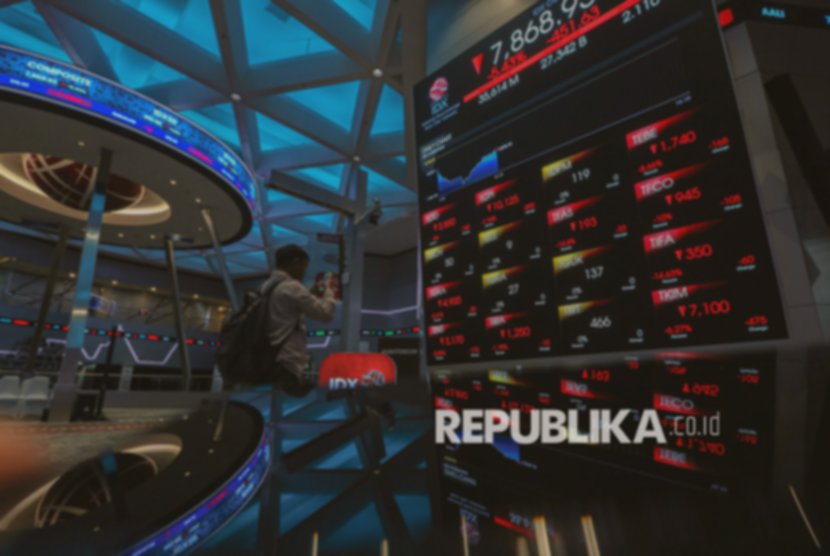
The Jakarta Composite Index (IHSG) is expected to trade sideways with a slight upward bias next week, according to capital market observer Reydi Octa. This forecast comes as the market has yet to fully emerge from a consolidation phase, influenced by recent global and domestic sentiments, prompting investors to eagerly await new catalysts for clearer direction.
“The IHSG is projected to move sideways with a tendency for slight strengthening, exhibiting a technical rebound pattern after several weeks of pressure,” Reydi stated when contacted by Antara in Jakarta on Sunday, April 12, 2026. He further elaborated that this cautious movement is because the market has not entirely exited its consolidation period, implying that the range of motion will likely remain limited while participants search for fresh impetus.
Looking ahead to the upcoming week, Reydi anticipates that international sentiment will continue to be shaped by several critical factors. These include the future direction of interest rates set by the U.S. central bank, The Fed, alongside movements in U.S. Treasury yields. Furthermore, ongoing geopolitical dynamics and fluctuations in global commodity prices are expected to play a significant role in influencing market sentiment.
Positive catalysts that could bolster the market, as noted by Reydi, might stem from a strengthening of global stock exchanges and a potential easing of geopolitical tensions worldwide. Such developments would provide a much-needed boost, potentially shifting the market out of its current cautious stance.
Domestically, market participants are expected to closely monitor foreign investors’ ongoing responses to MSCI issues and gauge the overall confidence in the local stock market. These factors are crucial indicators of the Indonesian market’s attractiveness to international capital and will heavily influence local trading activity.
Additionally, the direction of Bank Indonesia (BI) interest rates, any updates to ratings from global index providers, forthcoming inflation data, and the stability of the rupiah exchange rate will collectively dictate foreign capital flows into the domestic market. These economic indicators are vital for assessing Indonesia’s macroeconomic health and its appeal to global investors.
“The combination of BI’s interest rate policy, developments in global index ratings, inflation data, and the rupiah’s exchange rate will determine whether capital inflows can regain stability or if investors will maintain a ‘wait and see’ approach,” Reydi emphasized. This highlights the delicate balance of factors influencing foreign investment decisions in Indonesia.
Regarding current investor behavior, Reydi noted a prevailing defensive and selective stance. Investors are primarily focusing on large-capitalization (big caps) and highly liquid stocks, seeking stability and resilience in an uncertain environment. This strategy reflects a cautious approach to mitigating risks.
“Investors are being more defensive and selective, prioritizing big caps and liquid stocks,” Reydi explained. He added that this environment has also led to a significant rotation into commodity and energy-based sectors, a direct consequence of global geopolitical pressures impacting supply chains and resource prices.
On Friday, April 10, 2026, closing data from the Indonesia Stock Exchange (IDX) revealed that the IHSG closed significantly higher, gaining 150.91 points, or 2.07 percent, to settle at 7,458.50. Similarly, the LQ45 index, which tracks 45 blue-chip stocks, also saw an increase of 12.57 points, or 1.71 percent, closing at 746.47.
The day’s trading activity was robust, with a recorded frequency of 2,287,124 transactions. A total of 42.94 billion shares were traded, amounting to a value of Rp 18.12 trillion. Market breadth was positive, as 485 stocks advanced, 181 declined, and 153 remained unchanged, reflecting a broadly optimistic end to the trading week.