
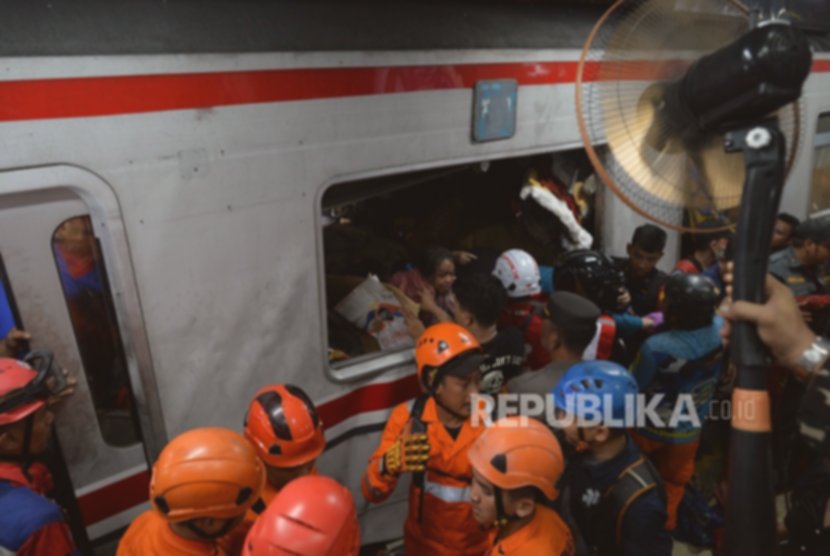

JAKARTA — The Indonesian National Police Traffic Corps (Korlantas Polri) has revealed the primary cause of the tragic train accident that occurred in Bekasi last night (July 24, 2026). Investigations indicate that the collision was triggered by an electrical short circuit in a Green SM Indonesia electric taxi that stalled on the railway tracks.
According to Commissioner Sandhi Wiedyanoe, Head of the Accident Data Analysis Section at Korlantas Polri, the incident occurred at the Ampera level crossing. “The accident was caused by an electrical failure in an electric-powered taxi. This malfunction took place precisely at the Ampera railway crossing,” Sandhi stated during a press briefing on Tuesday (April 28, 2026).
Sandhi further explained that the vehicle’s malfunction led to a catastrophic collision with an oncoming train. Beyond the vehicle failure, officials are investigating potential lapses in coordination among railway personnel. “There may have been a breakdown in communication or a failure to provide comprehensive and accurate information to the operator of the Argo Bromo Anggrek train,” he noted.
At the time of the crash, the Argo Bromo Anggrek train was traveling at 110 kilometers per hour, well above the 100 km/h threshold. This lack of critical coordination resulted in the collision near East Bekasi Station. To gain a clearer picture of the incident, police are utilizing Traffic Accident Analysis (TAA) technology. This method allows investigators to reconstruct the events before, during, and after the crash, which is essential for identifying potential criminal negligence in the traffic incident.
As the investigation deepens, the focus has also turned to the victims. Police have confirmed a total of 15 fatalities resulting from the accident. Currently, ten bodies are being held at the Kramat Jati Police Hospital in East Jakarta, while others have been transported to alternative medical facilities.
Kombes Budi Hermanto, Head of Public Relations for the Polda Metro Jaya, stated that identifying the victims remains the top priority. “We currently have 10 victims at the Kramat Jati Police Hospital, all of whom are still in the process of identification,” Hermanto confirmed. Authorities are actively working with families, as seven families have already submitted data to assist in the matching process.
Recounting the sequence of events, Hermanto explained that the disaster unfolded when the taxi attempted to cross the tracks near East Bekasi Station just as the train approached. Given the train’s speed, the operator was unable to avoid the impact. Emergency response teams were immediately dispatched to the scene to conduct initial rescue operations. As the identification process continues, authorities acknowledge that the final death toll could potentially rise as more information becomes available.
Summary
The Indonesian National Police have identified an electrical short circuit in an electric taxi that stalled on the railway tracks as the primary cause of the fatal train accident in Bekasi. The situation was exacerbated by the Argo Bromo Anggrek train traveling at a speed of 110 kilometers per hour, which exceeded the designated safety limit. Investigators are now utilizing Traffic Accident Analysis (TAA) technology to examine potential communication failures among railway personnel and determine if criminal negligence contributed to the collision.
Tragically, the accident resulted in at least 15 fatalities, with authorities currently working to identify the victims at the Kramat Jati Police Hospital. Seven families have already provided data to assist in the identification process, and officials note that the final death toll may increase as the investigation continues. Emergency response teams remain focused on the site, while police prioritize supporting the affected families during this recovery period.