
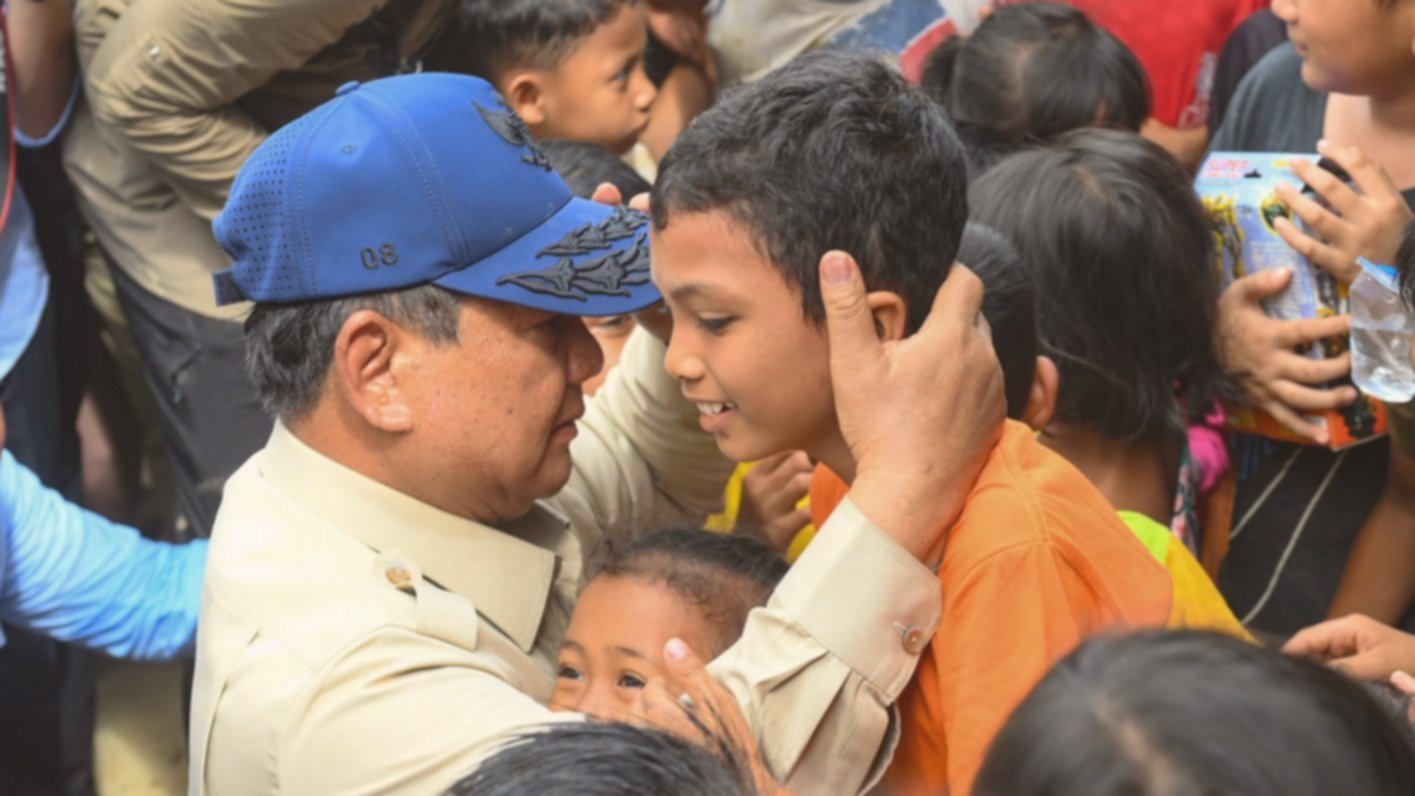
President Prabowo Subianto recently cited a survey proclaiming Indonesia as the world’s happiest nation. However, sociologists contend that this widespread happiness is primarily fueled by a powerful culture of “citizen helping citizen,” rather than directly stemming from government policies or performance. This perspective offers a nuanced view, contrasting sharply with international reports like the UN-backed World Happiness Report (WHR), which positions Indonesia in the middle ranks due to persistent issues such as inequality, uncertain health and life expectancy, threatened freedom of choice, and high corruption. The disparity raises crucial questions about the true validity of President Prabowo’s claim regarding Indonesian happiness.
During the National Christmas Celebration 2025 at Senayan Indoor Tennis Court, Jakarta, on Monday, January 5, President Prabowo expressed gratitude, asserting that amidst global uncertainty, turmoil, and wars, Indonesia “remains peaceful to this day.” While acknowledging internal disagreements, conflicts, and rivalries among groups, Prabowo emphasized, “Generally, other nations are beginning to see Indonesia. That a nation this large can live in harmony, with mutual respect and mutual love.” He then bolstered his hypothesis by referencing a “Harvard and Gallup” survey on happiness.
“Out of nearly 200 countries, the nation whose people, when asked, responded that they were experiencing happiness… The country whose people now say they are the happiest, number one in the world, is Indonesia,” Prabowo declared. He expressed deep emotion over these findings, acknowledging that “the majority of our people, in fact, still experience very, very simple lives, in conditions which, we must admit, are not truly prosperous.” Prabowo stated that other nations were baffled by this phenomenon, finding it “confusing for other nations, and also, moving for me,” before adding that he and his ministers in the Red and White Cabinet were “working very hard.” He concluded, “We received this task from the Indonesian nation. I am assisted by my aides, people whom I recognize as the nation’s best sons and daughters,” which was met with applause.
Upon closer examination, the survey Prabowo likely referenced as “Harvard and Gallup” is the Global Flourishing Study (GFS). This research extends beyond mere happiness, focusing on the broader concept of “flourishing”—defined as “the relative achievement of a state in which all aspects of a person’s life are good, including the context in which that person lives [resides].” The study emphasizes that a good life encompasses more than just health or happiness, involving a rich interplay of various life dimensions. Essentially, the GFS assesses whether one’s life is progressing well, holds meaning, and contributes to personal growth over the long term.
The GFS measures six core dimensions: happiness and life satisfaction, mental and physical health, meaning and purpose in life, character and virtue, close social relationships, and financial and material stability. The latest GFS report, released in April 2025, involved 207,920 respondents aged 18 and above, across 22 countries and one territory (Hong Kong)—significantly different from the “nearly 200 countries” mentioned by Prabowo. Despite the narrower scope, the study claims to represent 64% of the global population by including highly populous nations like China, India, and Indonesia. Utilizing a longitudinal research method, which repeatedly observes the same subjects over an extended period through face-to-face, phone, and web interviews, the survey was conducted between March 21, 2022, and April 12, 2024, with a 95% confidence level. The GFS is a collaborative effort between researchers at Harvard’s Human Flourishing Program, Baylor University’s Institute for Studies of Religion, and partners Gallup and the Center for Open Science.
According to the latest GFS results, Indonesia indeed received the highest score among the 23 surveyed countries and territories, with 8.47 points, followed by Mexico (8.19) and the Philippines (8.11). The lowest scores were found in Japan (5.93), Turkey (6.59), and the UK (6.88). This high ranking for Indonesia, however, applies to five of the core dimensions: happiness and life satisfaction, mental and physical health, meaning and purpose in life, character and virtue, and close social relationships. Intriguingly, when it comes to the dimension of financial and material stability, Indonesia ranked second-to-last, categorized as “unsecure” with a score of merely 0.7.
Rakhmat Hidayat, a sociologist from the State University of Jakarta (UNJ), posits that Indonesia’s high GFS score, particularly in flourishing and meaning, is profoundly influenced by its intrinsic “solidarity and social values.” He highlights that the manifestation of these values through “gotong royong” (mutual cooperation) imbues Indonesians with a deeper sense of meaning, a quality recognized internationally compared to other nations. “It is produced by society, and simultaneously reproduced, continuously maintained, cared for, preserved, and taught by elders, by family ancestors to their younger generations, to their children to help each other, to be harmonious, to be empathetic,” Rakhmat explains. He emphasizes that President Prabowo’s citation of this survey does not directly link public policies to the high flourishing scores. “He cannot justify [through the survey] that our society is doing fine, and then use that to justify or legitimize his other policies, implying that society is fine,” he says, adding that such an interpretation “simplifies the problem.”
Regardless of who holds the presidential and vice-presidential offices, Rakhmat argues, these “solidarity values remain deeply ingrained.” Nevertheless, the government plays a strategic role in strengthening these values through specific policies. “Because it is culturally instilled in our society, by villages, by inter-generations, by traditional leaders, by community figures, that is stronger compared to political interests,” Rakhmat asserts. He cites the “Jogo Tonggo” (Neighbor Watch) movement during the Covid-19 pandemic in Central Java as an example—a community-led initiative for mutual support, which received local government backing. Another instance is the “citizen helping citizen” solidarity that emerged during flash floods and landslides in parts of Sumatra, where volunteers played a crucial role alongside government resources, despite instances of official blunders and alleged terror against critics.
Whinda Yustisia, Executive Director of the Indonesian Social Survey (ISS), finds the GFS results unsurprising. She notes that the GFS primarily emphasizes social relationships, togetherness, and inherited spirituality. “Without the government doing anything, our score remains high. Our ancestral heritage is indeed strong; that is our strength,” she affirms. This sentiment resonates with ordinary citizens interviewed by BBC News Indonesia regarding flourishing and meaning in Indonesia, all identifying as “urban middle-class.” Ayu, for instance, feels “lucky” to be Indonesian due to the “strong positive collective culture” among her peers. She observes that despite economic, security, and political challenges, Indonesians can still “laugh,” describing them as “very comic, always finding a way to laugh even in the tightest situations.” However, she also notes that it’s becoming “harder to laugh” these days. Laila expresses contentment with her life, having “achieved the balance I need today,” and values her living environment for its “deep emotional and social connection. There is a sense of attachment that is born and grows long before the mind can judge.” Meanwhile, Wahyuni finds meaning in the hope that “Indonesia can become a developed country, because its resources are good, abundant, plentiful. And it can be capital.” Yet, she adds, “But I don’t know when it will progress. I want to see Indonesia advance, not stay like this.”
It’s important to recognize that the GFS is not the sole arbiter of global well-being and happiness. The World Happiness Report (WHR), a collaborative effort by the Oxford Wellbeing Research Centre, Gallup, and the UN Sustainable Development Solutions Network, offers a different perspective. Unlike the GFS, the WHR incorporates variables such as income, inequality, healthy life expectancy, freedom to make life choices, generosity, and perceptions of corruption. In its 2024 report, the WHR placed Indonesia at 83rd out of 147 surveyed countries. Within Southeast Asia, Indonesia’s position trails Singapore, Vietnam, Thailand, the Philippines, and Malaysia, though it ranks higher than Laos, Cambodia, and Myanmar, providing a more comprehensive, albeit lower, global standing.
Whinda Yustisia also analyzes the WHR figures, highlighting that generosity is a strong contributing factor to Indonesian happiness, ranking “number one” globally in kindness. However, she notes that Indonesia’s position in the WHR also reveals a quality of life that is not yet fully optimal, a sentiment echoed by an associate professor at the Faculty of Psychology, University of Indonesia. This is evident in the fact that indicators for inequality, income, healthy life expectancy, freedom of choice, and perception of corruption in Indonesia remain below average. “Those are quality of life indicators, still below,” Whinda states, reinforcing the idea that overall well-being is multifaceted.
Whinda further substantiates the theory of a disconnect between happiness and other dimensions of quality of life through the latest Indonesian Social Survey (ISS). This national poll, involving 2,200 respondents, predominantly from lower-middle-class economic groups, was titled “80 Years of Independent Indonesia: How is the Quality of Life of Indonesian Society?” Released in August 2025, the ISS survey indicated that psychological well-being—which includes happiness—among Indonesians is “quite good,” scoring 67.3 on a scale of 0-100. However, economic well-being indicators, such as debt habits and difficulty finding employment, were significantly lower, scoring only 42.6. “This means people can be happy even if their economic conditions are poor. This implies that psychological well-being is not solely shaped by government performance or good government policies in the economic sector,” Whinda explains. She adds that being “happy even when the economy is tough” serves as a mechanism for society to “rationalize difficult conditions.”
Yet, this delicate balance can shift dramatically if society is continuously exposed to injustice without any discernible change. “This can turn [into] dissatisfaction or poor economic conditions leading to mass anger. So, the root economic problems must still be addressed,” she warns. Consequently, the ISS study also measured the level of respondent trust in state institutions. The President emerged as the most trusted institution (90.9%), followed by the Vice President, ministers, and the TNI (military). The ISS report concludes, “Politically, strong trust in four state institutions signifies a large legitimate capital for President Prabowo. This is valuable social capital, but also fragile if not immediately translated into measurable improvements in two main weaknesses: household economy and environment.”
Summary
President Prabowo Subianto recently cited a survey, identified as the Global Flourishing Study (GFS), claiming Indonesia is the world’s happiest nation. Sociologists, however, attribute this high flourishing score to Indonesia’s profound cultural values like “gotong royong” and strong citizen solidarity, rather than direct government policies. While Indonesia ranked highest overall among 23 surveyed entities in the GFS, it notably scored second-to-last in financial and material stability.
This contrasts with the UN-backed World Happiness Report (WHR), which places Indonesia 83rd globally due to persistent issues like inequality and lower life expectancy. The Indonesian Social Survey (ISS) also indicates high psychological well-being despite low economic indicators, suggesting a societal mechanism to cope with difficult conditions. Experts warn that this resilience is fragile and requires governmental action to address economic problems and perceived injustice, despite high public trust in institutions.