
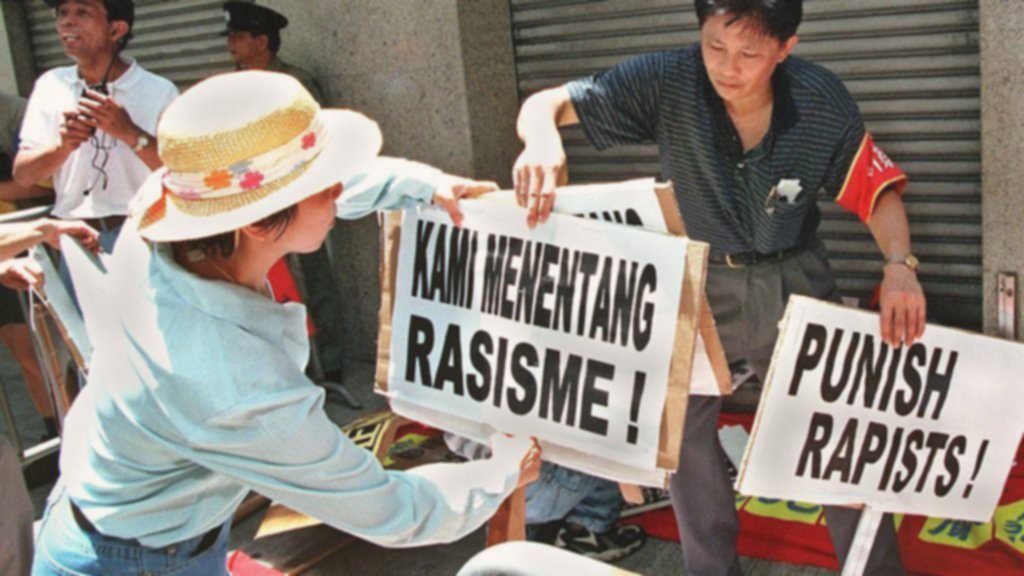

The events of May 1998 continue to cast a long shadow over the lives of Chinese-Indonesians, leaving indelible marks even today. Yet, amidst the lingering trauma, various strategies for survival and rebuilding hope have emerged across generations.
Through a deeply personal lens, photographer Juliana Tan endeavors to reconstruct fragmented childhood memories and, in doing so, find a path to reconcile with the past. Her journey culminates in a poignant photo book titled “A Kind of Magic.”
“Even though my childhood will not return, I can create a kind of portal through photography to bring back memories. This gives me hope to move forward by learning from the past,” Juliana reflected when asked about her photo story book.
Now residing in Singapore, the photographer meticulously pieced together shards of her childhood memories from Bandung, a city she was compelled to leave in May 1998.
Meanwhile, younger generations, like Charlenne, who were born after the Reformasi era, reveal how the trauma of 1998 continues to be inherited, shaping their cautious approach to behavior and social interactions.
On the other hand, other survivors, such as Henita from Tebing Tinggi, North Sumatra, carry deep wounds and unanswered questions about justice and their sense of belonging as citizens.
However, amidst the specter of old sentiments, nascent signs of solidarity across generations and ethnicities are also emerging, offering a glimmer of new hope.
‘What truly made me leave my home?’
Juliana Tan was only nine years old in 1998.
She recalls her mother coming to her school, meeting her teacher to sign something. Upon returning home, she was told to take a packed bag.
She was informed they would be leaving for Singapore that very day.
“I was so surprised. I even wondered if I was being punished after seeing my mother at school earlier. But then we were going to Singapore. I didn’t know if it was a holiday or what. We didn’t even have tickets,” Juliana recounted.
Eventually, her father managed to secure three tickets to Singapore. Juliana departed with her mother and younger sister. Once there, Juliana was enrolled in English and Mandarin classes.
After a considerable period living in Singapore, she realized that this departure was not merely a vacation, but a way to continue their lives.
Initially, Juliana’s book, a decade in the making, was intended as a memoir she hoped would reconnect her to her “roots.” The project concluded with her father’s passing in 2022.
She felt she no longer had a reason to return to Bandung or to stay connected with the city.
“I often think, what did those nine years mean to me? What truly made me leave my home, my community, and my country?” she pondered.
“My relationship with my father also felt distant because we had to live in different countries, even though before that, I was very close to him.”
Later, the book’s content expanded beyond just photographs. It also wove in essays by three other Chinese-Indonesian women.
Unexpected reactions followed its 2025 publication, particularly during its launch event in Glodok, Jakarta. She was astonished to see people attend and share their own poignant stories regarding May 1998.
Some spoke of living in Jakarta but being sent to Bogor to temporarily stay with Muslim relatives. A senior journalist also shared his experiences covering the 1998 riots.
Remarkably, her book resonated even with Generation Z, who, despite not experiencing the 1998 events directly, expressed keen interest in delving deeper into the occurrences and understanding the experiences of the Chinese-Indonesian community.
On that day, Glodok, a district once targeted by mob violence in 1998, with its corners still harboring collective trauma, momentarily transformed into a safe and warm space for survivors and all concerned individuals—regardless of ethnicity.
Trauma is real
When discussing May 1998, the narratives that invariably surface are often steeped in the bitterness endured by Chinese-Indonesians. However, sometimes the way to resist forgetting and to overcome trauma doesn’t necessarily involve confronting the wound directly.
Juliana adopted a highly subtle approach, conveying a warm message from her younger self, rather than a narrative of bitterness that could potentially trigger recurring trauma.
“I prefer a softer way of discussing this topic. There’s no need to show all the facts; I just want people to walk with me in my imaginary city through photographs that capture very precious memories,” she explained.
“The fact that photography allowed me to start all of this, even though something bad might have happened, this time it feels magical to me.”
Nevertheless, this subtle approach does not mean that the dark chapter of history should remain unaddressed. History, in fact, is key to preserving memory. However, merely exploring wounds for dramatic effect is a different story altogether.
For this reason, the path to recovery can also involve fostering hope, resilience, and a sense of security. This is especially crucial given the persistent absence of legal resolution and state recognition for Chinese-Indonesians, who are often scapegoated during times of crisis.
The role of fellow citizens is considered vital in dispelling fear and building trust.
Charlenne Kayla Roeslie understands that this path is neither easy nor straightforward. Seeds of segregation, present since the colonial era and diligently cultivated by the New Order regime, have deeply permeated society. Consequently, Chinese-Indonesians are constantly cautious in their actions and expressions.
“For instance, whenever I’m with Chinese friends, especially across different generations, the message always comes up: ‘as Chinese, it’s best to stay low or not cause trouble’,” Charlenne shared.
Charlenne further noted a tendency to send children to predominantly Chinese schools, limit social circles to the community, and even design homes and buildings with high walls or fences and grilles for security reasons.
She believes this phenomenon is intrinsically linked to trauma response, where the community seeks what it perceives as ideal security measures.
“It’s a kind of safety measure. But it can’t be blamed either, as it relates to trauma, and the scale of trauma varies from person to person. It’s not that easy to overcome community trauma,” Charlenne stated.
The writer admits she did not directly experience May 1998, as she was born afterward. However, its lingering effects are palpable, both at home and in her surrounding environment.
Her parents, for example, initially forbade her from taking public transportation. She also cited other situations, such as when a bomb exploded in Sarinah in 2016, causing her school to dismiss students early.
Some parents even called the school to check on their children’s safety.
Similarly, when accusations of blasphemy against Basuki Tjahaja Purnama (Ahok) reverberated in 2017, and news of large-scale protests emerged, the atmosphere grew tense, and her school prepared to dismiss students early.
Separately, Juliana also expressed feeling the impact. “When I was making this book, my mother told me, ‘why are you digging up that problem again?'” she recounted.
However, she felt her endeavor was necessary. She explained that she didn’t recall many childhood moments beyond her relationship with her father, the cool Bandung weather, family vacations to Puncak, and watching Si Komo on Sunday mornings.
Therefore, the process of creating the photo book helped her reconnect with her childhood and solidify her identity and origins, which had been uprooted by the 1998 events.
“This is my way of coping with everything by preserving all that I can, both for myself and for the people I love,” she affirmed.
‘We are already Indonesian citizens, aren’t we?’
Unlike Juliana and Charlenne, Henita was a university student at the Faculty of Economics, University of North Sumatra, in May 1998. This woman from Tebing Tinggi, North Sumatra, even joined her peers in street protests to demand Soeharto’s resignation.
However, as the riots spread, fear compelled her to stay indoors. At the time, she was living at her relative’s house near Kampung Keling, now known as Kampung Madras.
This area was a commercial district largely inhabited by Chinese-Indonesians. This demographic caused local residents to fear attacks from rioters, especially given the terrifyingly empty streets of Medan.
Henita and her neighbors were forced to stand guard inside their homes, arming themselves with wooden planks and even baseball bats.
“Not hiding. More accurately, we didn’t go out. Because all the streets were empty. No one was out. Mostly just within Kampung Keling. We didn’t dare to take vehicles anywhere. We were afraid a riot might suddenly break out,” she described.
She confessed that she still feels a profound sadness when recalling the 1998 events, even after two decades. Adding to her pain, her family’s clothing store in Tebing Tinggi was completely looted.
While she doesn’t wish to dwell on the past, many questions still linger in Henita’s mind.
“The fear is gone. It’s just sadness. Because the government itself, why like that? It feels unfair. We are also Indonesian citizens. The only difference is our narrow eyes. That’s it. As for citizenship, we are already Indonesian citizens,” she asserted.
Despite many changes post-Reformasi, Henita believes that racial issues continue to haunt ethnic Chinese descendants.
“There are differences, yes. But still, when there’s a riot, the first victims are always the Chinese. I don’t know why that is. Perhaps it’s social jealousy,” she mused.
In her experience, Charlenne also observes a shift in generational perspectives among the Chinese-Indonesian community. As a Gen Z individual, she feels a lighter step when engaging with society, a sentiment echoed by her peers.
“That we don’t carry the burden of ’98, we don’t have that past trauma. Directly, it makes my steps and perhaps those of some other friends lighter, in a way,” Charlenne stated.
She even acknowledges a newfound freedom of choice, allowing her to venture beyond her “bubble.” For her university studies, she enrolled in an institution with a diverse student demographic and pursued a journalism major.
This contrasts with the New Order’s legacy, which had narrowed choices for Chinese-Indonesians.
“The New Order’s policies left us with no political power. We had no social power. We were pigeonholed as ‘homo economicus,’ only permitted to trade. Only capable of business.”
Still, she acknowledges that the path she has chosen may not be applicable to all Chinese-Indonesians.
“Indeed, one cannot generalize the Chinese as a homogenous community. Because if you look at ‘Chineseness,’ it is very region-based. Although historically similar, daily experiences in each area can differ,” Charlenne explained.
Ignatius Wibowo, in his writing titled “When Will ‘Chineseness’ Cease?”, posits that the 1998 events marked the pinnacle of the internal struggle for Chinese-Indonesians. Before the tragedy erupted, they were burdened by the New Order’s assimilation policies.
They were compelled to change their Chinese names to local names, ostensibly to integrate. They were forbidden from celebrating their religious observances and cultural traditions.
One such tradition, Chinese New Year (Imlek), was prohibited at the time. Chinese-Indonesians often secretly celebrated Imlek in quiet, only with their immediate families.
They also struggled to pass on their language to the next generation due to government prohibitions.
Sylvie Tanaga, in her essay “Chinese-Indonesians Under the Shadow of Knowledge Genocide,” published in Project Multatuli, refers to this as the systematic destruction of Chinese historical traces and a form of knowledge genocide.
As a result, many young Chinese-Indonesians grew up knowing little about their ancestors, who had played significant roles in politics, society, media, arts, and culture.
This heavy price, it seems, came bundled with enduring discrimination. When 1998 shattered their dignity and sense of security, Chinese-Indonesians realized they would perpetually be scapegoated and targeted by mob anger during crises.
‘Everyone is angry and shares the same anxieties’
This deep-seated apprehension is inextricably linked to the long history surrounding the ethnic Chinese community. Since the VOC era, they were exploited for economic gain. However, when crises struck, they faced discrimination and economic pressure through taxes and levies.
In 1740, the VOC, facing a cash deficit, raided Chinese-Indonesians. The pretext was public security, citing rising criminality. At that time, Chinese-Indonesians were accused as perpetrators. This led to the Geger Pecinan (Chinatown Riot) near Kali Angke.
Mely G. Tan, in her writing “Ethnic Chinese in Indonesia,” states that over 10,000 Chinese-Indonesians were killed. This event constituted the worst anti-Chinese incident ever recorded.
A year after independence, a massacre of Chinese-Indonesians occurred in Tangerang. As many as 653 Chinese were killed, and 1,000 Chinese-owned homes were damaged. This took place during the period of physical revolution.
Between the 1940s and 1960s, various incidents of violent repression against Chinese-Indonesians occurred in several regions. At the local level, this racial sentiment appeared to be deliberately nurtured.
In 1965, Chinese-Indonesians were again targeted. They were accused of affiliating with the Indonesian Communist Party (PKI), whether through joining the Indonesian Citizenship Consultative Body (Baperki) or merely participating in events it organized.
The next major incident was in 1998, which also originated from a global economic crisis that subsequently pressured the rupiah. Racial sentiment was once again exploited.
This time, the segregation between pribumi (indigenous) and non-pribumi, fueled by economic inequality, was weaponized by the intellectual orchestrators of the May 1998 riots.

Charlotte Setijadi, Head of the Asia Program at the University of Melbourne, in her book “Memories of Unbelonging: Ethnic Chinese Identity Politics in Post-Suharto Indonesia,” notes that the 1998 tragedy led Chinese-Indonesians to initially choose not to react to avoid being targeted again.
However, after Soeharto’s resignation and the strengthening wave of reform, there was an increase in political participation among young Chinese-Indonesians.
“One of the primary motivations for their political participation was the desire to ensure the safety of Chinese-Indonesians and to represent their interests in government policy-making processes,” Charlotte wrote.
Active political participation can be seen as one strategy employed by Chinese-Indonesians to protect their social, economic, political, and cultural capital. Furthermore, Charlotte also found that this political participation aimed to demonstrate that Chinese-Indonesians can be nationalist citizens.
“This reflects a continuation of long-held beliefs about how ethnic Chinese need to constantly prove their worth and belonging in Indonesia,” she added.

Nevertheless, a closer examination reveals Chinese-Indonesian involvement in politics predates independence, with contributions to BPUPKI (Investigating Committee for Preparatory Work for Independence) and PPKI (Preparatory Committee for Indonesian Independence). This continued with the establishment of political parties, which were unfortunately later suppressed, accused of ties to the PKI.
In the contemporary context, political participation can also be measured by youth activism. Charlenne is one such individual actively involved in street protests and advocacy. Many also contribute to Legal Aid Institutions (LBH) and Non-Governmental Organizations (LSM) fighting for the rights of marginalized communities.
“Some also join Aksi Kamisan [Silent Protests on Thursdays]. Or in August 2025, she rallied donations. It’s quite heartwarming to see friends who care about these issues and try to do something without involving race or ethnicity,” Charlenne remarked.
This political strategy can complement the cultural approaches that have long been in place.
On the other hand, this activism also spawned movements like #WargaJagaWarga (Citizens Protecting Citizens) during the massive demonstrations in August-September 2025. Charlenne noted that Chinese-Indonesians, especially the elderly, felt relieved upon seeing such a movement.
“At that time, I was still working in Glodok. The residents there looked out for each other and exchanged emergency numbers, reliable institutions, or communities in case things went chaotic,” Charlenne recalled.
Furthermore, these young people reassure older generations that the situation will be different now.
“Because now people have awareness. Besides, during August-September 2025, people across all ethnicities were angry. My dad even said, ‘if you want to protest, just protest,’ because for him, everything had gone wrong. He was also more sympathetic to the protest,” Charlenne explained.
According to her, the main key now is to build hope and foster compassion, both from Chinese-Indonesians and non-Chinese alike.
“Indeed, effort is needed from within the intra-group itself to slowly find a way out of that bubble. From non-Chinese friends, they can reach out and show compassion to preserve social capital.”

In fact, this mutual protection also occurred in 1998. Henita remembers that the rioters were not from her neighborhood. In that area, cross-ethnic security assistance actually took place.
According to various reports from 1998, in several residential areas, prayer mats were hung on the fences of residents’ homes, including those of Chinese-Indonesians. Or “pribumi” (indigenous) was written on front fences.
Meanwhile, men guarded the entrances. Some housing complexes even took the initiative to set up emergency gates, taking turns on watch. They did not allow strangers who were not residents of the complex to enter.
In the case of the 1998 mass rapes, women’s activist Ita Fatia Nadia was also assisted by local residents in helping and evacuating Chinese-Indonesian women to hospitals.
Virdinda Achmad from Duta Aksi Nusantara believes that this racial sentiment can be collectively countered. Especially now that awareness exists.
“What needs to be built in a collective movement is the realization that we all share the same fate and anxieties. We are all ultimately groups of people affected by every political decision,” Virdinda asserted.
“The propaganda carried out will ultimately come back to us. It doesn’t matter what tribe, what ethnicity. Essentially, as long as we are not rulers with positions, seats, money, and weapons, then we will all share the same anxieties and fate,” she concluded.
From Singapore, Juliana also believes there is great hope after witnessing how people across different races tried to protect each other during the August-September 2025 riots, and recalling who and what should truly be resisted.
“As happened in 1998, there was manipulation that caused people to quarrel and attack each other. They wanted us to be enemies. When in reality, the problem was not with us,” she stated.
Journalist Nanda Fahriza Batubara in Medan, North Sumatra, contributed to the reporting and writing of this article.
- Investigating the May 1998 Mass Rape Reports – ‘Is a grenade still not enough?’
- Trauma of the 1998 Riots After a Series of Looting Incidents – ‘If homes guarded by the TNI can be looted, what about ordinary people’s homes?’
- Taking to the Streets and Getting Trapped in Riots: What Happened in Your City in May 1998?
- May 1998 Riots: ’26 years of denial regarding sexual violence against Indonesian women’
- May 1998 Tragedy: Memories of two mothers who lost their children
- The Days Leading Up to the 1998 Reformasi in Pictures and Notes
- May 1998 Riots: “What was our sin to be (threatened) with burning and killing?”
- Looting of Official Residences and Deaths Emerging – Will it end like the 1998 crisis?
- Stories of Chinese-Indonesians who settled abroad after the May 1998 riots and those who decided to return to Indonesia – ‘Hopefully the government does not erase history’
- Victims of the May 1998 riots, what is their condition now?
- 20 Years of Reformasi and Several Steps Backward for Indonesian Democracy
Summary
The 1998 riots in Indonesia left a deep, intergenerational impact on the Chinese-Indonesian community, manifesting in lasting trauma, feelings of insecurity, and a tendency to prioritize caution in social interactions. For many, the tragedy represented a culmination of long-standing systemic discrimination and state-sponsored marginalization, leading to displacement and the erasure of cultural identity. Through personal storytelling and creative projects like Juliana Tan’s photo book, survivors and their descendants are working to reconcile with this past, document their memories, and assert their identity as fellow Indonesian citizens.
Despite the lingering effects of the riots, there is a growing movement toward cross-generational and cross-ethnic solidarity. Younger generations, such as those active in current social and political advocacy, are breaking away from previous patterns of isolation by engaging in diverse social spheres and promoting collective action. By shifting the focus toward shared human experiences and mutual protection, these individuals are fostering new hope and resilience, aiming to ensure that the divisive sentiments of the past no longer dictate the future of the nation.