
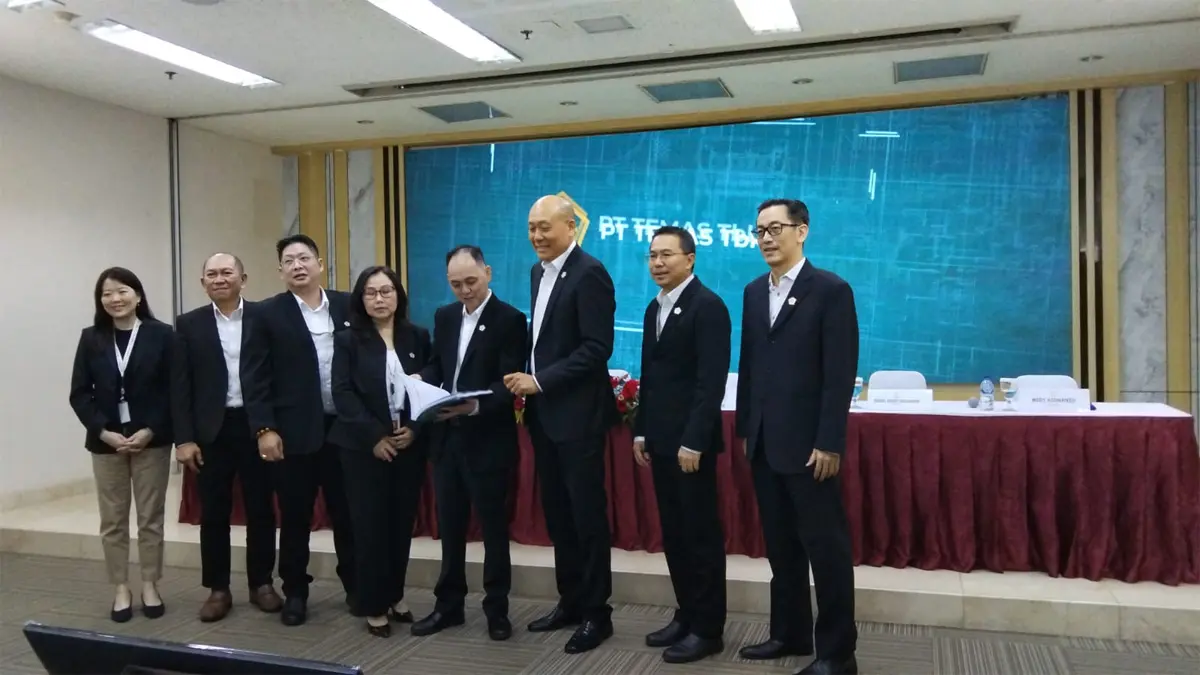

PT TEMAS Tbk (TMAS), a leading maritime transportation services company, has officially announced a dividend payout of Rp 228 billion for the 2025 fiscal year. This distribution represents approximately 40% of the company’s 2025 net profit, equating to Rp 4 per share.
Ricky Effendi, President Director of PT TEMAS Tbk, confirmed that the dividend payout aligns with the company’s established policy to provide cash dividends to shareholders at least once annually. Under this policy, the company commits to a dividend payout ratio of 30% of its current year’s net profit, provided that the net profit exceeds Rp 30 billion. “For the 2025 financial year, the dividend amount has received formal approval during the Annual General Meeting of Shareholders (RUPST),” Ricky stated during a public expose held in Jakarta on Tuesday, June 2, 2026.
Looking ahead to 2026, the company remains optimistic about its strategic trajectory. Key initiatives, including the acquisition of new vessels and the modernization of its fleet with eco-friendly ships, remain at the forefront of the company’s growth plan. In 2025 alone, the company successfully added seven new vessels to its fleet, resulting in a 17% increase in total transport capacity. Currently, the company operates 57 vessels with a total capacity of 28,542 TEUs and a deadweight tonnage of 464,701 DWT. Notably, the company has successfully improved the average age of its fleet from 15 years in 2023 to 13 years by the end of 2025.
To support its continued operational expansion, TMAS has earmarked a capital expenditure (capex) budget of Rp 2.5 trillion for 2026. Ganny Zheng, Director of Business Development at PT TEMAS Tbk, emphasized the company’s commitment to capitalizing on the growth of the national container shipping industry. The allocated capex will primarily fund the purchase of new vessels, fleet maintenance, port support equipment, and infrastructure development.
“We are also preparing for the launch of our LNG plant, which is targeted to begin operations in the second semester of 2026. Furthermore, we are expanding our integrated logistics services and continuing our Build-Operate-Transfer (BOT) collaboration with PT Pelindo Terminal Petikemas. This includes the expansion of the Tanjung Priok pier from 340 meters to 485 meters to establish a foundation for long-term capacity,” Ganny explained.
TMAS has set an ambitious revenue target of Rp 5.53 trillion for 2026, representing a growth of more than 27% compared to the Rp 4.34 trillion achieved in 2025. To reach this goal, the company plans to optimize its expanded capacity by opening new routes and increasing the load factor for every vessel. “Quality of service and fleet safety remain our top priorities, adhering to both national and international maritime industry standards,” added Ricky.
Regarding the global geopolitical landscape, the company remains vigilant, particularly concerning tensions in the Middle East. While these international developments do not have an immediate direct impact on TMAS’s operations, the company continues to monitor them closely as they remain significant factors influencing fuel price volatility and global supply chain dynamics.
Summary
PT TEMAS Tbk (TMAS) has announced a dividend payout of IDR 228 billion for the 2025 fiscal year, equivalent to IDR 4 per share and representing 40% of its net profit. This distribution adheres to the company’s dividend policy, which guarantees a payout of at least 30% of annual net profit. The decision was formally approved during the company’s Annual General Meeting of Shareholders.
For 2026, the company has allocated a capital expenditure budget of IDR 2.5 trillion to fund fleet modernization, infrastructure development, and the launch of a new LNG plant. With a revenue target of IDR 5.53 trillion, TMAS aims to expand its operational capacity through new shipping routes and integrated logistics services. Despite global geopolitical uncertainties, the company continues to focus on fleet efficiency and long-term strategic growth within the national container shipping industry.